
Louisiana GOP redraws map, cuts majority-Black district
 3 Min Read
Louisiana Republicans approved a new congressional map that dismantles one majority-Black district after a Supreme Court ruling, strengthening the GOP’s hold on the state delegation.
-
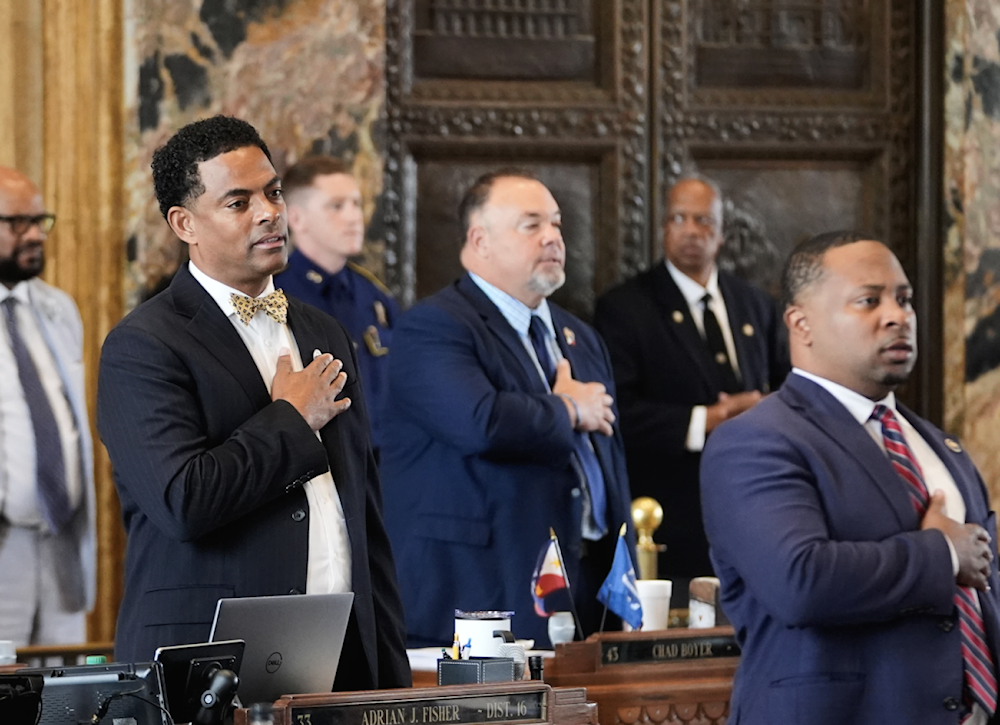
Louisiana Reps. Adrian Fisher, D-Dist 16, left, Chad Michael Boyer, R-Dist 46, and C. Travis Johnson, D-Dist 21, right, recite the pledge of allegiance prior to a house vote on a redistricting plan to eliminate a majority-Black congressional district in response to a U.S. Supreme Court ruling, in Baton Rouge, La., on May 21, 2026. (AP)
Louisiana Republicans approved a new congressional map on Friday that eliminates one of the state’s two majority-Black districts and is expected to strengthen the Republican Party’s control over the state’s congressional delegation ahead of the 2026 elections.
The revised map, passed by the Louisiana Senate after amendments in the state House earlier this week, is projected to give Republicans a 5-1 advantage in the state’s six-member US House delegation. Republicans currently hold a 4-2 edge.
The redraw follows the US Supreme Court’s ruling in Louisiana v. Callais, which found the state’s previous congressional map unconstitutional on the grounds that it constituted a racial gerrymander.
Republicans defend redraw as partisan, not racial
The newly approved map preserves one majority-Black district stretching from New Orleans to Baton Rouge, while dismantling the second district that previously gave Black voters broader representation in Congress.
Republican lawmakers argued throughout the debate that the map was designed according to partisan considerations rather than race.
“We focused on the Democrat numbers, not the racial numbers when drawing,” Republican state Representative Beau Beaullieu said during debate in the House.
State Senator Jay Morris, who authored the bill, defended the proposal by arguing that it complies with traditional redistricting standards and would withstand legal scrutiny.
Democrats warn of reduced Black representation
Democrats and voting rights advocates sharply criticized the map, arguing that it significantly reduces Black political representation in a state where roughly one-third of the population is Black.
“We are being asked to take one of two minority opportunity districts in this state… and reduce that minority opportunity representation to a single seat out of six,” Democratic Representative Kyle Green Jr. said during legislative debate.
“That’s not a map. That’s a math problem with the moral answer, and the answer is no,” he added.
Voting rights groups are expected to challenge the map in court, setting the stage for further legal battles over redistricting and minority representation.
Supreme Court ruling reshapes 2026 redistricting battle
Louisiana lawmakers delayed the state’s House primaries, originally scheduled for May 16, to redraw the congressional map following the Supreme Court ruling. The delay effectively discarded around 40,000 ballots that had already been cast.
The Louisiana redraw comes amid a wider national battle over congressional district maps after President Donald Trump encouraged Republican-led states to redraw districts in an effort to protect the GOP’s narrow House majority.
Democrats attempted similar efforts in several states, but recent court rulings, including the Callais decision and a Virginia Supreme Court ruling blocking a Democratic-backed map, have strengthened Republican redistricting efforts heading into the 2026 elections.


