
US Supreme Court strikes down Trump's sweeping global tariffs
 4 Min Read
The US Supreme Court rules that the International Emergency Economic Powers Act (IEEPA) does not authorize sweeping global trade duties.
-
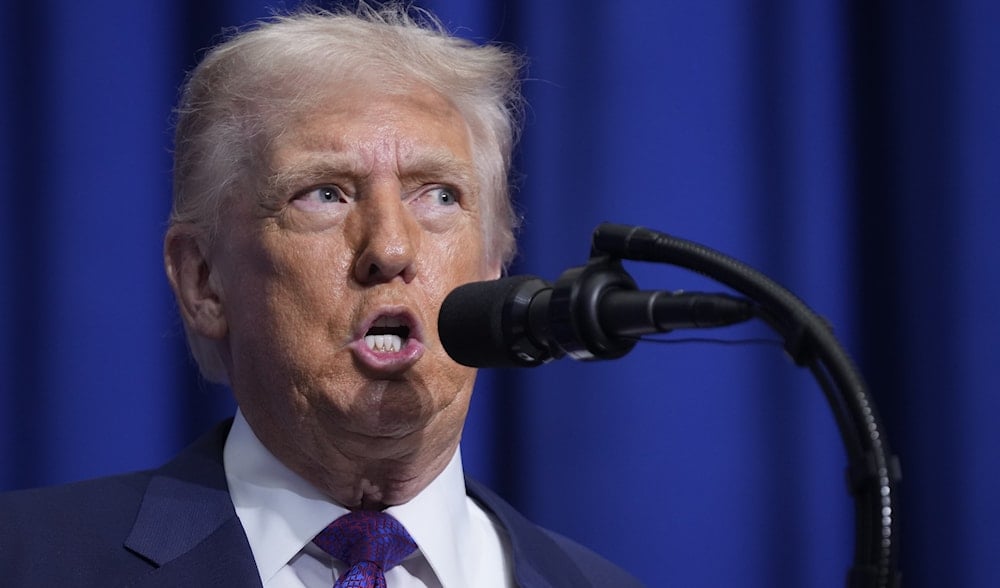
US President Donald Trump speaks during a "Board of Peace" meeting at the US Institute of Peace, Thursday, Feb. 19, 2026, in Washington (AP)
The US Supreme Court struck down President Donald Trump’s sweeping global tariffs, delivering a major blow to the signature policy of his economic agenda. The conservative-majority court ruled 6-3 that the International Emergency Economic Powers Act (IEEPA) “does not authorize the President to impose tariffs.”
The decision does not affect sector-specific tariffs previously imposed on imports such as steel, aluminum, and other goods, nor does it halt ongoing government investigations that could lead to additional targeted duties. However, it marks Trump’s most significant defeat at the Supreme Court since taking office.
In his opinion, Chief Justice John Roberts emphasized that “IEEPA contains no reference to tariffs or duties,” noting that Congress had not explicitly granted the authority to impose such sweeping trade measures. The ruling upheld lower court decisions declaring Trump’s IEEPA-based tariffs illegal.
Three conservative justices, Brett Kavanaugh, Clarence Thomas, and Samuel Alito, dissented, while the court’s three liberal justices joined three conservatives in the majority. Analysts say the ruling could reshape the administration’s trade strategy going forward.
US business groups welcome ruling
US business groups welcomed the Supreme Court’s decision, with the National Retail Federation describing it as providing “much-needed certainty” for American firms and manufacturers. The federation also called on lower courts to “ensure a seamless process to refund the tariffs to US importers,” though the justices did not address how refunds would be handled.
Justice Brett Kavanaugh, in dissent, cautioned that the refund process could become a “mess", echoing concerns raised during oral arguments, while economists also warned of significant financial implications.
Gregory Daco, chief economist at EY-Parthenon, told AFP that the loss of IEEPA-related tariff revenues for the US government could total around $140 billion.
He added that the ruling is likely to reduce the average US tariff rate from 16.8% to roughly 9.5%, although this decline may be temporary as the administration seeks alternative ways to reimpose some duties.
The Budget Lab at Yale University estimated that consumers would face an average effective tariff rate of 9.1 percent following Friday’s decision, down from 16.9 percent. Still, it noted that this rate “remains the highest since 1946,” excluding 2025.
EU, Canada, UK react
The European Union said it is carefully studying the Supreme Court ruling and will remain in close contact with the Trump administration to assess potential impacts.
"We take note of the ruling... and are analysing it carefully," EU trade spokesman Olof Gill said.
"We remain in close contact with the US administration as we seek clarity on the steps they intend to take in response to this ruling," he added.
"Businesses on both sides of the Atlantic depend on stability and predictability in the trading relationship."
Britain announced plans to work with the United States to understand how the decision could affect the bilateral trade deal, with a government spokesperson emphasizing that the UK expects its “privileged trading position with the US to continue.”
Canada welcomed the ruling, describing it as confirmation that Trump’s tariffs were “unjustified”, though officials noted that measures causing the greatest disruption to Canadian industries remain in force. Canada largely avoided IEEPA levies under exemptions in the North American Free Trade Agreement, but sector-specific tariffs on steel, aluminum, and autos remain active.
Canadian Minister for International Trade Dominic LeBlanc stressed that affected businesses still need “support” and pledged continued collaboration with the US to foster growth on both sides of the border.
The Canadian Chamber of Commerce warned against viewing the decision as a reset of US trade policy, urging caution as new, potentially more disruptive mechanisms could be used to reassert trade pressure. Similarly, Britain emphasized ongoing cooperation with the US to monitor tariff implications and protect trade relations.


