
Machado lauds US strikes on Venezuela, says no contact with Trump
 3 Min Read
Maria Corina Machado speaks out after US strikes in Venezuela and Maduro’s abduction, praising US action and confirming plans to return.
-
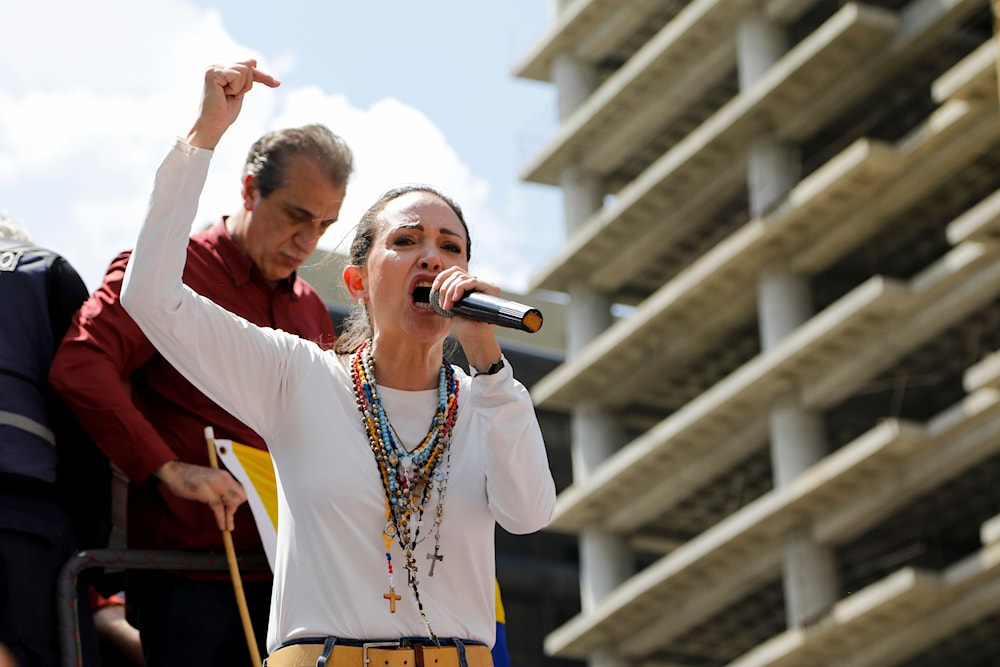
Opposition leader Maria Corina Machado speaks at a rally to protest official results that declared President Nicolas Maduro the winner of the July presidential election, in Caracas, Venezuela, Saturday, Aug. 17, 2024. (AP)
US-Backed Venezuelan opposition leader and Nobel Peace Prize laureate Maria Corina Machado said Monday that she has not spoken with US President Donald Trump since October 10, 2025, the day her award was announced.
Machado made the remarks during an interview on the Fox News Hannity program.
Machado left Venezuela last month to travel to Norway to receive the prize and has not returned, telling Fox News she plans to go back “as soon as possible.”
The interview marked Machado’s first public comments since US forces conducted strikes on Venezuela on Saturday and kidnapped President Maduro. She praised the US aggression, describing it as “a huge step for humanity, for freedom and human dignity.”
Trump, however, dismissed the notion of collaborating with Machado, stating that “she doesn’t have the support within or the respect within the country.”
Her alignment with the Trump administration grew overt in 2025, especially after she publicly supported Donald Trump’s pressure campaign and military actions against Maduro’s government, praising his strategy as essential to ousting Maduro by December–January 2025–26.
Donald Trump discards Machado
While Machado dedicated her October 10, 2025, Nobel Peace Prize to Trump, the latter, in return, explicitly dismissed her in January 2026 as lacking domestic support despite her public endorsements of his policy.
The Wall Street Journal reported on January 6 that a recent CIA intelligence assessment indicated that key figures within Nicolas Maduro’s government, including the recently sworn-in Interim President Delcy Rodríguez, are considered best positioned to maintain stability in Venezuela if Maduro were to lose power.
Sources familiar with the matter say the CIA shared its assessment with President Trump and a small group of senior officials in recent weeks, focusing on the domestic situation if a sudden power vacuum were to occur rather than recommending Maduro’s removal.
The CIA analysis identified Delcy Rodríguez and two other senior officials as potential interim leaders capable of maintaining stability in the country, with the other names undisclosed, though Interior Minister Diosdado Cabello and Defense Minister Vladimir Padrino are widely regarded as the most influential figures after Maduro. Both Cabello and Padrino, however, face criminal US charges and are unlikely to cooperate with Washington.


