
Macron urges nations not to be 'vassals' of US or China
 4 Min Read
French President Emmanuel Macron has called on nations not to become "vassals" of the US or China, proposing a "coalition of independence" as France refuses to back the US-Israeli war on Iran and tensions with Washington escalate.
-
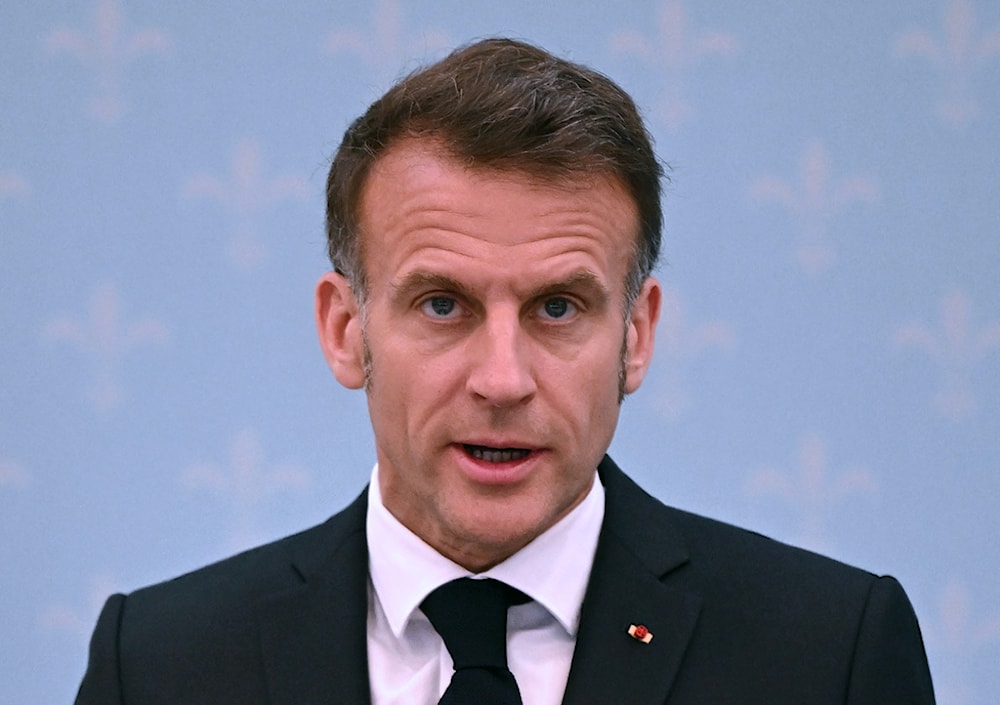
French President Emmanuel Macron speaks during a joint press conference with South Korean President Lee Jae Myung after their meeting at the presidential Blue House in Seoul, Friday, April 3, 2026. (AP)
French President Emmanuel Macron has called on nations around the world not to become "vassals" of the United States or China, following his public disagreement with President Donald Trump over the war on Iran and NATO.
During a trip to Seoul on Friday, Macron urged countries including South Korea, Japan, Brazil, India, Australia, and Canada to form a "coalition of independence" based on shared commitments to issues such as international law, democracy, and climate change.
"During decades, we had a so-called stability based on this international order and the few certainties we had. It's up and down now. We should not just be passive in this new disorder. We have to build a new order," Macron said in a speech at Yonsei University.
"Our objective is not to be the vassals of two hegemonic powers… We don't want to depend on the dominance of, let's say, China, and we don't want to be too exposed to the unpredictability of the US," he added.
A rift over Iran
Macron has significantly increased France's defense spending in recent years, focusing on missile, drone, and submarine capabilities. Last month, he said France could extend its nuclear umbrella to protect Germany and other European countries.
Macron has also refused to back the US-Israeli war against Iran and hit back at Trump, who recently derided NATO as a "paper tiger" after its European members declined to answer his call to unblock the Strait of Hormuz.
"I don't believe that we will fix the situation just by bombing or by military operations," the French leader said, referring to past and present US interventions in the Middle East.
According to The New York Times, France joined Russia and China in opposing a UN Security Council resolution that would have authorized military action against Iran in the Strait of Hormuz. The vote, originally scheduled for Friday, has been postponed.
Escalating tensions
Macron's refusal to back the US-Israeli war on Iran has not gone unnoticed. "Israel" has suspended military purchases from France amid escalating tensions following Paris's airspace restrictions, according to "Israel's" public broadcaster Kan.
The Israeli Ministry of War has frozen ongoing agreements with French defense firms, including contracts related to components used in the manufacturing of various weapons systems. The move is being driven by Minister of War Israel Katz and Director-General Amir Baram, who are advancing a policy aimed at reducing reliance on foreign suppliers.
The shift follows a recent escalation with France, centered on Paris's refusal to facilitate weapons transfers. France reportedly denied "Israel" permission to use its airspace to transport US military supplies, marking a significant departure from previous coordination and adding pressure on supply routes.
The development drew a sharp response from Trump, who criticized France's stance in a post on Truth Social. "The Country of France wouldn't let planes headed to Israel, loaded up with military supplies, fly over French territory… The U.S.A. will REMEMBER!!!," he wrote, accusing Paris of being "VERY UNHELPFUL."
France has also taken additional measures in recent months, including limiting Israeli participation in defense exhibitions and tightening conditions around military cooperation, citing political and humanitarian concerns tied to the genocide in Gaza.
For Macron, the standoff with the US-Israeli bloc is a calculated risk, but appears to be a growing consensus among many European nations given the current situation. His call for a "coalition of independence" is a direct challenge to the post-Cold War order in which European nations looked to Washington for security. As the war on Iran grinds on with no end in sight, the rift between Europe and the US-Israeli axis appears likely to widen further, with outcomes that could reshape the transatlantic alliance for years to come.
Read More: Trump-NATO tensions deepen as Europe unites against war on Iran


