
Madrid housing protests grow as Sanchez pledges government action
 4 Min Read
Spain's housing crisis sparks mass protests in Madrid as rising rents and evictions fuel public anger and push Pedro Sanchez to pledge government action.
-
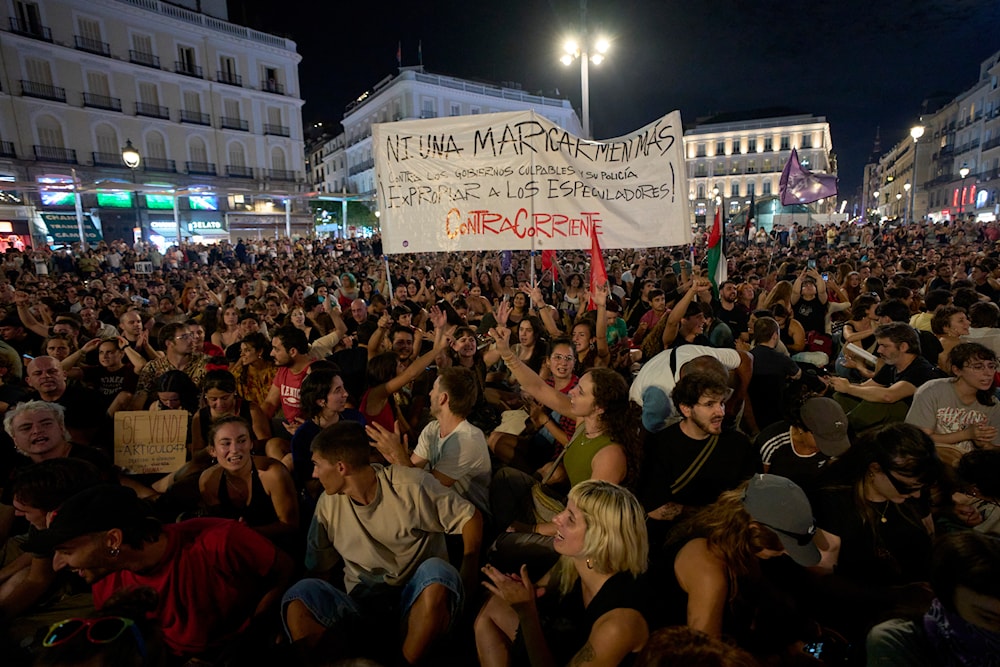
People gather during a protest following the eviction last Wednesday of 87-year-old Maricarmen to demand stronger laws to protect renters at Sol square in Madrid, Spain, Saturday, Sept. 26, 2026 (AP)
A growing protest camp in the heart of Madrid over unaffordable housing pushed Spanish Prime Minister Pedro Sanchez on Sunday to pledge swift government action.
Hundreds of protesters set up tents over the weekend in the capital's busy Puerta del Sol public square to press their demands.
The movement was triggered by a police eviction on Wednesday of an 87-year-old woman from her lifelong Madrid apartment. The woman, Maricarmen Abascal, was carried out on a stretcher after police broke down her door, in a scene that caused widespread outrage.
Her plight tapped into long-simmering resentment in Spain's major cities over spiralling costs to rent or buy homes.
Tens of thousands march while protesters set up camp
Tens of thousands of protesters took to Madrid's streets on Saturday, rattling keys and blowing whistles. Authorities said 25,000 people took part, while the Madrid Tenants' Union, which organised the protest, said over 300,000 turned out.
Many then set up their tent camp in Puerta del Sol, vowing to stay until housing access is improved, or the government falls.
"We'll stay as long as necessary. Even as we mobilise the pressure keeps mounting, and we're already at our limits," one 28-year-old protester, who gave his first name as Sergio, said in front of his tent.
Sanchez pledges housing law, opposition support remains uncertain
The housing problem in Spain has become a burning issue ahead of a general election due to take place next year.
Sanchez, in a political rally organised Sunday by his Socialist Party, addressed the evicted woman, saying: "Maricarmen, I have a message for you. The government is working all out to present the law on housing."
He urged other political parties to back the bill, which is expected to contain measures such as the automatic renewal of rental contracts and further restrictions on evictions.
But Sanchez's party lacks a majority in Spain's parliament, where it is unclear whether the package would be approved. A similar bill was defeated earlier this year.
Tenants' Union Calls for Support as Evicted Woman Becomes Symbol of Crisis
The Madrid Tenants' Union urged on X for city residents to join the Puerta del Sol protest. "We can't take any more. Either the rental system falls, or the government falls," it said.
Abascal was forced to leave the apartment where she had lived for 70 years after a real estate firm acquired the property and raised the rent by 275 percent to 2,650 euros ($3,000), according to the union.
Now a symbol of Spain's housing crisis, she urged Spaniards to join the protest Saturday in a video message posted online just hours before it got under way. "I want what has happened to me to serve so that it does not happen to other people," she said from hospital, where she has been treated for exhaustion since her eviction.
"I want it to encourage people to fight and to help change the laws that have allowed me to be evicted," she added in the video, posted by the tenants' union.
Rental market impossible amid rising prices: demonstrators
Many who took part in the street demonstration said that the rental market had become impossible. A Madrid real-estate site, Idealista, estimates that rent has nearly doubled in the past decade.
"It is a struggle to find a place you can afford, then you live in fear of being forced out," demonstrator Enrique Ortega de Miguel, a 38-year-old graphic designer who lives with his mother, told AFP.
Puerta del Sol, a busy hub intensively used by commuters and tourists, has been the venue for past protests. In 2011, young demonstrators railing against poor economic conditions and corruption occupied it for three weeks.
The Bank of Spain estimates the country of around 50 million people is short of 700,000 homes, based on the gap between demand and new construction. Spain has little public housing, while rents have been driven up by increased demand, including from tourism and population growth linked to immigration, analysts say.


