
Maduro affirms he is president, rejects allegations in sham US trial
 6 Min Read
Venezuelan President Nicolas Maduro pleads not guilty in New York federal court to narco-terrorism charges, with the next hearing set for March 17.
-
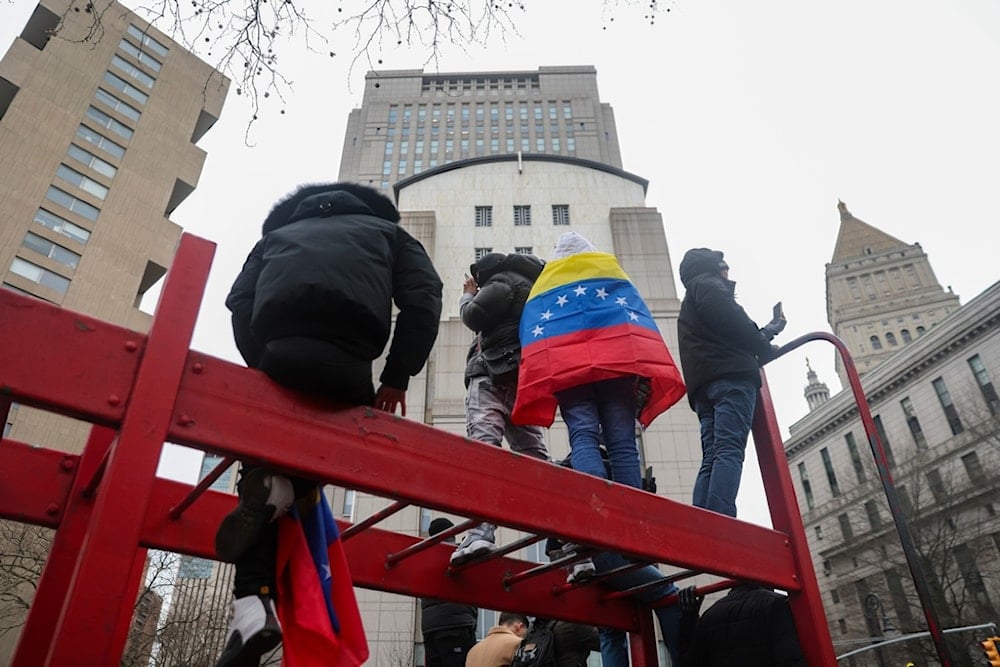
People protest outside Manhattan Federal Court before the arraignment of Venezuelan President Nicolas Maduro, Monday, January 5, 2026, in New York (AP)
Venezuelan President Nicolas Maduro on Monday pleaded not guilty during a sham trial in a New York federal court to narco-terrorism and related criminal allegations, according to Reuters.
Maduro, who was kidnapped from his home by US forces on Saturday, rejected four criminal counts brought by US prosecutors, including narco-terrorism, conspiracy to import cocaine into the United States, and possession of machine guns and destructive devices. The charges stem from a long-running US hoax accusing the Venezuelan leader of involvement in drug trafficking networks, allegations Caracas has consistently denied.
During the illegal court hearing, US media reported that Maduro asserted his political legitimacy, telling the court that he remains the president of Venezuela. "I’m not guilty, I’m a decent man, and I remain the President of my country," President Maduro said.
According to reporters present in the courtroom, the session ended with a tense exchange involving a member of the public, during which Maduro described himself as a prisoner of war.
Maduro unaware of charges
CNN reported that Maduro told the so-called court he had not seen the indictment before appearing and was unfamiliar with his legal rights, raising questions about whether he had sufficient time to consult with his legal team prior to the hearing. The New York Times separately reported that Maduro said he was unaware of the full details of the so-called charges against him at the time of his court appearance.
Maduro’s wife, Cilia Flores, also appeared alongside him, where she declared her complete innocence of the accusations brought against her by the United States. Flores requested a consular visit for herself and her husband, according to US media reports.
Maduro’s legal counsel told CNN that the Venezuelan president has health issues that will require medical attention. The lawyer also warned the judge that Flores may be suffering from fractured or severely bruised ribs and would need a physical evaluation.
US media further reported that neither Maduro nor Flores is currently seeking bail, though their attorneys indicated that an application may be submitted at a later stage. The next hearing in the case has been scheduled for March 17.
Charges mirror 2020 indictment
The charges outlined in the new indictment are similar to those filed against Maduro in Manhattan federal court in 2020, during the first Trump administration. However, the latest indictment, filed under seal in the Southern District of New York shortly before Christmas, includes additional charges against First Lady Cilia Flores.
Maduro is charged alongside his wife, his son, and three others, all accused of involvement in the alleged drug-trafficking and arms conspiracy.
The indictment revives an earlier drug trafficking hoax while introducing a controversial twist: linking him to the Venezuelan street gang Tren de Aragua (TdA), The Guardian's Aram Roston wrote.
The Guardian's analyst states that the indictment, which mirrors the 2020 US extrajudicial charges brought against Maduro, names five co-defendants. One of them is Héctor Rusthenford Guerrero Flores, the alleged founder of TdA, who was indicted separately two weeks earlier.
European leaders legitimize Trump's colonial invasion of Venezuela
When US forces invaded Venezuela on January 3, abducting its president and declaring Washington's intention to seize the country's oil resources, European leaders faced a straightforward choice, according to The Guardian's diplomatic editor: condemn an egregious violation of international law, or endorse the first openly colonial military operation of the 21st century. They chose the latter, cloaking complicity in rhetoric about "peaceful transition" while deliberately ignoring the illegality, immorality, and dangerous precedent of Trump's actions.
European responses proved remarkably uniform. Rather than address the invasion itself, leaders rushed to focus on Venezuela's political future.
EU Commission President Ursula von der Leyen declared support for "a peaceful and democratic transition" while adding that "any solution must respect international law," speaking in the future tense to avoid acknowledging that such law had already been violated.
EU foreign policy chief Kaja Kallas offered similar doublespeak, calling for restraint while emphasizing Europe's rejection of Maduro's legitimacy. By immediately pivoting to post-Maduro discussions, European leaders treat the invasion as fait accompli, accepting that might makes right.
The laws Trump shattered
Trump's operation violated Article 2(4) of the UN Charter, which prohibits force against any state's territorial integrity. No Security Council resolution authorized action. Washington's justification of "self-defense" against narcoterrorism fails to meet legal thresholds, which permit such force only in response to armed attacks.
The invasion also shattered the OAS Charter's Article 19, which forbids intervention "for any reason whatever" in another state's affairs. By abducting a head of state and announcing plans to "run Venezuela," Washington violated international law on head-of-state immunity and self-determination.
Speaking to The Guardian, Yale professor Oona Hathaway warned that accepting drug trafficking as an invasion justification "gets rid of any kind of limits on the use of force." Yet European leaders let these limits dissolve without protest.
Outcome over principle
According to The Guardian, behind diplomatic euphemisms lies cynical calculation; European leaders are quietly relieved by the outcome. Europe had long opposed Maduro, previously recognizing opposition figures, and his removal serves European interests by eliminating a Russian and Chinese ally.
That this came through illegal invasion matters less than the geopolitical realignment it enables. British Prime Minister Keir Starmer shed "no tears over Maduro's departure" while avoiding how international law applies to invasion and kidnapping.
Even French President Emmanuel Macron, whose foreign minister acknowledged the operation "violates the principle of non-use of force," undercut that clarity by declaring Venezuelans should "rejoice."
Trump's colonial vision
Trump openly stated colonial objectives. Speaking from Mar-a-Lago, he declared the United States would "run" Venezuela, detailing plans to deploy American oil companies to "fix infrastructure" and "start making money for the country." Washington would be "selling oil, probably in much larger doses." His declaration that "we're in the oil business" removes any pretense of humanitarian purpose.
He boasted of watching the raid "like a television show," celebrating the "speed" and "violence." Venezuelan oil infrastructure was deliberately spared during strikes that killed dozens of civilians, preserving assets for US exploitation.
His administration made clear this invasion is not isolated but a template. Secretary of State Marco Rubio threatened Cuba: "If I were them, I'd be worried." Trump also warned Colombian President Petro to "watch his ass," citing cocaine production as potential justification.


