
Majority of Americans say Iran war not in US national interest: Poll
 5 Min Read
Only 38 percent back the military strikes, and nearly half believe the president has focused too much on international affairs rather than domestic issues.
-
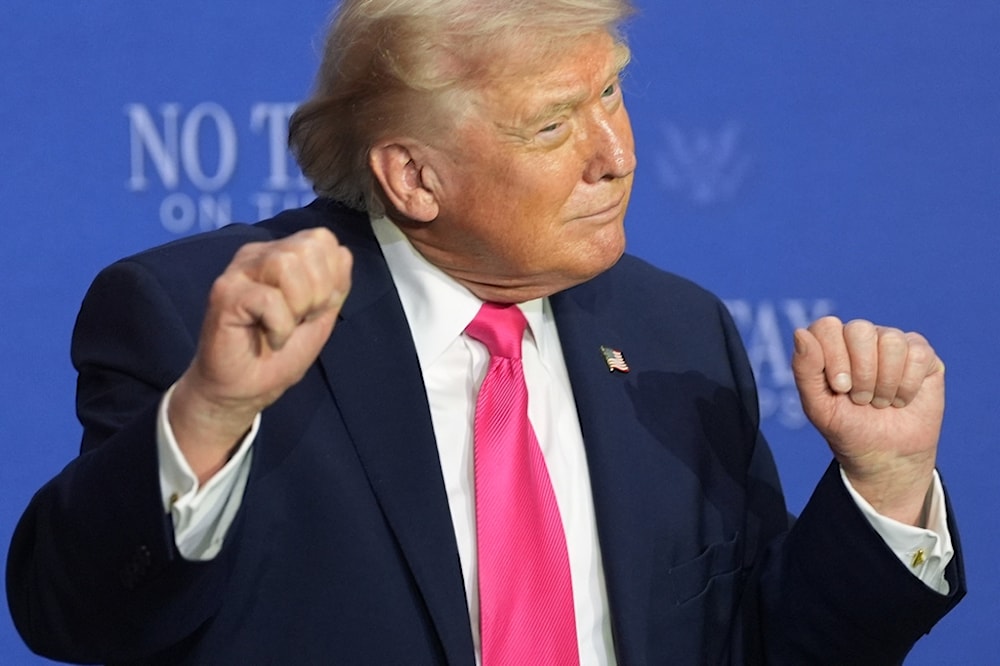
US President Donald Trump dances at a roundtable event about no tax on tips, Thursday, April 16, 2026, in Las Vegas (AP)
Support for military action in Iran remains weak, with just 38 percent of Americans backing the war, a new POLITICO poll has shown, with views remaining largely unchanged from the days following the joint US-Israeli aggression, even as the administration has now had weeks to make its case to the public.
A majority of respondents said the war is not in the interests of the American people, and a plurality remain unconvinced that the president has clear objectives. This skepticism includes a notable portion of his own 2024 supporters.
Nearly half of all respondents said the president has spent too much time focusing on international affairs rather than domestic issues, according to the survey conducted by Public First. This view was shared by 29 percent of his own 2024 voters.
GOP strategists warn of messaging problem
The findings suggest that Trump has made little progress in winning over the public on a war that has pulled him away from helping anxious Republicans sell their economic message ahead of November. There are growing concerns that the war, along with its ripple effects on gas, oil, and food prices, could undercut the GOP's most critical midterm messaging.
Michigan-based Republican strategist Jason Roe said the biggest problem is that the war was not pre-sold to the American public. He noted that Trump campaigned against these kinds of policies and actions before reversing himself suddenly, meaning that the American people were not conditioned to prepare for this war.
A 41 percent plurality of Americans said Trump does not have a plan for resolving the war with Iran, virtually unchanged from the previous month. Even as the president has claimed victory and suggested the war may be winding down, only 15 percent of respondents said he has achieved his goals for intervening.
Forty percent of respondents said Trump will either never achieve his goals in Iran or does not have explicit goals at all.
Trump voters express confidence despite doubts
Trump has largely retained support for the war among his base. However, more than a third of Trump voters said he does not have a plan, though many trust that his actions will resolve the war anyway.
Forty-five percent of Trump voters said the president has not yet accomplished his goals, though they expect he will. Their responses reveal strong confidence in the president while also suggesting an awareness that the war could extend beyond the four to six week timeline the administration initially indicated.
Only 15 percent of Americans said Trump has achieved his goals in the war. Another 25 percent said they believe he will achieve his goals, but has not yet done so. Roughly four in ten believe Trump will never achieve his goals or has no goals at all.
Shifting justifications, uncertain future
The president has offered shifting justifications for launching the war. He promised as recently as this week that the war was nearing an end, telling Fox Business regarding Iranian negotiators, "I think it can be over very soon. If they're smart, it will end soon."
When asked whether oil and gas prices would decline before the midterm elections, Trump said prices may be "a little bit higher, but it should be around the same," offering little reassurance to Republicans worried that high costs will persist through November. In a separate interview, he reversed course, stating that he believes gas prices will be "much lower" before the midterms. "They said I expect oil to be high at the midterms, I don't expect that, I think that we will be somewhere around where we were, maybe even lower," he said.
The future of negotiations remains uncertain as the war stretches into its seventh week. After peace talks ended without a deal, Trump escalated pressure on Tehran by ordering a naval blockade of Iranian ports, a move that risks further strain on gas prices. The Strait of Hormuz reopened for commercial traffic on Friday, a development that sent oil prices plunging.
Republicans in Washington have largely remained aligned with Trump publicly, but there are growing concerns that a prolonged war could alienate war-weary voters within the party. The war has proven to be as much of a messaging challenge as it is a policy problem for the GOP, with voters in both parties consistently listing cost-of-living concerns as their top issue heading into the midterms.
Michigan-based Republican strategist Jason Roe told POLITICO, "I think the number one messaging problem has been that every day we're told it's going to end tomorrow, and we're now nearly two months into that promise. I think most elected Republicans are still optimistic that this thing is going to be resolved quickly, but I think the biggest failure is telling us it's going to be over tomorrow every day."
Read more: Trump approval drops to lowest as war on Iran hits economy


