
Mandelson-Epstein saga: McSweeney resigns, leaves UK cabinet in crisis
 8 Min Read
Starmer's chief of staff resigns over Peter Mandelson’s US envoy role amid severance controversy and Epstein link fallout.
-
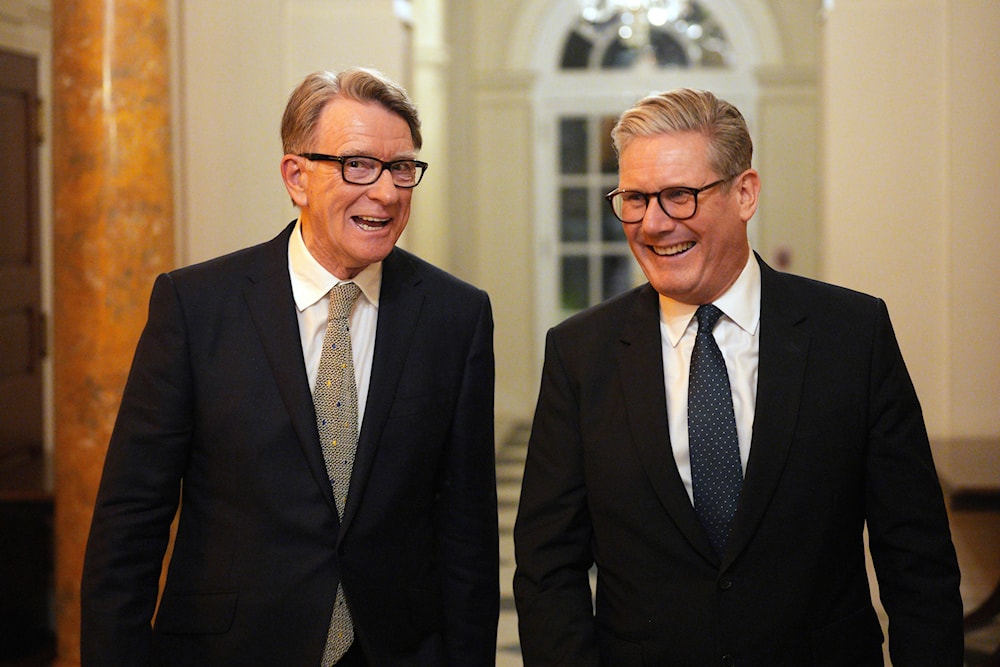
British Prime Minister Keir Starmer talks with Britain's ambassador to the United States, Peter Mandelson, during a welcome reception at the ambassador's residence on Wednesday, Feb. 26, 2025, in Washington (AP)
Morgan McSweeney, the UK Prime Minister’s Chief of Staff, has resigned after accepting responsibility for advising Keir Starmer to appoint Peter Mandelson as British ambassador to the United States.
In a resignation letter released on Sunday, McSweeney said the decision to appoint Mandelson “was wrong” and had damaged “our party, our country and trust in politics itself.” He acknowledged that he had advised Starmer to proceed with the appointment and said he took “full responsibility” for that advice.
“In public life responsibility must be owned when it matters most, not just when it is most convenient,” McSweeney wrote, adding that “the only honourable course is to step aside.”
He also called for a fundamental overhaul of the government’s vetting and due diligence process, saying it must serve as a genuine safeguard rather than a symbolic reform. Despite his resignation, McSweeney expressed continued support for Starmer, describing it as “the honour of my life to serve” and pledging to back the prime minister’s mission to rebuild public trust.
Reacting to his chief of staff’s departure, Keir Starmer said in a statement, “It’s been an honour working with Morgan McSweeney for many years. He turned our party around after one of its worst ever defeats and played a central role running our election campaign. It is largely thanks to his dedication, loyalty and leadership that we won a landslide majority and have the chance to change the country.”
Starmer appointed Jill Cuthbertson and Vidhya Alakeson as acting chiefs of staff, with immediate effect. Both served as deputy chiefs of staff since 2024.
'It's about time'
The Conservative leader Kemi Badenoch said Starmer should also “take responsibility” for his actions. In a post on X, Badenoch wrote: “It’s about time. But once again with this PM it’s somebody else’s fault: ‘Mandelson lied to me’ or ‘Morgan advised me’.”
She added: “Keir Starmer has to take responsibility for his own terrible decisions. But he never does.”
It’s about time.
— Kemi Badenoch (@KemiBadenoch) February 8, 2026
But once again with this PM it’s somebody else’s fault: “Mandelson lied to me” or “Morgan advised me”.
Keir Starmer has to take responsibility for his own terrible decisions. But he never does. https://t.co/KvVIhUmK6v
The UK Foreign Office said on Sunday it was reviewing an exit payment made to former British ambassador to the United States Peter Mandelson, following allegations linking him to convicted US sex offender Jeffrey Epstein. The move comes after newly released US documents raised fresh questions about Mandelson’s conduct while in office.
According to a report in the Sunday Times, Mandelson received an estimated severance package of between £38,750 and £55,000 ($52,000–$74,000) after serving just seven months in the diplomatic post before being dismissed.
Documents released on January 30 by the US Justice Department appear to show that Mandelson allegedly shared confidential UK government information with Epstein during his time as a British minister, including material related to the 2008 financial crisis. The claims have sparked a police investigation into the 72-year-old senior Labour figure for alleged misconduct in public office.
In a statement, the Foreign Office confirmed it had launched a review of the severance payment “in light of further information that has now been revealed and the ongoing police investigation.”
The controversy has intensified political pressure on Prime Minister Keir Starmer, who appointed Mandelson to the ambassadorial role.
Cracks grow in Starmer's cabinet
Prime Minister Keir Starmer is facing mounting political strain as divisions emerge within his own cabinet over the appointment of Peter Mandelson. According to a report in the Sunday Telegraph, Foreign Secretary David Lammy became the first senior minister to publicly distance himself from the premier over the controversy.
The newspaper, citing friends of Lammy, reported that he had opposed Mandelson’s appointment as ambassador to Washington due to his well-known links to Jeffrey Epstein. Mandelson, a central figure in British politics for decades and a former European Union trade commissioner, had been a prominent Labour powerbroker.
The row comes at a challenging time for Starmer’s government, which took office just over 18 months ago following a landslide election victory. Labour has since struggled in the polls, trailing Nigel Farage’s anti-immigration Reform UK amid criticism over immigration policy, economic growth, and the ongoing cost of living crisis. Reform UK has led by double-digit margins in opinion surveys for much of the past year.
Mandelson stepped down earlier this week from the unelected House of Lords. Starmer had already dismissed him from his diplomatic post in September after an earlier tranche of Epstein-related documents was released. The latest disclosures have once again cast a spotlight on a number of high-profile figures linked to Epstein, who died in jail in 2019 while facing sex trafficking charges.
PM's future in serious scrutiny
Senior Conservative figure Alex Burghart has cast doubt on Keir Starmer’s future as prime minister, saying the Labour leader must take responsibility for appointing Peter Mandelson despite claiming he had been misled.
Burghart, the shadow chancellor of the Duchy of Lancaster and shadow Northern Ireland secretary, said Starmer had been “lied to by someone who was known to be a serial liar,” adding there was “no excuse” for what he described as a poor judgment call. “He was in possession of enough facts to have not made that appointment and he did anyway,” Burghart said, arguing the prime minister’s position was no longer “tenable".
He described the matter as ultimately one for the Labour Party to resolve, suggesting it would be up to Labour MPs to decide whether to remove Starmer from office.
Burghart also indicated that the Conservatives could table a motion of no confidence but acknowledged it would only be meaningful if it attracted broader support. “There is no point in us doing that if other people won’t support it,” he said, adding that Conservative whips would be open to discussions with Labour MPs willing to back such a move.


