
UK slashes World Food Programme funding amid global aid crisis
 4 Min Read
UK aid cuts to World Food Programme and UN agencies could reduce assistance to vulnerable populations by up to 60%.
-
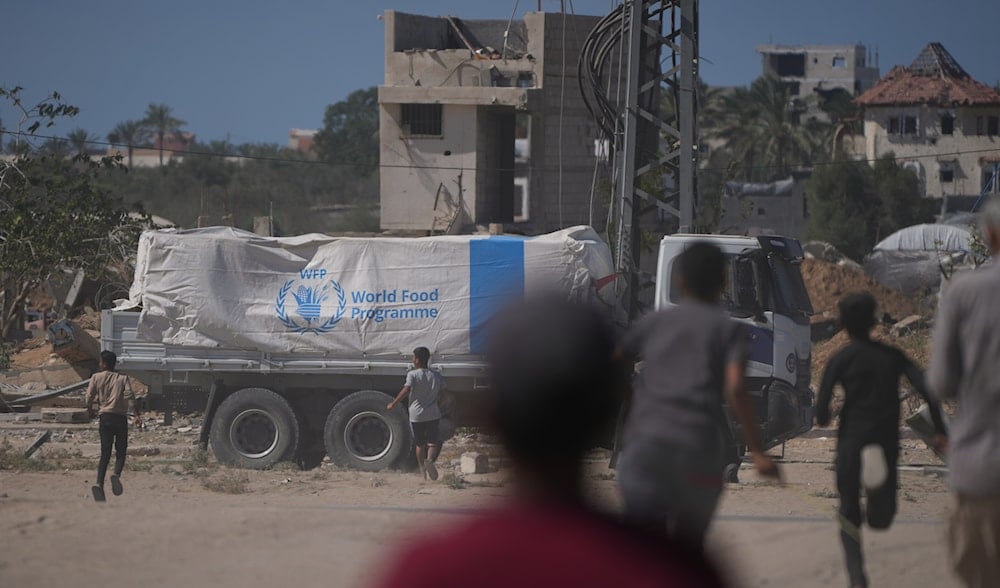
Palestinians rush toward trucks carrying aid from the World Food Programme (WFP) as they drive through Deir al-Balah in central Gaza, Wednesday, Oct. 15, 2025. (AP Photo/Abdel Kareem Hana)
The UK has reduced its contribution to the World Food Programme by nearly 30%, dropping from $610 million in 2024 to $435 million in 2025, despite Prime Minister Keir Starmer's pledges to combat global hunger. The cuts form part of a broader retreat from international development commitments that campaigners warn will cost lives across the Global South.
Britain's aid budget has plummeted from a pre-pandemic legal commitment of 0.7% of gross national income to an effective 0.3% by 2025-26, representing more than a 50% reduction. Civil society organizations say this is the lowest UK aid spending this century, with the deepest cuts materializing throughout 2025-26.
The government has justified the reductions by emphasizing a "modernized aid budget" focused on efficiency and transparency, with funding redirected toward select multilaterals like the World Bank and Gavi. However, the overall envelope has shrunk dramatically, with humanitarian programs bearing the brunt of the cuts.
READ MORE: Britain opted for cheaper Sudan plan despite risk of mass killings
Humanitarian agencies face funding collapse
UN humanitarian agencies and NGO-implemented programs have been disproportionately affected compared to World Bank-style financing. UNICEF UK warns that if the 0.3% trajectory continues, child-focused bilateral aid alone could decline by over £500 million by 2027, compounding already significant cuts to multilateral child programs.
Programs in South Sudan, Ethiopia, Somalia, and the occupied Palestinian territories face severe reductions, with NGOs reporting that education, protection, and health projects will simply cease operations. Meanwhile, the UK hosted a two-day conference on Afghanistan's malnutrition crisis without making any financial commitments.
A coordinated western retreat
Britain's cuts coincide with similar retrenchment across major donor nations. For the first time in nearly three decades, France, Germany, the UK, and the US all reduced official development assistance in the same year (2024), with projections showing synchronized cuts continuing through 2025.
According to the Center for Global Development, the United States leads the contraction with a 56% reduction compared to two years prior. The UK follows with a 39% cut relative to 2023 levels, Germany at 27%, Canada at 25%, and France at 19%.
The OECD projects a 9% decline in global aid for 2024 and another 9-17% drop in 2025. These eleven major donors collectively provide 87% of WFP funding and over 60% of WHO financing, meaning their synchronized withdrawal creates a cascading crisis for humanitarian operations.
Devastating impact on vulnerable populations
The practical consequences are stark. Bilateral aid to least-developed countries may fall by 13-25%, with sub-Saharan Africa facing potential cuts of 16-28%. Health assistance could plummet by 60% from its 2022 peak, threatening vaccination programs, HIV and TB treatment, and maternal-child health services built over two decades.
UN humanitarian response plans for 44 crises received less than one-tenth of the required funding in early 2025. For communities on the ground, this translates to suspended school feeding programs, reduced primary healthcare, fewer food distributions, and diminished protection services.
A government spokesperson maintained that the UK remains the fifth-largest WFP donor, pointing to £20 million in Gaza water and sanitation aid announced in October. However, with the Home Office allocating £2.2 billion of overseas development assistance to domestic asylum seeker hotel bills this year, the effective contraction in international support remains severe.


