
Marandi, Hoh: Iran challenges US regional order | Exclusive
 18 Min Read
Analyst and Professor Mohammad Marandi and former USMC Captain and State Department officer Matthew Hoh examine Iran’s potential role in ending the war on Yemen, Saudi Arabia’s regional vulnerability, Britain’s involvement in the war on Iran, and the growing political and economic costs of Washington’s military strategy.
-
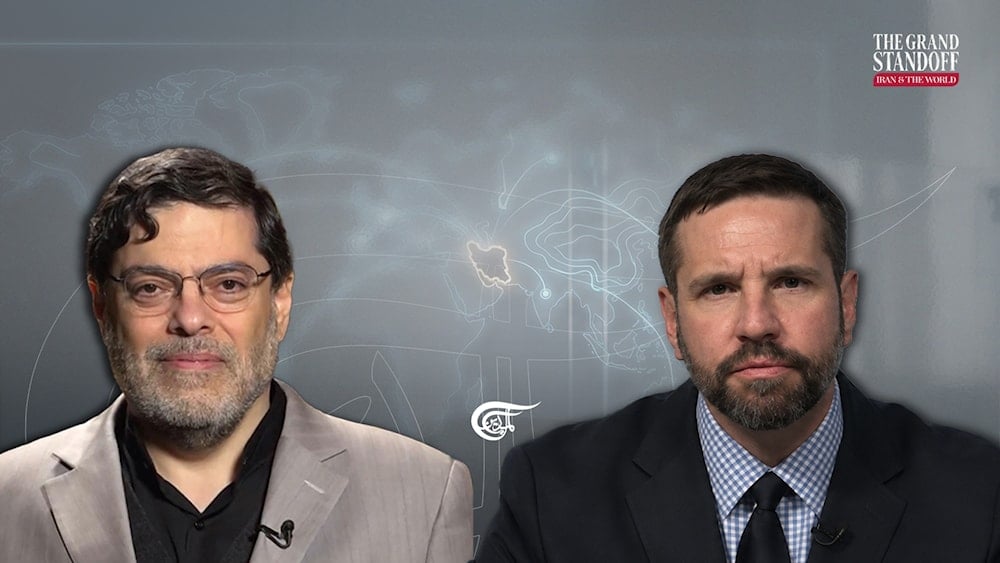
Analyst and Professor Mohammad Marandi and former USMC Captain and State Department officer Matthew Hoh for Al Mayadeen's The Grand Standoff: Iran and the World (Al Mayadeen English)
Iran is willing to help bring the war on Yemen to an end, but Saudi Arabia must recognize Yemen’s sovereignty and negotiate directly with the authorities in Sanaa, analyst and Professor Mohammad Marandi stated.
Former USMC Captain and State Department officer Matthew Hoh, on his part, said Iran’s potential role in mediating a settlement could challenge Washington’s regional order and expose the dependence of US-aligned governments on American power.
Speaking on Al Mayadeen's The Grand Standoff: Iran and The World, Marandi and Hoh both examined Britain’s involvement in the US war on Iran, the credibility of Washington’s negotiating commitments, and the growing economic and political costs of the war.
Marandi argued that Western narratives about Iran and the Axis of Resistance have weakened, while Hoh maintained that President Donald Trump’s unpredictable decision-making and the absence of a coherent US strategy are undermining Washington’s ability to achieve its objectives.
Hoh said that Iran’s potential role in mediating a settlement poses a challenge to Washington’s regional order by demonstrating that regional countries can pursue their own interests without operating as subordinate partners of the United States. He said such a development could deepen divisions within the US-led regional order.
The two guests also examined Britain’s involvement in the US war on Iran, the implications of possible attacks beyond West Asia, and the consequences of President Donald Trump’s unpredictable decision-making. Both questioned Washington’s ability to achieve its objectives through continued military pressure, with Marandi emphasizing the changing international perception of Iran and the Resistance, and Hoh highlighting the war’s economic and political costs for the United States.
Iran’s mediation challenges the US-led regional order
For Hoh, Iran’s potential role in mediating an end to the war on Yemen is significant not only because of the possibility of a settlement, but also because of what it would reveal about the balance of power in the region.
He argued that Washington’s political establishment has long portrayed Ansar Allah as an Iranian-controlled force, dismissing its independent political agency. The renewed war, he said, has exposed the greater dependence of US-aligned actors on Washington and its regional partners.
“What this renewed war has shown, has shown as Professor Morandi was explaining, that the real puppets, the real proxies in this case, are on the Western side. They are in the American imperial camp and not in the order that opposes that imperialism,” Hoh said.
In his assessment, Iran’s ability to facilitate a settlement would advance a broader effort to reshape regional relations, deter future US and Israeli attacks, and reduce the American military and political presence in West Asia.
Hoh argued that this objective requires regional countries to cooperate as sovereign actors rather than function as proxies or junior partners of external powers. An Iranian-mediated settlement, he said, could expose the contradictions within the US-led order and create further divisions among its members.
“This is why this proposal is very dangerous for Washington, D.C.,” Hoh said, referring to the prospect of Iran playing a mediating role. He added that such an outcome would raise questions about “who here actually is an honest broker, who's an honest actor, who are the real vassals and proxies in this situation.”
Marandi similarly argued that Iran wants the war on Yemen to end and is prepared to help achieve that outcome. He rejected the portrayal of Tehran as an obstacle to peace, maintaining that the central issue is Saudi Arabia’s refusal to recognize Yemen’s sovereignty and engage with the authorities in Sanaa.
Saudi Arabia’s refusal to recognize Sanaa prolongs war
Marandi argued that Saudi Arabia has repeatedly attempted to structure negotiations around its own allies, including the Saudi-backed Yemeni government based in Riyadh, while treating the authorities in Sanaa as the opposing side. He said this approach fails to reflect the political realities on the ground.
According to Marandi, the Saudi-backed camp lacks the popular legitimacy and independent authority required to represent Yemen effectively. Its influence, he argued, has depended heavily on Saudi financial support rather than a genuine domestic constituency.
“Sanaa has every right to say that we are not going to negotiate with Saudi proxies, and that the only way forward is for Saudi Arabia and Yemen to sit down and resolve issues, and Iran is willing to help with that,” he said.
Marandi maintained that the authorities in Sanaa have demonstrated their support base despite years of war, airstrikes, and restrictions that imposed hunger and disease on Yemenis. He argued that Riyadh’s refusal to acknowledge this reality is making a settlement increasingly difficult.
The issue, in his view, is not simply the format of negotiations but Saudi Arabia’s unwillingness to accept that a sustainable agreement must involve the Yemeni authorities that exercise power in Sanaa.
He said that Iran’s position has remained consistent over the past 11 years, arguing that Saudi Arabia should recognize Yemen’s sovereignty rather than continue a military aggression against the country.
“The real question is, why are the British cooperating with the United States to bomb Iran?”
Marandi also rejected narratives promoted by regional media outlets that portray Iran as seeking to prolong the war. He argued that Saudi Arabia could have pursued a fundamentally different relationship with Yemen by investing in the country instead of spending vast sums on its subjugation.
“If they had invested a fraction of that money, just invested, not given, invested a fraction of that money in Yemen, the relationship with Yemen would have been completely different from what it is today,” he said.
For Marandi, an end to the war requires a political shift in Riyadh: recognition of Yemen’s sovereignty, direct negotiations, and the lifting of the siege on the country.
Saudi Arabia faces mounting political and economic risks
Marandi warned that Saudi Arabia’s continued refusal to pursue a settlement could leave the kingdom increasingly exposed, particularly given its dependence on oil revenues and the internal vulnerabilities he associates with its political system.
He described Saudi Arabia as a fragile state facing internal divisions and argued that declining oil revenues could place Crown Prince Mohammed bin Salman and the ruling family under greater pressure.
Marandi attributed Riyadh’s approach in Yemen to the crown prince’s political arrogance and poor strategic judgment. He cited Saudi Arabia’s war on Yemen, its confrontation with Qatar, and its treatment of former Lebanese Prime Minister Saad Hariri as examples of decisions that, in his assessment, failed to achieve their intended objectives.
He also referred to the killing of Saudi journalist Jamal Khashoggi, arguing that these episodes reflected a pattern of decisions that have carried serious political consequences without delivering lasting strategic gains.
Marandi compared Mohammed bin Salman’s approach to that of Trump, arguing that both leaders surround themselves with people who reinforce their own positions rather than challenge their decisions.
Although he expressed little optimism about a change in Saudi policy, Marandi maintained that a different course remained possible if Riyadh accepted mediation and pursued peace.
“If he does change, if he is willing to change his mind, the Iranians are willing to help bring this to an end,” he said.
The argument places the future of the Yemen war within a broader regional contest over sovereignty and political independence. For Marandi, Saudi Arabia’s willingness to recognize the authorities in Sanaa would be a decisive step toward ending the war, while continued reliance on military force and proxies risks deepening the kingdom’s own difficulties.
Challenging Western accusations against Iran
The two guests also questioned Western narratives surrounding alleged Iranian activities and the broader campaign against Tehran.
Marandi expressed skepticism about British claims concerning an alleged terrorist plot targeting a UK airbase, questioning why suspects had been released on bail if British authorities possessed compelling evidence that they posed a serious threat.
He argued that Western governments have repeatedly used accusations against Iran to justify increased tensions, sanctions, and other punitive measures. As an example, he cited allegations in Australia concerning the Iranian embassy and antisemitism, saying evidence had not been provided to substantiate them.
For Marandi, the central issue was not the accusations directed at Iran but Britain's involvement in the US military aggression.
“The real question is, why is the regime in London complicit in atrocities against the Iranian people, waging an illegal war, and threatening to wage another phase of this illegal war, and helping in the 12-day war?” he said.
He argued that Western governments occupy the roles of accuser and judge despite their own involvement in military operations against Iran. Marandi also maintained that the extensive sanctions already imposed on Tehran, followed by direct military action, had left Washington and its allies with fewer options for exerting additional pressure.
Hoh likewise questioned the British account of the alleged plot, arguing that the release of the suspects raised doubts about the narrative presented by authorities.
Hoh also challenged the framing of possible attacks against military facilities as terrorism, arguing that the use of British bases to support US military operations made the United Kingdom a participant in the war.
“The United Kingdom allows the Americans to use those bases. They are not being coerced,” he said. “They are voluntarily doing so. The United Kingdom is a belligerent in this war.”
His argument was that Britain's military cooperation with Washington should be considered when assessing the potential consequences of the war, rather than treating the countries hosting or facilitating military operations as detached from the war itself.
Hoh warns that warfare may reach US and European territory
Hoh argued that the war on Iran illustrates a broader shift in modern warfare: countries conducting military operations abroad cannot assume that the consequences will remain confined to the territories they target.
He pointed to the growing reach of drone warfare and cited Ukrainian attacks on Russian airfields as an example of how military operations can extend deep into an adversary's territory. He argued that the same broader principle applies to the war on Iran, warning that Western governments may eventually face military consequences at home.
“These wars can now be taken and carried out against the aggressors in their home states, whether those home states be in Europe or potentially in the United States,” Hoh said.
He said that the distinction between a battlefield abroad and relative security at home is becoming less reliable as states develop the means to strike targets far from their own territory.
Hoh also linked the issue to public opposition to the war in Western countries, stating that its economic effects have already created political pressure. The possibility of direct military consequences in the United States or Europe, he said, would introduce another dimension to the costs borne by governments supporting the campaign.
He maintained that the Israeli public had benefited from the direct participation of the United States because it reduced the burden of the war on "Israel" itself. A war that produces economic disruption abroad, he argued, could become substantially more politically damaging to Western governments if it also brings military consequences to their own territory.
Hoh presented this as part of a wider transformation in the character of warfare, in which military powers can no longer assume that they will remain insulated from the wars they initiate.
Trump’s unpredictability undermines the prospects for diplomacy
Both guests questioned the credibility of Washington’s commitments under Trump, arguing that his approach to negotiations has made a durable settlement more difficult to envisage.
Marandi pointed to the 12-day war, the subsequent war against Iran, and the failure to implement the memorandum of understanding (MOU) as examples of what he considers a recurring pattern: Washington engages in negotiations or makes commitments, only to abandon them or launch military action.
He argued that Iran has little reason to trust a new American commitment simply because it is announced publicly. Even if Trump were to declare that an agreement had been reached and accepted Iran’s terms, Marandi said, there would be no guarantee that Washington would implement it.
“This is a person whose signature means nothing, whose words mean nothing, who's constantly contradicting himself,” Marandi said.
He maintained that Iran has insisted on the full implementation of the MOU, rather than accepting a declaration of agreement without concrete action. In his assessment, the problem extends beyond the content of any proposed deal to the credibility of the US administration itself.
Hoh similarly argued that Washington lacks a coherent strategic vision and that US policy has become excessively dependent on Trump's personal decisions.
“There is no strategic plan. There's no strategic vision. They don't have an idea where they want to go,” Hoh said.
He acknowledged the influence of the US military-industrial complex, oil and gas companies, and "Israel" on American policy, but argued that these institutional pressures do not eliminate the central role of the president's personal choices.
Hoh said Trump's approach to the war and negotiations changes according to his immediate calculations, making it difficult for Iran or other countries to predict Washington's next move. He contrasted this with leaders whose positions may be hostile but whose policies remain more consistent and therefore easier to anticipate.
The two guests' arguments converge on a central obstacle to diplomacy: even when negotiations produce an apparent breakthrough, the absence of confidence in Washington's commitments makes implementation the decisive issue. For Iran, the question is not merely whether the United States will agree to terms, but whether it will honor them.
Hormuz pressure and the political costs of the war
Marandi also discussed the reduction in oil shipments through the Strait of Hormuz, linking the changing volume of maritime traffic to Iran's enforcement of its regulations against vessels that violate its orders.
He said Iran had reduced strikes against such tankers during the period surrounding President Masoud Pezeshkian's trip to Washington and the days leading up to it. During that period, Marandi said, approximately 10.5 million to 11 million barrels of oil passed through the strait each day.
He argued that the subsequent increase in the targeting of vessels violating Iranian regulations had contributed to a substantial decline in oil shipments. Marandi also noted the timing of the escalation following the UAE's hosting of Israeli Prime Minister Benjamin Netanyahu, while cautioning that this was not necessarily the sole explanation.
Marandi suggested that Iranian decision-makers may also see pressure on the United States ahead of the November midterm elections as strategically useful. He emphasized that this was his personal assessment, not Iran's declared policy, and acknowledged that an electoral defeat for Trump's party would not necessarily end the war.
“I would imagine, and I say this as an Iranian citizen—obviously, I'm not in government—but I would imagine that Iran is intensifying pressure on the United States before the midterms,” he said.
Marandi argued that Iranian leaders have strong reasons to increase pressure on Trump after the deaths and destruction caused by the war. At the same time, he stressed that Iran does not want to shut down trade through the Strait of Hormuz, noting that countries friendly to Tehran, including China, depend on oil supplies and would suffer from a wider disruption.
Hoh approached the question from the perspective of US domestic politics, arguing that the economic consequences of the war could make its continuation increasingly costly for Trump.
He said that ending the war could offer political advantages by reducing oil prices and, in turn, gasoline and diesel prices. In the United States, where many people depend on cars for everyday transportation, Hoh argued, fuel prices make the economic effects of the war directly visible to voters.
“There is nothing with the exception of angering the Israeli lobby, the military-industrial complex, the fossil fuel companies,” Hoh said, describing what he sees as the limited domestic political costs Trump would face from ending the war. “Other than that, there is no downside to ending this war in the United States.”
Hoh argued that lower energy prices and reduced economic uncertainty could benefit Trump ahead of the congressional elections. He also questioned whether Washington had any remaining conventional military options capable of forcing Iran to surrender, arguing that even the use of nuclear weapons would not necessarily change Iranian decision-making.
He warned that the United States could instead intensify attacks on Iranian infrastructure and civilian targets in an attempt to punish the population. However, he argued that such actions would not necessarily break Iran's resolve.
The two assessments highlight the competing pressures surrounding the Strait of Hormuz and the war more broadly: Marandi sees the potential for Iran to use pressure strategically while avoiding a complete shutdown of trade, while Hoh emphasizes how the economic consequences could translate into domestic political costs for Washington.
Gaza and the wars on Iran reshape global perceptions
Beyond the immediate military and diplomatic confrontation, Marandi argued that the war on Gaza and successive wars against Iran have weakened the credibility of Western narratives about Tehran and the Axis of Resistance.
He described a broader shift in international attitudes, saying that perceptions began changing after the war on Gaza and continued to evolve through the 12-day war and the subsequent conflict involving Iran.
“One thing that I'm pretty sure that your viewers have noticed is that after Gaza, the mood across the world began to change with regards to Western narratives, and the narratives of regimes in our region with regards to Palestine, with regards to Iran, with regards to the resistance,” Marandi said.
He argued that the international standing of Iran and the Resistance has grown as more people question the narratives advanced by Western governments and their regional allies. According to Marandi, this shift is reflected in the growing willingness of academics, writers, activists, intellectuals, and religious figures to visit Iran and engage directly with its society.
He cited his conversations with participants from different countries at the Valdai Conference in Moscow the previous week, saying that many expressed respect for Iran and the broader Resistance for confronting what they view as imperial power.
Marandi maintained that this engagement is bringing together people from different religious traditions, ethnic backgrounds, and political orientations, including secular and religious figures who had previously been cautious about associating with Iran or had accepted negative portrayals of the country.
He presented the shift as part of a broader contest over political legitimacy, arguing that the wars have not produced the international isolation of Iran that its adversaries sought.
For Hoh, the challenge to Washington is also strategic. If Iran can help resolve regional wars while resisting US military pressure, it could strengthen the argument that regional countries do not need to rely on American leadership to secure their interests.
The two guests thus linked the immediate confrontation to a wider struggle over the future of West Asia: whether the region remains organized around US power and its alliances, or whether states and political movements opposing that order can expand their autonomy.


