
Marandi, Schlanger: US war exposes limits of American power - Excl.
 7 Min Read
Speaking on The Grand Standoff, Marandi and Schlanger argue that the US war on Iran has exposed American military vulnerabilities and strengthened Tehran's confidence.
-
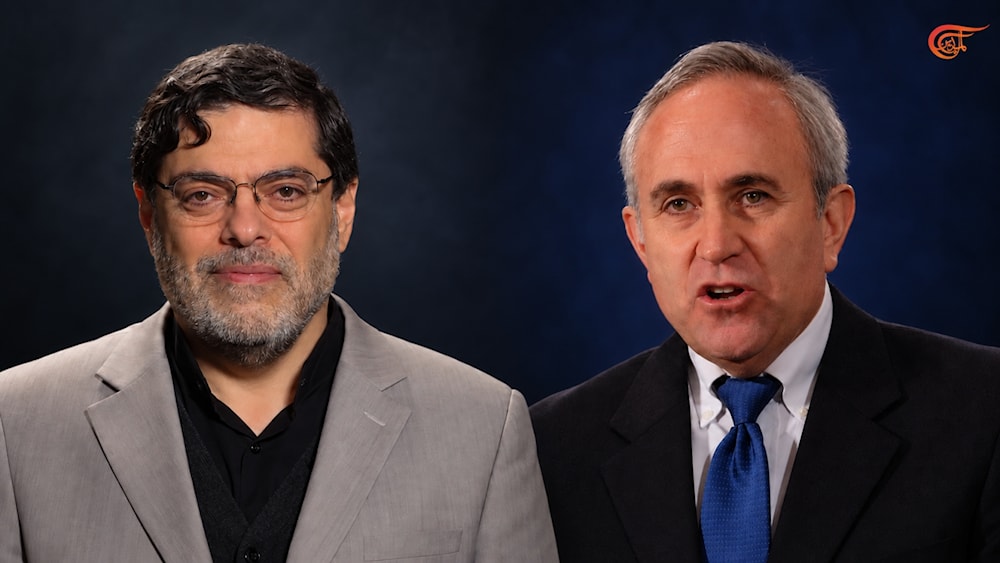
Professor Mohammad Marandi (left) and Schiller Institute spokesperson Harley Schlanger discuss the US war on Iran on Al Mayadeen’s The Grand Standoff (Photo illustration)
Iran’s experience confronting the United States has strengthened its military confidence and readiness to take the initiative if threatened, Professor Mohammad Marandi said Wednesday, while Schiller Institute spokesperson Harley Schlanger argued that Washington has trapped itself in a war that lacks a clear winning strategy.
Speaking on Al Mayadeen’s The Grand Standoff: Iran and the World on Tuesday, the two discussed Iran’s military resilience, the mounting costs of Washington’s pressure campaign, regional cooperation with “Israel", and efforts to challenge Western media narratives through direct communication with Americans.
Marandi said Washington’s decision to launch the war had exposed weaknesses in its own military capabilities while demonstrating the effectiveness of Iran’s defense investments.
“I think the biggest mistake that the United States made in initiating this war was that it revealed its incapability to undermine Iran's military,” he said.
Marandi: Iran prepared to take the initiative
Marandi attributed Iran’s resilience to sustained investment in missiles, drones, and underground facilities designed to protect its military assets.
Speaking from Moscow, where he said he was attending the Valdai conference, he described encounters with international participants who had expressed surprise at Iran’s performance against the United States.
That experience, he argued, had given Tehran greater confidence both in its own capabilities and in its understanding of American vulnerabilities.
“So as long as the United States threatens Iran, the Iranians are prepared to strike the United States, and they are prepared to strike the United States first if that is necessary.”
Marandi also said Iran remained committed to demanding that Washington fulfill its obligations under the memorandum of understanding, arguing that successive predictions of an imminent Iranian collapse reflected a persistent failure to understand the country.
“This just shows how the United States from day one has underestimated Iran at all levels,” he said.
He maintained that Iran’s ability to withstand pressure extended beyond its military preparations, pointing to the population’s cultural and religious identity and its determination to resist a war imposed on the country.
Schlanger: Trump caught in a trap of his own making
Schlanger said US policy combined an exaggerated belief in American military supremacy with a refusal to recognize Iran’s capabilities and the resilience of its population.
Referring to President Donald Trump’s remarks at the UN General Assembly, he argued that Washington continued to threaten Iran without presenting a coherent strategy for defeating it.
“He's in a trap of his own making,” Schlanger said. “And every time he makes a threat, it undermines his credibility for diplomacy, undermines his credibility as a leader.”
He argued that the administration faced a dilemma: continuing the war risked exposing further military weaknesses, while withdrawing would require explaining the gap between Trump’s promises and the conflict’s outcome.
According to Schlanger, US officials were struggling to identify a way to claim victory, or even the appearance of victory, that would allow Washington to pull troops out.
“But each time, we haven't learned the lesson that military firepower alone doesn't guarantee victory.”
Schlanger nevertheless warned that these difficulties did not rule out another US attack. Pressure to restore the military’s reputation could encourage further escalation, he argued, even as the war demonstrated the vulnerability of American deployments abroad.
He said US bases had proved difficult to defend, raising broader questions about Washington’s ability to sustain its extensive overseas military presence.
Economic pressure carries growing costs for Washington
Both speakers argued that Washington’s attempt to force Iran into submission through economic pressure was imposing costs on the United States and its Western partners.
Schlanger described the campaign presented as an economic “D-Day” against Iran as a policy rebounding on those pursuing it.
“It's actually an economic D-Day for the United States and for the Western countries,” he said.
Marandi similarly argued that prolonging the war would deepen Washington’s economic and political difficulties. He challenged the assumption that comparing the immediate damage suffered by each country offered an adequate measure of their ability to sustain the confrontation.
“The United States has much more to lose than Iran, and Iran has an extraordinary resilience,” he said.
Both guests linked the war’s domestic consequences to Trump’s prospects in the approaching midterm elections. Marandi predicted a serious electoral setback, while Schlanger said pressure to find an exit was growing within the administration.
Neither portrayed a Democratic victory as a guarantee of a fundamental change in US policy. Schlanger pointed to Democrats advocating tougher action against Iran and greater support for “Israel", while Marandi questioned whether the party offered a meaningful improvement over the Republicans.
Cooperation with 'Israel' erodes regional legitimacy
Turning to regional relations with “Israel", Marandi argued that governments expanding political and economic cooperation with the occupation were undermining their standing among their own populations.
“The more collaboration, the more economic cooperation that exists between them, the more the leaders delegitimize themselves,” he said.
He argued that continued cooperation exposed the contradiction between these governments’ public expressions of support for Palestinians and their actual policies toward the Israeli occupation.
In Marandi’s assessment, this gap also helped explain expressions of support for Iran across the region during its confrontation with US forces. He said many people viewed governments hosting American military facilities as complicit in policies enabling the genocide in Gaza.
Schlanger likewise described Gulf governments as facing difficulties in their relations with their populations, alongside a more uncertain strategic environment.
Discussing Benjamin Netanyahu’s regional diplomacy, he warned that political pressure on the Israeli leadership could increase the danger of escalation.
“When Netanyahu feels threatened, that's when he's most dangerous,” he said.
Reaching Americans beyond the dominant media narrative
The discussion also addressed a message issued by Iran’s Islamic Revolution Guard Corps and the prospects for communicating directly with the American public.
Marandi said its significance lay partly in its source: an institution routinely demonized in Western coverage was presenting its own arguments to audiences rarely exposed to Iranian perspectives.
He expressed doubt that the message would receive extensive circulation through Western media and social platforms, but said such efforts remained worthwhile.
“I think that this is a good endeavor, but I think it does not decrease the burden on the shoulders of the rest of us, Iranian and non-Iranian alike, to address this narrative and to undermine it.”
Schlanger welcomed the initiative, arguing that direct communication could challenge portrayals of Iranians as inherently hostile to Americans.
“And I think the most effective thing is, where possible, people-to-people diplomacy.”
He said podcasts and social media had opened opportunities for alternative perspectives, including Marandi’s appearances before American audiences, despite what he described as censorship and restrictions on distribution.
For Marandi, challenging those narratives remained inseparable from confronting the continued killing of Palestinians and the support sustaining the Israeli occupation.
“It's no surprise, therefore, that all of these countries, whether Western or regional, are antagonizing the axis of resistance, whose crime is that they say no to genocide," he said.
Read more: Iran receives US response on seven-day Hormuz reopening plan: Reuters


