
Medvedev calls prospect of Germany obtaining nukes 'casus belli'
 4 Min Read
Dmitry Medvedev warns that any such step by Germany would trigger Moscow's full range of retaliatory measures under its nuclear deterrence policy.
-
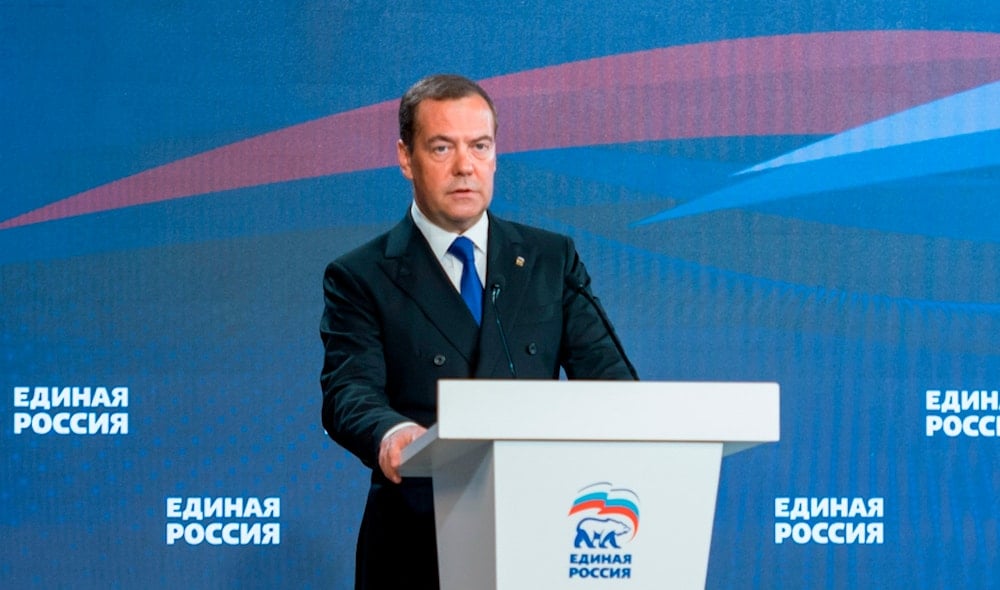
Russian Security Council Deputy Chairman and the head of the United Russia party, Dmitry Medvedev, left, speaks during a joint session of the Supreme Council and the General Council of the United Russia party in Moscow, Russia, June 9, 2021 (AP)
Russian Security Council Deputy Chairman Dmitry Medvedev has declared that even the prospect of Germany acquiring nuclear weapons would constitute a "casus belli" for Moscow, providing grounds for the use of all appropriate response measures outlined in Russia's nuclear deterrence policy, including potential nuclear escalation.
In an article for RT, Medvedev wrote that any scenario in which Berlin obtains nuclear armament would unequivocally trigger Russia's full range of retaliatory options. He said such a development would give Moscow the right to employ every means specified in the Basic Principles of State Policy of the Russian Federation on Nuclear Deterrence.
"It is also worth noting that even the prospect of Germany acquiring nuclear weapons unequivocally constitutes a casus belli, providing grounds for the use of all appropriate response measures set out in the Basic Principles of State Policy of the Russian Federation on Nuclear Deterrence," Medvedev wrote.
The senior Russian official also suggested that such exercises could raise similar concerns in the United States, which has been advocating for a new START IV agreement that would include China as a party.
Germany's nuclear ambitions a red line for Moscow
Medvedev's warning comes amid ongoing discussions in Europe about the continent's defense capabilities, fueled by the US-Israeli war on Iran and growing doubts about Washington's commitment to NATO. Some European politicians have floated the idea of Germany developing its own nuclear deterrent or hosting American nuclear weapons more permanently.
Russia has long opposed any expansion of NATO's nuclear capabilities closer to its borders. Medvedev's statement serves as a sharp reminder that Moscow views any nuclear role for Germany as an unacceptable threat requiring a decisive military response, potentially including the use of Russia's own strategic arsenal.
The official's remarks also tie into broader Russian warnings about the destabilizing effects of Western military buildups. Medvedev has previously used stark language to caution NATO against further encroachment, and his latest intervention raises the stakes significantly by explicitly linking a hypothetical German nuclear capability to Russia's nuclear deterrence doctrine.
Russia long viewed Germany as NATO's military bridgehead
Medvedev's latest warning is not made in a vacuum. Senior NATO and German military officials have openly discussed preparing Germany as the alliance's central logistical hub for the eastern flank. Lieutenant General Alexander Sollfrank, head of NATO's Joint Sustainment and Deployment Command, stated at a Bundeswehr conference that up to 800,000 NATO troops and their equipment could be deployed via German territory at short notice in the event of a conflict with Russia.
German officials themselves have expressed concern over the country's military readiness. Inspector General Carsten Breuer admitted that Germany had neglected to prepare for war for too long, leaving the task to others. He warned of a "twilight transition period" where it is not yet war but no longer complete peace.
Chancellor Friedrich Merz has called for a "radical change in mentality" and even suggested reintroducing conscription to address personnel shortages. NATO officials also noted that Russia continues to modernize its armed forces, increasing missile stockpiles, drone production, and troop strength.
From Moscow's perspective, Germany is already being transformed into a formidable staging ground for NATO's potential military operations. The prospect of Berlin now also acquiring nuclear weapons takes that threat to an entirely new level, one that Medvedev has explicitly labeled a "casus belli".


