
Merz says EU must expand to preserve 'global sovereignty'
 3 Min Read
German Chancellor Friedrich Merz calls for further EU expansion, arguing that admitting new members would strengthen the bloc's sovereignty and global influence.
-
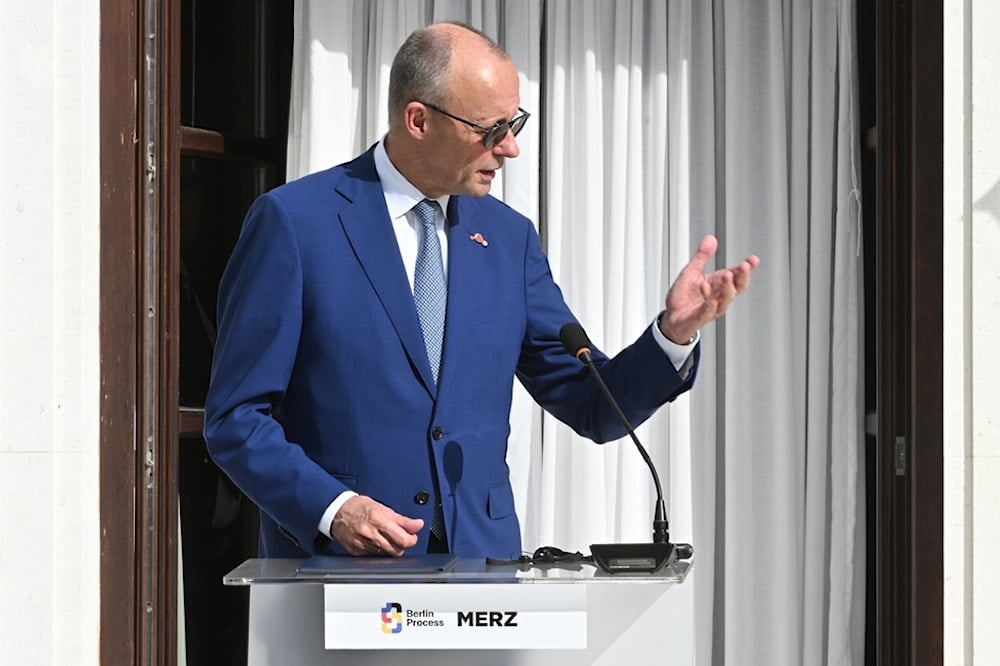
Germany's Chancellor Friedrich Merz speaks during a press conference at the Berlin Process Leaders' Summit in Sveti Stefan, Montenegro, Thursday, Oct. 22, 2026. (AP Photo/Risto Bozovic)
German Chancellor Friedrich Merz has called for further European Union expansion, arguing that the bloc must admit new members to preserve its sovereignty and strengthen its position as a global power.
“We want to preserve the dynamics of the EU's expansion. The EU needs to expand if it wants to uphold its sovereignty in the world and to be seen as a factor of power at the global stage,” Merz said on Thursday following the Berlin Process summit in Montenegro, as reported by RIA Novosti.
Merz stressed that Western Balkan countries seeking EU membership must themselves demonstrate the political will to advance the accession process and implement the necessary reforms.
The summit brought together Western Balkan leaders and European officials as Germany continues to push for enlargement, which has gained strategic importance amid tensions with Russia and concerns over foreign influence in Europe's neighboring regions.
Western Balkans remain central to EU enlargement drive
The Berlin Process, launched by Germany in 2014, seeks to strengthen regional cooperation and accelerate the integration of Albania, Bosnia and Herzegovina, Kosovo, Montenegro, North Macedonia and Serbia into the European Union.
Montenegro is currently the most advanced candidate among the six Western Balkan countries. According to the EU Council, Podgorica has opened all 33 accession negotiating chapters and provisionally closed 21 of them. Albania has also made progress, opening all 33 chapters and provisionally closing four as of October 2026.
Montenegro aims to complete accession negotiations by the end of 2026 and join the EU in 2028. However, its bid faces obstacles, including outstanding reforms and bilateral disputes with Croatia.
Euronews reported on October 16 that Germany was pressing Croatia to resolve disputes with Montenegro that could delay its accession. The disagreements include contested borders, property claims and issues linked to the legacy of the Yugoslav wars. Berlin has sought to prevent these disputes from derailing the broader enlargement process.
Germany pushes for faster integration as EU weighs safeguards
Berlin has also advocated for steps that would bring candidate countries closer to the EU before they obtain full membership. Germany and France have proposed giving aspiring members greater access to EU programs and the bloc's single market during the accession process, according to Reuters reporting in June.
The push comes as EU officials seek to maintain momentum on enlargement while addressing concerns over democratic standards, rule of law and the ability of new members to participate in the bloc's decision-making. In September, Reuters reported that the European Commission was considering safeguards designed to protect the EU against democratic backsliding by future members, including possible restrictions on certain membership rights and a phased approach to integration.
The accession process remains demanding, requiring candidates to align their laws and institutions with EU rules. Membership also requires the approval of all 27 existing member states, leaving bilateral disputes and disagreements within the bloc capable of slowing progress.
For Merz, continued expansion is tied to the EU's ability to act as an influential global power. Yet the bloc faces the challenge of reconciling that strategic ambition with the reforms, political agreements, and unanimous approvals required to bring new members into the union.


