
Netanyahu bolstered Hezbollah; security belt 'illusion': Haaretz
 3 Min Read
Haaretz says US-Iran talks on Lebanon effectively elevated Hezbollah's status and exposed flaws in Netanyahu's policy.
-
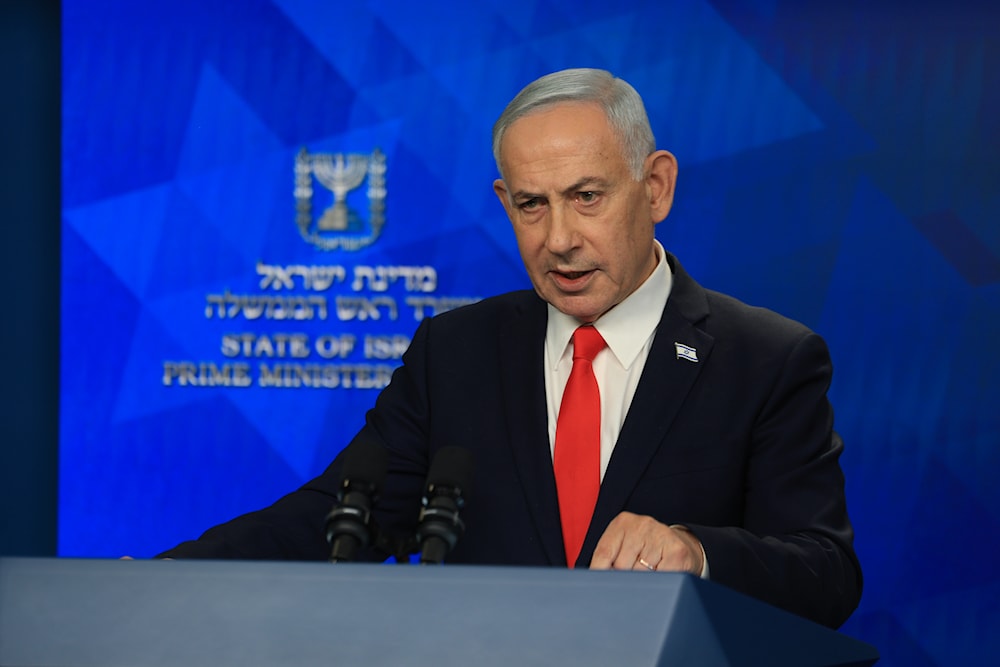
Israeli Prime Minister Benjamin Netanyahu holds a news conference in occupied al-Quds, occupied Palestine, June 15, 2026 (AP)
The main outcome of the recent US-Iran talks in Switzerland has been Washington's de facto recognition of Iran as a partner in implementing a ceasefire in Lebanon, along with implicit acknowledgment of Hezbollah as a party to dialogue with which "Israel" must coordinate its responses, according to the Israeli newspaper Haaretz.
In an editorial titled "Netanyahu Strengthened Hezbollah," the paper argued that this development follows months of Prime Minister Benjamin Netanyahu's refusal to engage in "genuine" talks with the Lebanese government. These talks would have required mutual steps and concessions from both sides. Instead, the editorial charged, Netanyahu has "once again bolstered the extremists while weakening the moderates."
Haaretz further warned that Netanyahu has placed "Israel" at a perilous crossroads. On the one hand, a withdrawal from Lebanon would grant Hezbollah greater national legitimacy and crown Iran's achievements as a "complete and real victory." On the other, continued occupation of Lebanese territory could deepen, or complete, the rift with the US administration.
The editorial suggested that the least damaging option would be a gradual, yet complete, withdrawal from Lebanon, this time with full coordination with the Lebanese government, while seeking to reward Beirut rather than Hezbollah wherever possible.
Haaretz also asserted that "Israel" cannot guarantee the safety of its settlers through territorial control and occupation of lands that do not belong to it, while dismissing the concept of "security belts" as an illusion, arguing that their cost has proven far higher than their benefit.
Such approaches, it concluded, are no substitute for building relations based on agreements with regional states and for mending the fracture with the United States.
Iran, US reach new framework to guarantee Lebanon's sovereignty
This closely follows talks between Iran and the United States in Switzerland; the first round of talks since reaching an agreement mediated by Pakistan on June 22. Among the key agreements were a Lebanon ceasefire monitoring mechanism, coordinated frozen Iranian assets release arrangements, and temporary sanction relief on the energy front.
Speaking on the outcome of the talks, Ghalibaf said the two sides established coordination frameworks explicitly aimed at supporting Lebanon's sovereignty and territorial integrity, alongside mechanisms to manage on-the-ground arrangements following any cessation of hostilities.
According to the top Iranian official, the talks produced an agreement to set up joint coordination centers tasked with facilitating the return of displaced Lebanese civilians and overseeing the withdrawal of Israeli forces occupying Lebanese territory.
Ghalibaf further noted that a separate monitoring mechanism would be responsible for tracking and investigating potential violations of any ceasefire agreement in Lebanon, ensuring a structured and verifiable response to disputes as they arise.
The parliament speaker also confirmed that procedural arrangements had been made for potential future meetings with US Vice President JD Vance, should the need arise. Such meetings, he explained, would be aimed at following up on the memorandum of understanding and resolving outstanding disagreements between the parties.
Ghalibaf described these communication channels as part of an ongoing coordination process designed to sustain dialogue and prevent escalation, signaling that both sides, at least for now, appear committed to keeping the diplomatic track open.


