
Netanyahu faces criticism after Trump blocks Beirut strike
 5 Min Read
Benjamin Netanyahu faced mounting criticism after Donald Trump reportedly pressured him to abandon plans for a major strike on Beirut amid escalating tensions with Hezbollah.
-
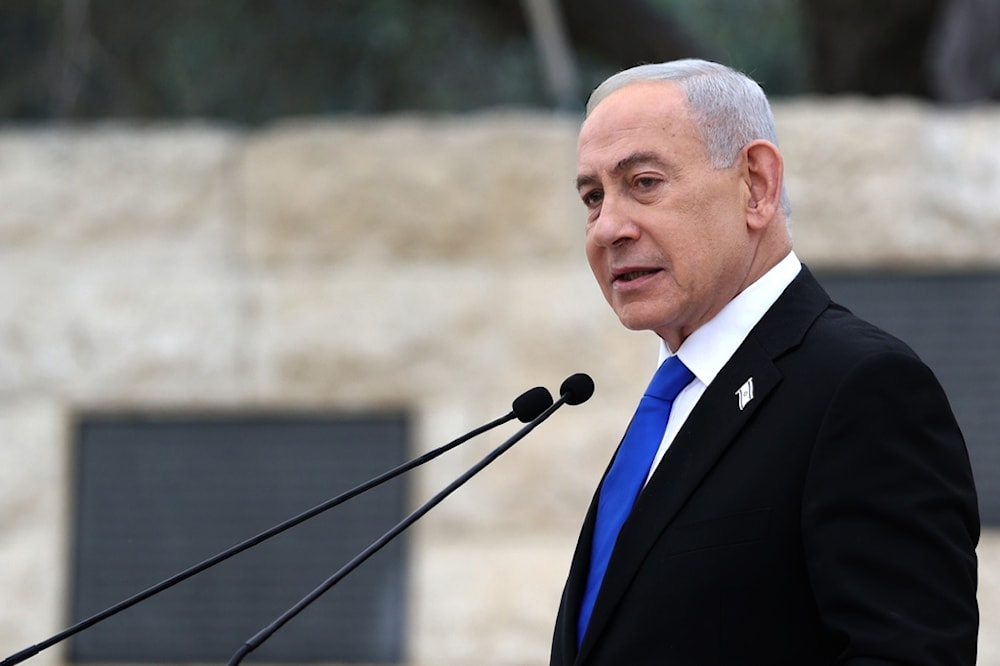
"Israel's" Prime Minister Benjamin Netanyahu attends a ceremony at the cemetery in Occupied Al-Quds, April 21, 2026. (Ilia Yefimovich/Pool Photo via AP)
Israeli Prime Minister Benjamin Netanyahu has come under increasing political pressure after reportedly backing away from threats to launch major strikes on Beirut after US President Donald Trump confronted him on a phone call.
The episode has triggered criticism from both opposition figures and members of Netanyahu's own coalition, with rivals accusing him of yielding to US pressure instead of continuing to target Lebanon.
Tensions surged after Netanyahu announced that he had instructed the military to target sites in Beirut in response to Hezbollah drone operations against northern occupied Palestine.
Iran also sent threats to retaliate against "Israel" if it moved forward with attacking the Lebanese capital.
"Given the regime's repeated violations of the ceasefire, should this threat [against Lebanon] be carried out, we warn the residents of the northern areas and the military settlements in the occupied territories: if you do not wish to be harmed, leave the area," The Commander of Iran’s Khatam al-Anbiya General Headquarters, Ali Abdollahi, said on Monday.
The Israeli threat to Beirut raised fears of a major escalation in Lebanon, where Hezbollah has been resisting increased Israeli aggression despite a ceasefire being announced in April.
Trump stated that he had urged Netanyahu to abandon plans for a "major raid," claiming the Israeli premier subsequently reversed course.
"[Hezbollah] agreed to stop shooting at 'Israel' and its soldiers. Likewise, 'Israel' agreed to stop shooting at them," Trump wrote on Truth Social. "Let's see how long that lasts — Hopefully it will be for ETERNITY!"
The development was widely interpreted inside the occupation entity as a public demonstration of Washington's influence over Israeli military decision-making.
Read more: You're f****** crazy: Trump scolds Netanyahu for Lebanon escalation
Netanyahu faces backlash across political spectrum
Netanyahu's retreat from the threatened attack drew immediate criticism from political opponents who portrayed the move as evidence of weakening leadership.
Former Israeli Prime Minister Naftali Bennett accused Netanyahu of undermining what he described as Israeli sovereignty by yielding to external pressure.
Israeli opposition leader Yair Lapid also attacked the prime minister, accusing him of leading a "vassal state."
Meanwhile, former Israeli occupation army Chief of Staff Gadi Eisenkot criticized Netanyahu for accepting what he characterized as a humiliating demand from Washington.
The backlash reflects growing dissatisfaction among sectors of the Israeli public and political establishment over the government's inability to achieve its stated objectives against Hezbollah despite months of military operations.
Coalition allies urge escalation against Hezbollah
Criticism also emerged from within Netanyahu's own governing coalition.
Israeli Police Minister Itamar Ben-Gvir publicly urged the prime minister to disregard Trump's demands and intensify the aggression against Hezbollah.
"You said that a strong prime minister tells the President of the United States — 'yes' when possible, and 'no' — when necessary. This is the time to tell our friend, President Trump — 'no'," Ben-Gvir wrote.
He called for expanding military operations in southern Lebanon, arguing that stronger action was necessary to restore security in settlements in northern occupied Palestine.
Lebanon front strains wider regional ceasefire efforts
The dispute comes as Hezbollah has resisted a total Israeli invasion since the US-announced ceasefire in April.
Over recent days, Israeli occupation forces have expanded operations deeper into southern Lebanon and issued evacuation orders affecting hundreds of thousands of Lebanese civilians.
At the same time, Hezbollah has continued operations targeting Israeli military positions and settlements in northern occupied Palestine, causing a number of casualties among the ranks of the invading Israeli occupation forces.
Lebanon's National News Agency reported multiple Israeli airstrikes on southern Lebanese towns on Tuesday, including Jebchit and Ansar. Lebanon's Civil Defense also reported that an Israeli strike directly hit one of its centers in Kfar Sir in the Nabatieh district, causing damage to the facility.
Read more: Ghalibaf to Berri: Any Iran-US agreement must end war on Lebanon
Iran links truce talks to Lebanon and Gaza
The developments also affected broader regional diplomacy. Iranian media reported that Tehran suspended discussions with Washington regarding the extension of a separate US-Iran ceasefire amid continued Israeli military operations in Lebanon and Gaza.
Iran has repeatedly stressed that any long-term arrangement with the United States must include a cessation of Israeli aggression against both Lebanon and Gaza.
Following his intervention in Lebanon, Trump stated that negotiations with Tehran were continuing and claimed progress was being made toward extending the ceasefire and reopening the Strait of Hormuz.
He later told ABC News that he expected an agreement to be reached within days.
Tehran is currently mulling over the final draft of a potential memorandum of understanding related to the war on the Islamic Republic, ensuring extra caution as an official told Mehr that "the United States' bad history of not keeping its promises."


