
Netanyahu is addicted to war, remaining in power: Israeli media
 3 Min Read
Israeli reports say Israeli Prime Minister Benjamin Netanyahu faces political decline, weakened polls, and growing isolation after the war on Iran.
-
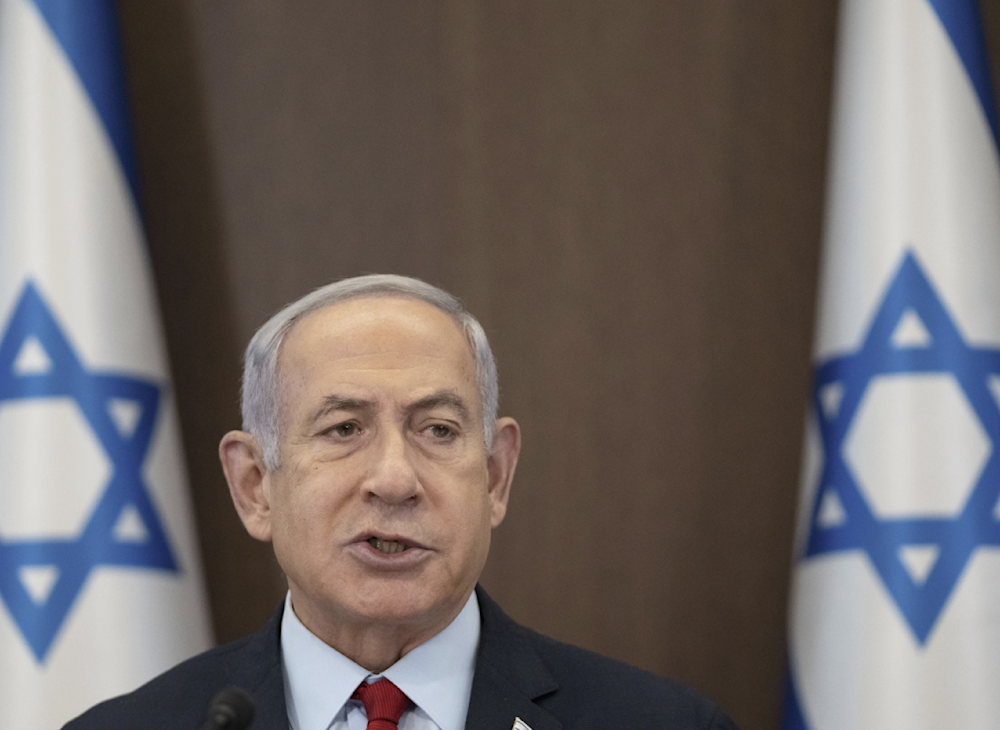
Israeli Prime Minister Benjamin Netanyahu chairs a cabinet meeting at the prime minister's office in occupied al-Quds, on June 18, 2023. (AP)
Israeli media reports indicate that Israeli Prime Minister Benjamin Netanyahu is facing growing political and international pressure, with commentators attributing his recent “hallucinatory” rhetoric to deepening isolation and the failure to achieve a decisive military outcome against Iran.
According to weekend polling cited in the reports, Netanyahu’s position has significantly weakened:
- Loss of seats in the Knesset
- A shrinking governing coalition
- Rising support for Naftali Bennett
The polls were described as “disastrous,” reflecting a broader erosion of Netanyahu’s political base.
Criticism of leadership and decision-making
Some Israeli commentary stated that "Israel" is now led by a figure driven by severe delusion and an unchecked drive to remain in power, warning that he is effectively “addicted to war” and sacrificing public interest for political survival.
Additional reports claim Netanyahu’s policies have contributed to growing international isolation for “Israel,” with increasing criticism on the global stage.
They also point to:
- Rising international condemnation
- Potential legal exposure over war crimes
- Strained diplomatic standing
Claims regarding US involvement
Reports stressed that Netanyahu played a role in drawing US President Donald Trump into the war, leaving Washington politically strained both domestically and internationally.
Israeli media coverage reflects mounting concern over Netanyahu’s leadership, highlighting political decline in "Israel" and expanding isolation abroad following the war on Iran.
Israeli media detail 'Israel’s' failed Iran war objectives
Amir Oren, a senior correspondent and columnist for Haaretz, argued in a report that "Israel" failed to achieve the objectives of its war on Iran, noting that Prime Minister Benjamin Netanyahu “will not pay out of his own pocket for the absolute failure of this war.”
He identified three core dimensions of failure: “the regime that was not toppled, the buried nuclear program that was not dismantled, and the Strait was not opened,” adding that everything else amounts to little more than “stories and excuses.”
In detail, Oren revealed that “they have failed—the regime held on, and the nuclear project still exists (which would not have happened had it not been for Trump’s breach of Barack Obama’s agreement, encouraged by Netanyahu), while the maritime blockade shocked Trump.”
He further explained that the Israeli Air Force’s efforts to degrade Iran’s military capabilities and “push back the starting line of the next round” did not produce meaningful results, since “the objectives of the responsible leadership were not achieved.” He stressed that “victory or defeat are not measured by the number of corpses or destroyed vehicles.”
By contrast, Oren argued that the only absolute truth was “the strike on the home front and the depth,” referring to the Israeli front that Netanyahu, in his view, neglected throughout his tenure while pursuing confrontation with Iran. He also pointed to "Israel’s" broader strategic depth, “stretching from New York to California through the administration, Congress, political parties, and public opinion,” according to Oren.


