
War on Iran cripples US arsenal, deepens China dependence: Politico
 4 Min Read
The war on Iran has drained US missile defense capabilities and exposed Washington’s reliance on China-controlled critical minerals, deepening its strategic vulnerability.
-
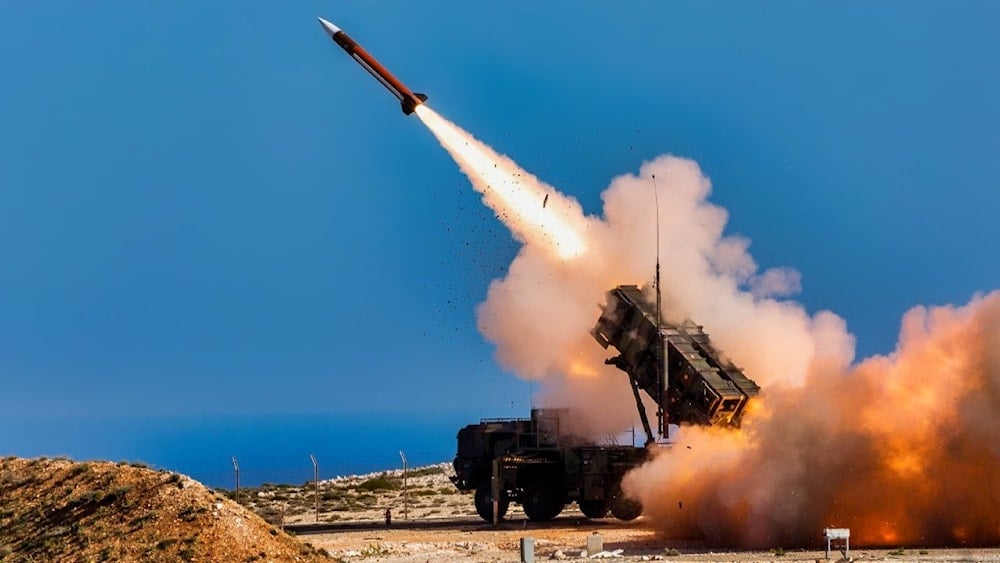
German soldiers assigned to Surface Air and Missile Defense Wing 1 fire the Patriot weapons system at the NATO Missile Firing Installation (NAMFI) during Artemis Strike Nov. 7 in Chania, Greece (German Air Force)
The war on Iran has significantly backfired by exposing structural weaknesses in US military power, draining its advanced defense systems, and placing Washington in a position of strategic dependence on its global rivals, Politico reported on Thursday.
According to the report, sustained Iranian defensive operations on US positions in the region have degraded key radar and missile defense infrastructure, forcing the United States to expend large numbers of interceptors to defend its assets. This dynamic has rapidly depleted US stockpiles, revealing the limits of its ability to sustain high-intensity conflict.
Rather than weakening Iran, the war has underscored the resilience of its military posture and its capacity to impose costs on a technologically superior adversary, according to Politico. Analysts note that Iranian retaliatory operations targeting radar and communication systems have complicated US defensive capabilities, increasing the number of interceptors required per incoming threat and accelerating the exhaustion of American reserves.
At the same time, efforts to rebuild these systems have highlighted a deeper vulnerability: the United States’ reliance on supply chains it does not control. A key component in advanced missile defense systems is gallium, a critical mineral essential for radar and interception technologies. China dominates the global processing of gallium, giving Beijing significant leverage over Washington at a moment of heightened demand.
“Broadly does it make us more vulnerable? Yes, I think so,” said Mikhail Zeldovich, an investor focused on critical minerals. “I don’t think there’s any doubt there.”
China gains leverage
This dependency comes as prices for gallium have surged by more than 30 percent in recent weeks, reflecting both increased demand and the geopolitical tensions surrounding supply. China has previously demonstrated its willingness to restrict access to critical minerals, using its near-monopoly to influence negotiations with the United States.
“The minute you look like a demander and there’s things you want, then this relationship is at that point where the other side, then, is smelling leverage, right?” said Wendy Cutler, a former USTR negotiator. “And so [Beijing] can up their demands.”
Beyond gallium, other rare earth elements central to US weapons systems, such as terbium and dysprosium, are also overwhelmingly processed in China, further constraining Washington’s ability to rapidly rebuild its military capacity. Experts warn that disruptions to these supply chains risk creating bottlenecks across the US defense industry.
“Disrupting those supply chains can create new bottlenecks in the defense industry supply chains, which we already have enough challenges in meeting demand within our defense industry,” said Brian Hart, the deputy director and fellow of the China Power Project at the Center for Strategic and International Studies. “So adding on critical mineral bottlenecks there just complicates things a lot.”
Strategic backfire
The broader geopolitical consequences are already becoming apparent. The war has not only strained US military resources but also strengthened the strategic position of both Iran and China.
Tehran has demonstrated its ability to withstand sustained pressure while continuing to influence regional dynamics, including maintaining leverage over critical routes such as the Strait of Hormuz. Meanwhile, Beijing stands to benefit from increased US dependence on its controlled supply chains, a dynamic analysts say enhances China’s bargaining power in upcoming negotiations.
Recent analyses suggest the conflict may ultimately represent a strategic miscalculation by Washington, with limited gains and mounting costs. Critics argue that the war has failed to achieve its stated objectives while instead diverting US resources, weakening alliances, and empowering its adversaries.
Vulnerability deepens
As the United States enters a fragile ceasefire and begins assessing the damage, it faces a dual challenge: rebuilding depleted military capabilities while attempting to reduce reliance on adversarial supply chains. However, efforts to develop alternative sources for critical minerals are expected to take years, leaving Washington exposed in the near term.
“In the medium to short term, I think we’re still going to be in a position where China can leverage this dominance in some of these critical minerals,” said Hart. “And I think that Beijing has been successful in doing that.”
Read more: 37 days of war on Iran cost US staggering $42bln, tracker shows


