
No decision made yet over contradictory US messages, behavior: Baghaei
 4 Min Read
Iran says it has not decided on joining Islamabad talks, citing US contradictory actions, maritime violations, and lack of tangible diplomatic outcomes.
-
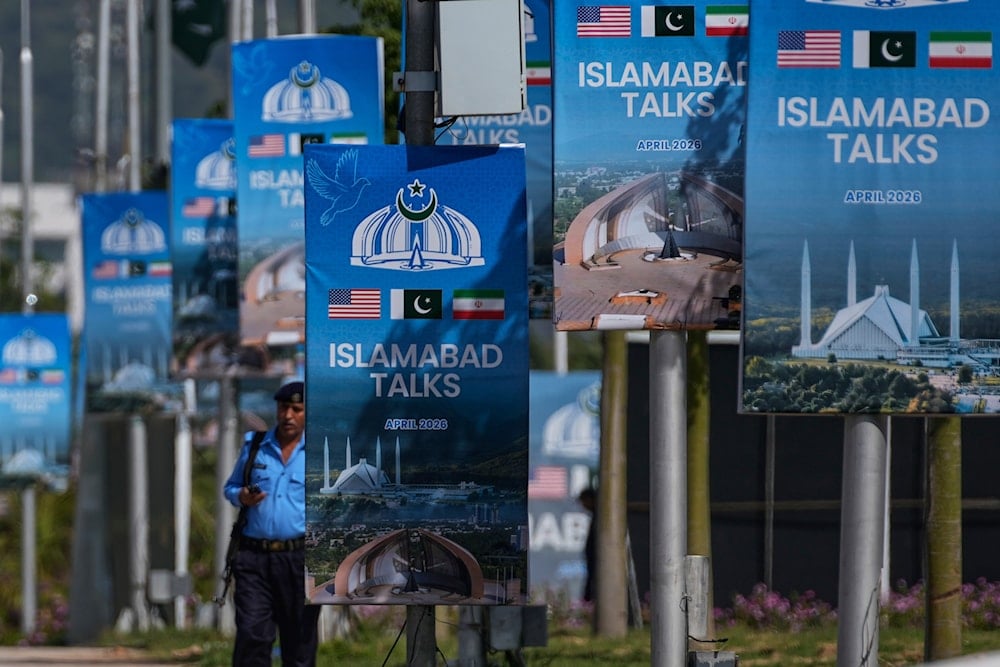
A police officer walks past billboards near the Serena Hotel ahead of the second round of negotiations between the US and Iran, in Islamabad, Pakistan, April 21, 2026 (AP)
Iran has not yet made a final decision on whether to participate in the Islamabad talks, according to Foreign Ministry spokesperson Esmaeil Baghaei, who said the delay stems from the contradictory messaging and conduct by the United States.
In remarks he made to the Iranian state TV, Baghaei said that “no final decision has been made regarding participation or non-participation in negotiations in Pakistan,” adding that “the reason is not an inability to make a decision, but rather the contradictory messages, conflicting behavior, and unacceptable actions from the American side.” He also described the recent US attack and hijacking of an Iranian vessel “a blatant violation of international law, maritime piracy, and state terrorism.”
He added that Iran’s approach to diplomacy is strictly results-based, saying that “whenever negotiations become result-oriented and produce tangible outcomes, Iran will decide on its participation.”
He also stressed that “simply going back and forth is not, in itself, a criterion for the success of a process, nor does it have inherent value,” adding that decisions are taken carefully after assessing all dimensions of the matter.
Ceasefire undermined from the start by US violations: Baghaei
Baghaei added that from the outset, ceasefire arrangements had been undermined by breaches by the United States, noting that although the ceasefire in Lebanon was meant to be part of the agreement, it was not implemented despite earlier understandings outlined in initial statements.
He said that after negotiations held in Islamabad, it was agreed that the other side would fulfil its commitments, while Iran would also proceed with its obligations. He added that the Iranian foreign minister later confirmed this framework, but the response from Washington was: “We thank Iran very much, but we will continue the naval blockade.”
Baghaei stated that the naval blockade is unlawful, asserting that it represents “a violation of international law according to international legal standards and a clear breach of the ceasefire understanding.”
He added that continued attacks on Iranian vessels reflect ongoing contradictory behavior, saying that “the behavior of the United States places its intentions and seriousness in its claims of diplomacy under major suspicion.”
He also said that “despite the losses and injuries, the other party did not achieve its goals, and the resilience of the people was the decisive factor,” adding that “US diplomatic claims are not in line with its field behavior and are aimed at influencing public opinion.”
Baghaei further emphasized that Iran has consistently honored its commitments, noting that it remained fully compliant for a year after the United States withdrew from the nuclear agreement.
Negotiations under threat not possible
On his part, Deputy Speaker of the Iranian Parliament, Hamid-Reza Haji Babaei, stated that negotiations with the United States under threats and intimidation are not possible.
"US greedy ambitions cannot be negotiated," he asserted.
Haji Babaei further stressed that the US "refuses to meet the demands of the Iranian people, so it must be compelled to yield and accept them."
Naderi dismisses reports of an Iranian delegation in Islamabad
Separately, Iranian lawmaker Ahmad Naderi dismissed reports of an Iranian delegation being present in Pakistan, calling them false.
Naderi added that the United States and its allies should pay war compensation and asserted that the Strait of Hormuz falls within Iranian territorial waters, where “our rules will prevail.”
He further emphasized that transit through the Strait will be subject to fees collected in Iranian rials, saying that “these fees will be permanent,” and asserted that the United States' naval blockade on Iran is an act that would fail despite external pressure.
Meanwhile, Iranian affairs analyst Mujtaba Heidari told Al Mayadeen that no Iranian political or media delegation has travelled to Islamabad, contradicting circulating media reports.


