
No immediate threat of war between Iran and US, Turkey FM claims
 4 Min Read
Foreign Minister Hakan Fidan stresses diplomacy over confrontation in US-Iran tensions, calls for unity on Syria and regional stability.
-
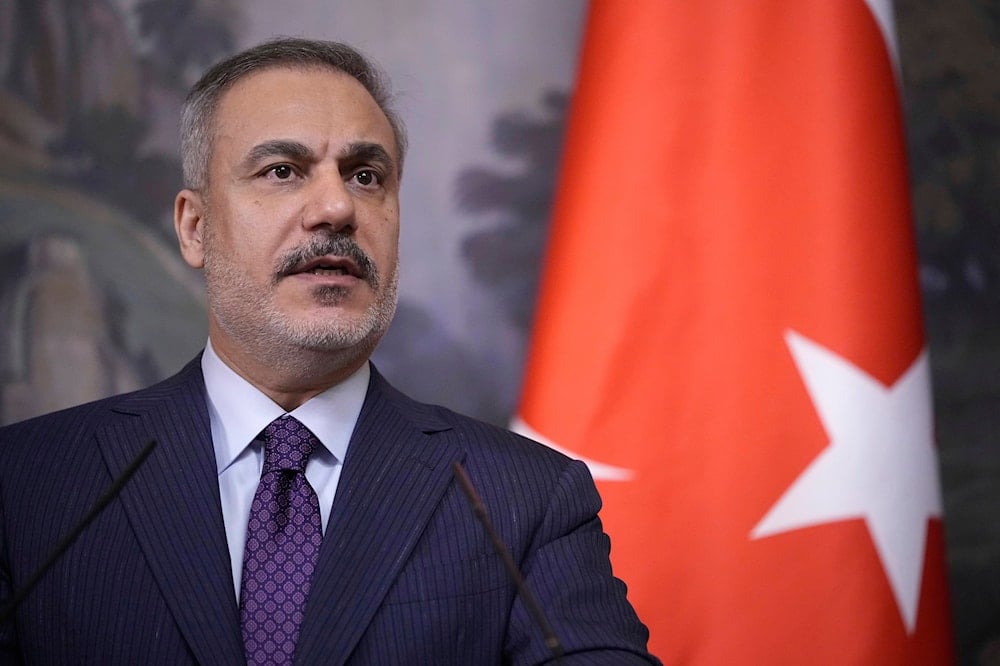
Turkish Foreign Minister Hakan Fidan speaks during a joint news conference following a meeting with Russian Foreign Minister Sergey Lavrov in Moscow, Russia, Tuesday, May 27, 2025 (AP)
There is no immediate threat of a military confrontation between Iran and the United States, Turkish Foreign Minister Hakan Fidan said on Monday, emphasizing the importance of diplomacy following recent mediated talks between the two sides.
Speaking during a live broadcast, Fidan underlined Ankara’s support for a creative and constructive diplomatic approach, noting the emergence of a more positive atmosphere after long-stalled US-Iran contact as significant for Ankara.
He said both parties appear willing to seek a peaceful solution. “We need to find a creative solution, and we see that both sides have the will to resolve the issue. For now, it seems there is at least no immediate threat of war,” Fidan stated.
The foreign minister added that Turkey views the Iran file as a key priority and is committed to preventing another regional war. He noted that President Recep Tayyip Erdoğan is closely following the matter.
Risks remain
Fidan confirmed that Iranian and US officials held rare talks in Oman two days prior, during which Iran’s Foreign Minister Abbas Araghchi updated counterparts on the discussions. He stated that although war does not appear imminent, the dynamics remain tense, referencing recent military deployments by the US, such as major fleets, bombers, and strategic assets.
Iran, on the other hand, has advocated for diplomacy but asserted its military strength and missile power in the face of any aggression.
“This is about demonstrating strength and being prepared,” he said, noting that any confrontation would come at a high cost to all involved.
Regarding the nuclear issue, Fidan said he relayed Turkey's views to both the US and Iran, proposing a framework to encourage progress.
Iran’s position and revolutionary structure explained
Responding to a question on the possibility of regime change in Iran through US airstrikes, Fidan dismissed the idea as “an empty dream.” He argued that change in Iran cannot come through military intervention, but rather through internal challenges affecting governance.
Fidan claimed that Iran is enriching uranium at levels that raise concern but insisted there is no evidence Tehran intends to build a nuclear weapon. “They are not producing a bomb, nor is there evidence they intend to, but they are enriching uranium to a level that raises concern,” he clarified.
He noted that Iran’s revolutionary leadership continues to operate according to the principles of the 1979 revolution, rather than adopting a standard nation-state model, which contributes to long-standing structural challenges.
Iran maintains that its nuclear program is peaceful and that Tehran does not intend to develop a nuclear bomb.
Turkey’s mediation proposal for Oman talks
Fidan recalled that during the 12-day June war, the US had warned Turkey of a possible escalation “within hours,” even as negotiations were scheduled. “The US was the one talking; Israel was the one striking,” he said, but added that conditions might differ this time.
Ankara has proposed a more direct negotiation method between US and Iranian officials, advocating for face-to-face dialogue. However, Iran has opted to maintain the current mediation format in Oman.
He confirmed that Turkey remains in close contact with regional players, including Qatar, Saudi Arabia, Egypt, and the United Arab Emirates, who have all expressed interest in supporting a diplomatic solution. “We suggested showing the same kind of solidarity on the Iran issue,” Fidan said, referencing regional unity achieved on the Palestine file.
Regional cooperation on the Syria file
Highlighting the need for enhanced cooperation platforms, Fidan stressed that restoring trust among regional countries is essential. He noted that Erdoğan supports institutionalizing solidarity across military, political, and economic areas and that several proposals are under active discussion.
On Syria, Fidan reaffirmed Turkey’s stance in support of the country’s unity and territorial integrity. He underlined the importance of resolving conflicts through dialogue, not bloodshed. He noted progress with the withdrawal of the PKK’s Syrian offshoot, YPG, from some areas, but said more steps are needed.
Read more: Syria, Turkey sign joint defense cooperation agreement


