
No Iranian official asked to delay arms control move: Iraqi president
 6 Min Read
Iraqi President Nizar Amedi says Baghdad will keep Iraq out of the US-Israeli war on Iran while asserting that placing all arms under state control is a sovereign Iraqi decision that Tehran has not opposed.
-
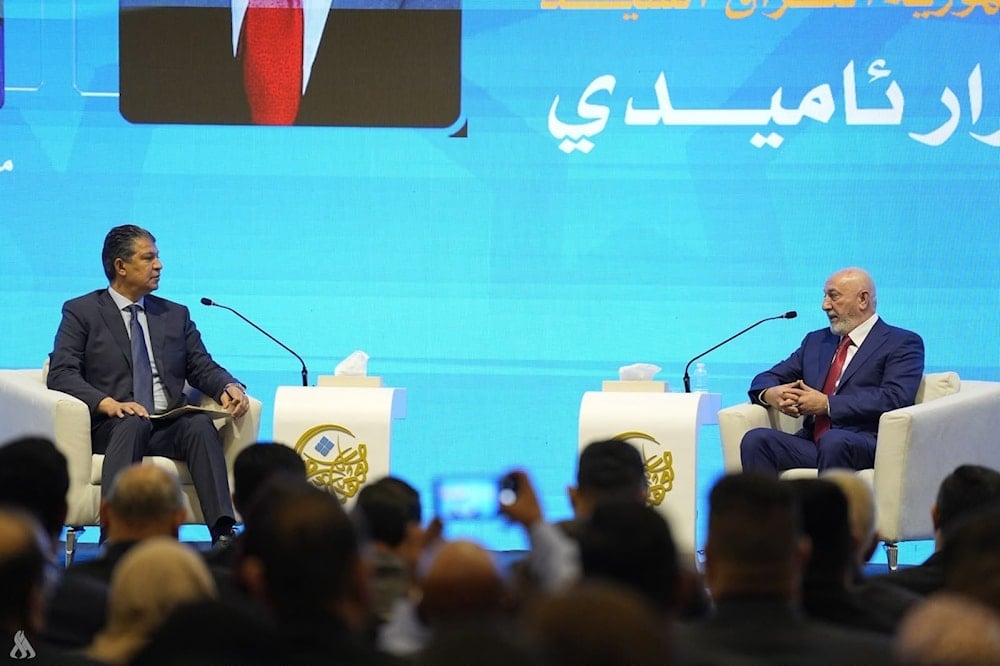
Iraqi President Nizar Amedi during a dialogue session moderated by Iraqi Media Network (IMN) head Karim Al-Hammadi on the sidelines of the Eighth Baghdad Dialogue Conference in Baghdad.
Baghdad is working to shield the country from the repercussions of the US-Israeli aggression on Iran, Iraqi President Nizar Amedi said Saturday, while stressing that efforts to bring all weapons under state authority are an internal Iraqi matter free from foreign dictates, the Iraqi News Agency (INA) reported.
The comments came as the war launched against neighboring Iran continues to reverberate across West Asia, where Tehran has retaliated against "Israel" and US military assets deployed in several countries, raising concerns in Baghdad that Iraq could be pulled into a widening confrontation.
Speaking during the Eighth Baghdad Dialogue Conference in a session moderated by Iraqi Media Network (IMN) Head Karim al-Hammadi, Amedi said Iraqi authorities were united around preventing such an outcome.
“Everyone is keen to prevent Iraq from being drawn into the ongoing war in the region,” he said, adding that “after Iran, Iraq is among the countries most affected by the war.”
Baghdad has sought to maintain channels with all sides while emphasizing that Iraqi sovereignty and national interests must take precedence as the conflict unfolds on its borders.
“Iraq speaks frankly with all countries, emphasizing that Iraq comes first,” Amedi said, while underlining “the need to prevent Iraq from being drawn into the ongoing war in the region, and that the decision to place all arms under state control is an Iraqi decision that involves no external interference or confrontation.”
Iran affirms arms issue is Iraq's internal decision
Amedi said Baghdad has also discussed the sensitive arms file directly with Tehran, amid attempts to portray efforts to place weapons under state control as being directed against factions with close relations to Iran.
He said “talks were held with Mohammad Bagher Ghalibaf Speaker of the Parliament of Iranand messages were conveyed to Iran regarding a review of the relationship between the two countries,” adding that “Iranian officials confirmed that the decision to place all arms under state control is an Iraqi decision, and no Iranian official has asked for this issue to be delayed.”
The remarks indicate that Tehran has not sought to block Baghdad's initiative, even as Iraq navigates the pressures created by the US-Israeli war on Iran and the risk of its territory becoming another arena of confrontation.
According to Amedi, Prime Minister Ali al-Zaidi has sought broader political backing for bringing weapons under the authority of the Iraqi state.
He said “the Prime Minister asked the State Administration Coalition to support placing all arms under state control,” stressing that “the Constitution requires that arms be held exclusively by the state, and that the religious authority also calls for this.”
Amedi further said “some factions have responded to the government’s request and handed over their weapons,” while reiterating that “Iraq does not accept the use of its territory to attack any country, and everyone wants arms to be held exclusively by the state.”
That position takes on particular significance as Baghdad attempts to prevent Iraqi soil from being used either as a launchpad for attacks or as a target for retaliation amid the wider confrontation.
Amedi separately excluded the Peshmerga from the arms-control initiative, describing it as “a constitutionally recognized institution that operates in the Kurdistan Region and is not a party to the issue of placing arms under state control.”
War on Iran hits Iraqi oil exports
Beyond the security implications, Amedi highlighted the economic pressure the war has placed on Iraq, particularly through disruption to oil transport in and around the Strait of Hormuz.
He pointed to “a problem with transporting oil due to the absence of a national carrier,” adding that “some vessels carrying Iraqi oil are being facilitated through the Strait of Hormuz, which has an impact on the entire world, not just Iraq.”
Iraq depends heavily on crude exports, much of which must pass through the strategic waterway, leaving Baghdad particularly exposed to disruptions caused by the war and the restrictions affecting maritime traffic.
Addressing attempts to end the conflict, Amedi said, “The United States wants an agreement to end the war.”
US-led coalition withdrawal remains set for September 30
The Iraqi president also addressed the continued presence of the US-led international coalition, reiterating that Baghdad no longer considers the mission necessary following its deployment against ISIS.
He said, “The international coalition came at Iraq’s request to confront the terrorist ISIS group, and Iraq no longer needs it, its withdrawal will take place on September 30.”
The issue of foreign forces has gained renewed importance during the war on Iran, as US military deployments throughout the region have become potential targets of Iranian retaliation and have increased concerns among regional governments over being drawn into the confrontation.
Turning to northern Iraq, Amedi acknowledged the continued Turkish military presence and said Baghdad is pursuing a settlement involving Ankara and the Kurdistan Workers’ Party (PKK).
“There is a Turkish presence in northern Iraq, and Iraq wants to establish peace with Turkey and the Kurdistan Workers’ Party (PKK),” he said.
Baghdad stresses internal stability
On domestic affairs, Amedi linked Iraq's internal stability to the security of the broader region, arguing that unresolved political and economic issues must also be addressed as Baghdad confronts the external pressures created by the war.
“The current government has begun resolving all outstanding issues and is moving toward addressing the economic file,” he said, stressing that “there can be no security in the region without the security and stability of Iraq.”
Amedi identified the long-delayed Oil and Gas Law as one of the country's most pressing unresolved legislative issues, saying, “The most important law is the Oil and Gas Law” and noting that “it has been a source of problems between Baghdad and Erbil.”
He also condemned the attempted targeting of Supreme Judicial Council President Judge Faiq Zidan, saying, “The attempt to target Supreme Judicial Council (SJC) President Judge Faiq Zidan constitutes a terrorist act and sets a dangerous precedent.”
On the general amnesty file, Amedi said, “The Presidency sends the files of the general amnesty to the judiciary, which is the body that considers whether or not they are included,” adding that “14,000 people sentenced to death have been in prisons since 2006.”
Read more: Ghalibaf, Al-Aboudi discuss security ties, arms control in Baghdad


