
Norway mourns Harald V as Haakon VIII takes throne amid royal turmoil
 5 Min Read
Norway is mourning King Harald V as Haakon VIII assumes the throne amid heightened scrutiny of the royal family over Queen Mette-Marit’s past ties to Jeffrey Epstein.
-
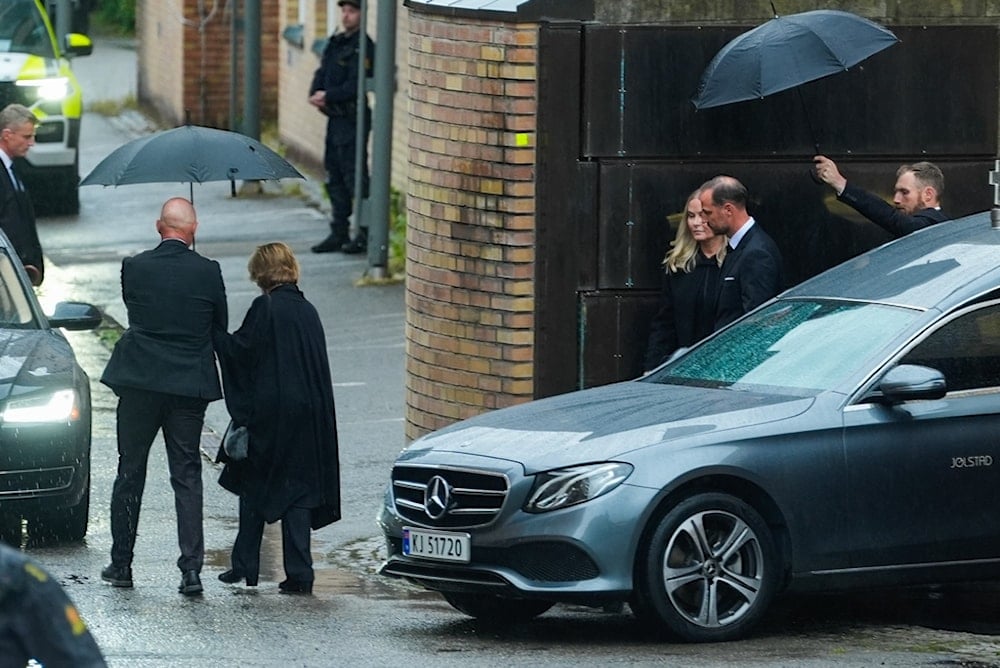
Queen Sonja, King Haakon and Queen Mette-Marit walk to the car as King Harald V's bier leaves the national hospital in Oslo on August 28, 2026 (AP)
Norway has entered a period of national mourning following the death of King Harald V, bringing an end to a 35-year reign and placing his son, Haakon VIII, at the head of a monarchy facing one of its most turbulent periods in decades.
Harald died at Oslo’s Rikshospitalet at 6:35 am on Friday at the age of 89, according to the Norwegian Royal House. He had been hospitalized earlier this month and was subsequently treated with antibiotics for a bacterial infection in his blood before his condition deteriorated.
His death automatically made his 53-year-old son Norway’s new monarch under the country’s constitutional rules.
Hours later, Haakon appeared before an extraordinary Council of State at the Royal Palace, formally informing Prime Minister Jonas Gahr Støre and the cabinet of his father’s death and announcing that he would reign as King Haakon VIII.
He also confirmed that he would retain the royal motto used by Harald and previous Norwegian kings: “Alt for Norge,” or “Everything for Norway.”
Haakon thanked the government and the Norwegian public for the support and sympathy shown to the royal family following his father’s death. His daughter, 22-year-old Ingrid Alexandra, attended the meeting alongside him and has now become crown princess and first in line to the throne.
Thousands pay tribute as national mourning begins
Public tributes have continued across Norway, with people gathering near the Royal Palace in Oslo and leaving flowers, candles and messages in memory of Harald.
His coffin was transferred from Rikshospitalet to the Royal Palace on Friday evening, accompanied by Haakon, Queen Mette-Marit, Crown Princess Ingrid Alexandra, Queen Sonja and other members of the royal family.
Flags at royal residences, government buildings and military installations have been lowered to half-mast as part of a national mourning period that will remain in force until Harald’s funeral.
The government has confirmed that the funeral will be held at Oslo Cathedral, although a date has yet to be announced. Members of the public will also be given an opportunity to pay their respects while Harald lies in state in the Palace Chapel.
Haakon is meanwhile scheduled to appear before Norway’s parliament, the Storting, on September 1 at 1 pm, where he will take the constitutional oath required of the monarch. Norway no longer holds coronations, having abandoned the practice more than a century ago.
Harald had occupied the throne since January 1991, following the death of his father, King Olav V.
Despite repeated health problems in later life, including bladder cancer, heart procedures and the implantation of a pacemaker in 2024, he consistently rejected the possibility of abdication.
His reign was associated with efforts to make the monarchy more accessible to the public, and he remained one of the royal family’s most popular figures even as controversies increasingly surrounded other members of the household.
Epstein controversy follows Mette-Marit into queenship
Haakon’s accession also means his wife, Mette-Marit, has become Queen of Norway, placing renewed attention on her past relationship with late US financier and convicted sex offender Jeffrey Epstein.
Documents released by the US Justice Department earlier this year reportedly contained nearly 1,000 references to Mette-Marit, including numerous email exchanges showing that she remained in contact with Epstein between 2011 and 2014.
The communications took place years after Epstein had pleaded guilty in Florida in 2008 to charges involving the solicitation of a minor for prostitution.
The disclosures triggered a major controversy in Norway, particularly after correspondence suggested a relationship considerably more extensive than had previously been publicly understood.
Mette-Marit acknowledged that maintaining contact with Epstein had demonstrated poor judgment and publicly apologized for the relationship.
In a televised interview in March, she said she had been “manipulated and deceived” by Epstein and expressed regret over any legitimacy her association may have afforded him. She denied having had an intimate relationship with him.
The controversy became serious enough for Støre to publicly criticize the then-crown princess’s judgment and call for further explanations — an unusual intervention by a Norwegian prime minister concerning a senior member of the royal family.
Her elevation to queen therefore places the issue closer to the center of the institution just as Haakon begins his reign.
The royal family has faced additional pressure surrounding Mette-Marit’s son from a previous relationship, Marius Borg Høiby, who was sentenced to four years in prison in June after an Oslo court convicted him of two counts of rape, domestic violence and other offenses. He was found guilty on 34 of 40 charges while being acquitted of two other rape charges.
The scandals have complicated what would otherwise have been a carefully managed generational transition.
Harald remained personally popular despite the controversies surrounding his relatives, meaning Haakon now inherits not only the throne but the task of maintaining public confidence in the institution without the stabilizing presence of his father.
Read more: Norwegian Parliament votes to retain monarchy despite Epstein scandal


