
Pentagon accused of concealing scale, strategy of US war on Iran
 5 Min Read
The Pentagon is facing mounting criticism for withholding information about US military strategy, casualties, Iranian strikes, and weapons shortages as Washington’s war on Iran expands.
-
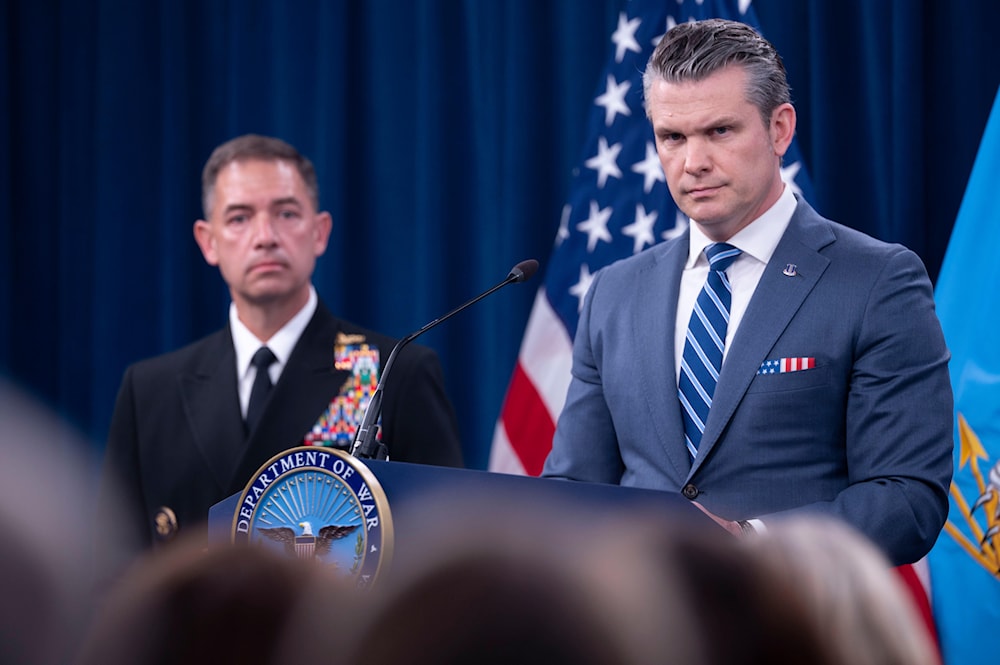
US Secretary of War Pete Hegseth takes questions from members of the media during a press briefing at the Pentagon, Thursday, April 16, 2026, in Washington. At left is Adm. Brad Cooper (AP)
The Pentagon is facing growing criticism over its refusal to publicly explain the direction, cost, and battlefield consequences of the expanding US war on Iran, as official briefings disappear and reporters are forced to rely increasingly on unnamed military sources, CNN reported.
Despite renewed American air strikes and the recent deaths of US service members in Jordan and Iraq, War Secretary Pete Hegseth has offered no detailed account of Washington’s military objectives or the circumstances surrounding the casualties.
The Pentagon has not held a formal press briefing since May 5, leaving journalists, military families, and the wider public with limited access to official information about the campaign.
The prolonged silence marks a sharp departure from previous US wars, when senior military officials regularly appeared before the press, even during periods of tension between the Pentagon and the media.
Media access restricted under Hegseth
Since taking office, Hegseth has repeatedly clashed with news organizations, restricted access to the Pentagon complex, and reduced direct engagement between military officials and experienced defense correspondents.
His department previously sought to bring more Trump-aligned outlets into the Pentagon press corps, but those organizations are also receiving little access as the administration limits public communication about the war.
The Pentagon’s public affairs office did not respond to a CNN request for comment regarding the absence of briefings.
The lack of official disclosure has compelled journalists to seek information from current and former officials who are not authorized to speak publicly.
At the same time, Hegseth announced the creation of a task force aimed at identifying and prosecuting individuals accused of leaking information to the press.
“The chilling atmosphere has gotten worse since he launched his task force with DOJ,” a military reporter said. “Sources feel like they’ll be prosecuted for simply speaking with journalists.”
The journalist was granted anonymity because of concerns surrounding the Pentagon’s treatment of media contacts.
Reports reveal undisclosed Iranian strikes
Much of the available information about US losses and Iranian operations has emerged through anonymous officials rather than formal Pentagon statements.
The New York Times reported that Iran “carried out three other strikes” against American forces in Jordan in recent days, leaving dozens of troops injured and damaging several helicopters.
“But the Pentagon did not disclose the earlier strikes, nor the casualties and damage they inflicted,” Times reporter Eric Schmitt wrote.
Schmitt said the administration has also withheld information regarding the depletion of important US weapons stockpiles and Iran’s ability to preserve and rebuild significant missile capabilities.
The Washington Post separately cited an unnamed official who warned that the United States was preparing for a broader confrontation despite concerns over whether the military could sustain continued operations.
“We do not have enough to safely sustain operations, and I don’t think the White House is aware of that,” the official said.
The statement raised questions over whether officials are turning to the media because internal warnings are not reaching senior decision-makers in Washington.
US escalation remains unexplained
The administration has provided little public justification for the return to large-scale aerial operations after consecutive nights of US strikes.
“From its initial shots, this war has been under-explained by the administration,” CNN analyst Stephen Collinson wrote. “The return to something like full-scale aerial war after a ninth consecutive night of US air raids is no exception.”
Hegseth has largely limited his public activity on the conflict to reposting brief statements issued by US Central Command.
While declining to explain the military campaign, he recently released a video promoting testosterone screening for troops and announced a “joint task force to IDENTIFY AND PROSECUTE LEAKERS.”
The Pentagon did not provide further details when reporters requested clarification about the initiative.
Trump claims clash with battlefield developments
President Donald Trump has continued to insist that the United States has decisively defeated Iran’s military capabilities, repeatedly using the word “obliterated” to describe the outcome of US operations.
Those claims have increasingly conflicted with reports that Iranian forces remain capable of carrying out strikes against American personnel and installations across the region.
During a Fox News broadcast, host Maria Bartiromo expressed confusion over Iran’s continued ability to respond militarily.
“I don’t understand how it’s possible that Iran has the capabilities to fight this way and continue to try to lash out… because the US has obliterated Iran’s military, and the president continues to reiterate that,” Bartiromo said to a guest on her show.
The remarks drew widespread criticism online, with commentator Hasan Piker asking, “How do Trump cultists live like this?”
Although some Fox News programs have cautiously questioned Trump’s escalation, other exchanges highlighting the widening scope of the war have received little attention on the network.
On Sunday, AFP reporter Danny Kemp reminded Trump that he had initially predicted a much shorter conflict.
“On Iran, Mr. President, you said at the start of the war it would be four or five weeks,” Kemp said.
“This is a far bigger job that we’re doing” now, Trump responded.
The exchange appeared to acknowledge that the war had expanded beyond the administration’s original public expectations, even as the Pentagon continues to avoid detailed scrutiny of its strategy, losses, and capacity to sustain further escalation.
Read more: Pentagon withheld US military casualties caused by Iran strikes


