
Pentagon approaching 'Winchester' for Tomahawk supply amid war on Iran
 3 Min Read
The US has fired over 850 Tomahawk missiles in four weeks of the war on Iran, raising Pentagon concerns over stockpile depletion and long-term military readiness.
-
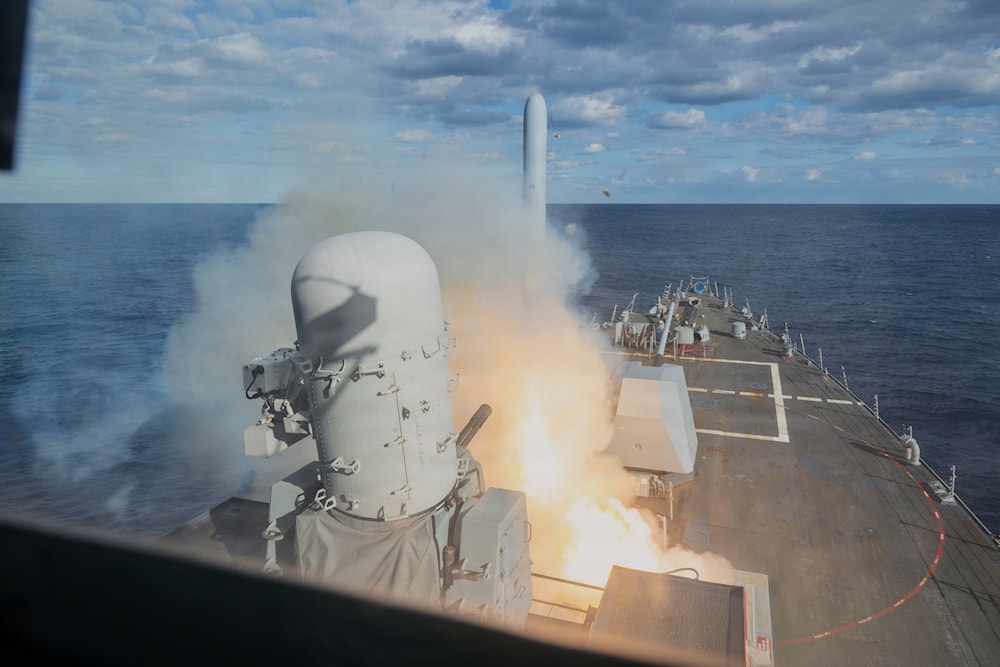
This image provided by US Central Command shows the Arleigh Burke-class guided-missile destroyer USS Bulkeley (DDG 84) firing a Tomahawk Land Attack Missile (TLAM) in support of Operation Epic Fury, on Saturday, Feb. 28, 2026 (AP)
The United States has launched more than 850 Tomahawk cruise missiles in the first four weeks of the US-Israeli war on Iran, depleting its stockpile at a pace that has alarmed Pentagon officials and triggered urgent internal discussions on resupply, sources familiar with the matter told The Wall Street Journal.
The long-range missiles, fired from US Navy warships and submarines, have been central to Washington’s war on Tehran. However, with only a few hundred Tomahawks produced annually, officials warn that the current rate of use is straining global supplies.
The heavy reliance on precision-guided weapons has prompted deliberations within the Pentagon over whether to shift stockpiles from other regions, including the Indo-Pacific, while accelerating long-term production efforts. Officials speaking on condition of anonymity described growing concern over the sustainability of current operations.
Missile depletion could affect future wars
Defense officials are closely monitoring the missile “burn rate”, warning that continued usage at current levels could impact not only the ongoing US-Israeli war on Iran but also US readiness for potential future operations elsewhere.
One official described remaining Tomahawk reserves in the Middle East as “alarmingly low", while another warned that, without intervention, the Pentagon is closing in on “Winchester", military slang meaning out of ammunition, for its supply of Tomahawk missiles in the Middle East.
The development comes amid broader concerns in Washington over the trajectory of the war, as the White House weighs further escalation, including the possible deployment of ground troops, while also pursuing negotiations.
Despite the scale of the bombardment, assessments indicate that Iran retains a significant portion of its missile capabilities, underscoring the challenges facing the United States and "Israel" in degrading Tehran’s military infrastructure.
Tomahawk missile behind US attack on Minab school
The attack on the Shajareh Tayyebeh elementary school in Minab, southern Iran, took place on February 28, 2026, during the opening day of the US-Israeli war on Iran. The strike hit the school in the morning hours, killing at least 160+ schoolgirls.
Evidence gathered in the days following the attack pointed to the use of a US Tomahawk cruise missile. Video footage, satellite imagery, and weapons analysis indicated the missile type, which is exclusively used by US forces in the war.
On March 9, 2026, verified footage showed a Tomahawk missile striking a nearby Iranian naval facility adjacent to the school, placing the area within active US targeting zones. Investigators concluded the school was hit during these strikes.
By March 10–12, 2026, preliminary findings from US and international investigations indicated that the United States was likely responsible for the strike. Officials said outdated intelligence may have misidentified the school as a military site, contributing to the deadly attack.
The Minab school bombing has since become one of the deadliest civilian incidents in the US-Israeli war on Iran, drawing widespread condemnation and calls for accountability. Analysts warn that, if confirmed, it would rank among the most severe civilian casualty events linked to US military operations in recent decades.


