
Pentagon blacklists major tech firms, claims aiding China's military
 4 Min Read
The Pentagon has added Alibaba, Baidu, BYD, Nio, and other major Chinese firms to a military-linked companies list, escalating tensions amid growing US-China technological rivalry.
-
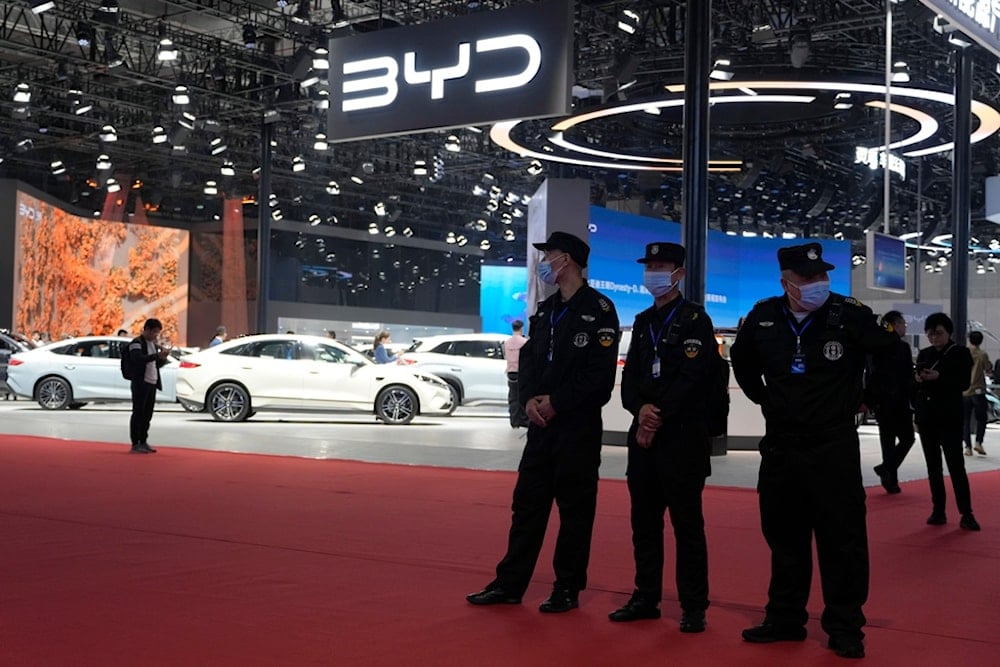
Security personnel on duty stand near the BYD booth during the Shanghai auto show, April 23, 2025. (AP Photo/Ng Han Guan)
The United States has expanded a controversial Pentagon blacklist to include some of China's largest technology and industrial firms, accusing them of supporting Beijing's military development in a move likely to intensify tensions between the world's two largest economies.
The updated list, released by the US Department of War on Monday, adds major Chinese companies, including Alibaba, Baidu, BYD, and Nio, alongside semiconductor, robotics, biotechnology, and telecommunications firms that Washington claims are connected to China's military-industrial development.
The decision comes weeks after a high-profile meeting between US President Donald Trump and Chinese President Xi Jinping in Beijing, highlighting the continued strategic competition underpinning relations between the two powers despite ongoing diplomatic engagement.
Alibaba, Baidu, BYD, and Nio added to Pentagon list
The Pentagon's updated "Chinese Military Companies" list significantly broadens the range of firms designated as supporting China's military modernization efforts.
Among the newly listed companies are e-commerce giant Alibaba, search engine operator Baidu, electric vehicle manufacturers BYD and Nio, memory chip producers CXMT and YMTC, biotechnology company WuXi AppTec, robotics developer Unitree, and autonomous systems firm RoboSense.
The designation does not automatically impose sanctions. However, under US law, the War Department will soon be barred from directly contracting with listed firms, while restrictions on purchasing their products through third parties are scheduled to take effect in 2027.
Washington has increasingly framed Chinese technological advancement as a national security challenge, targeting sectors ranging from semiconductors and artificial intelligence to advanced manufacturing and telecommunications.
Read more: China vows response to new US export control measures
Beijing condemns move as economic containment
China rejected the Pentagon's accusations, describing the list as discriminatory and politically motivated.
A spokesperson for the Chinese embassy in Washington said Beijing opposed efforts to target Chinese companies through unilateral measures.
"The US should stop its wrong practice and create a fair, just and non-discriminatory environment for Chinese companies," the embassy said.
The latest designations are likely to reinforce Chinese concerns that Washington is pursuing a broader strategy aimed at containing China's technological and economic development under the banner of national security.
Over recent years, the United States has imposed export controls, investment restrictions, and sanctions targeting Chinese firms in sectors deemed strategically important.
Companies reject allegations
Several of the companies included on the list strongly denied any connection to military activities.
Alibaba stated there was "no basis" for its designation and stressed that it is not part of any military-civil fusion program.
Baidu similarly rejected the allegations, describing to Reuters that claims of it being a military company are "entirely baseless."
WuXi AppTec said its inclusion was "incorrect" and announced plans to challenge the designation.
The Pentagon noted that listed companies may petition for removal from the blacklist.
Some Chinese firms previously designated have pursued legal action in US courts, arguing that the government failed to provide sufficient evidence linking them to military activities.
Procurement restrictions deepen technology confrontation
Although the blacklist falls short of direct sanctions, analysts say it sends a clear signal to government agencies, defense contractors, and private firms regarding Washington's assessment of Chinese technology companies.
The updated list reflects a growing US view that competition with China extends beyond individual firms and encompasses broader technological ecosystems.
The expansion also follows renewed scrutiny of advanced technologies such as artificial intelligence, robotics, semiconductor manufacturing, and quantum computing, sectors viewed by both governments as critical to future economic and strategic power.
For Beijing, the move is likely to be seen as another chapter in a wider campaign of economic pressure targeting Chinese technological development and global market expansion.
Read more: Xi urges stronger basic research to advance China's science, tech


