
Pentagon moves toward ground invasion in Iran amid rising losses
 4 Min Read
Pentagon prepares ground operations in Iran as US troop losses rise, raising fears of escalation and a wider, more dangerous phase of the war.
-
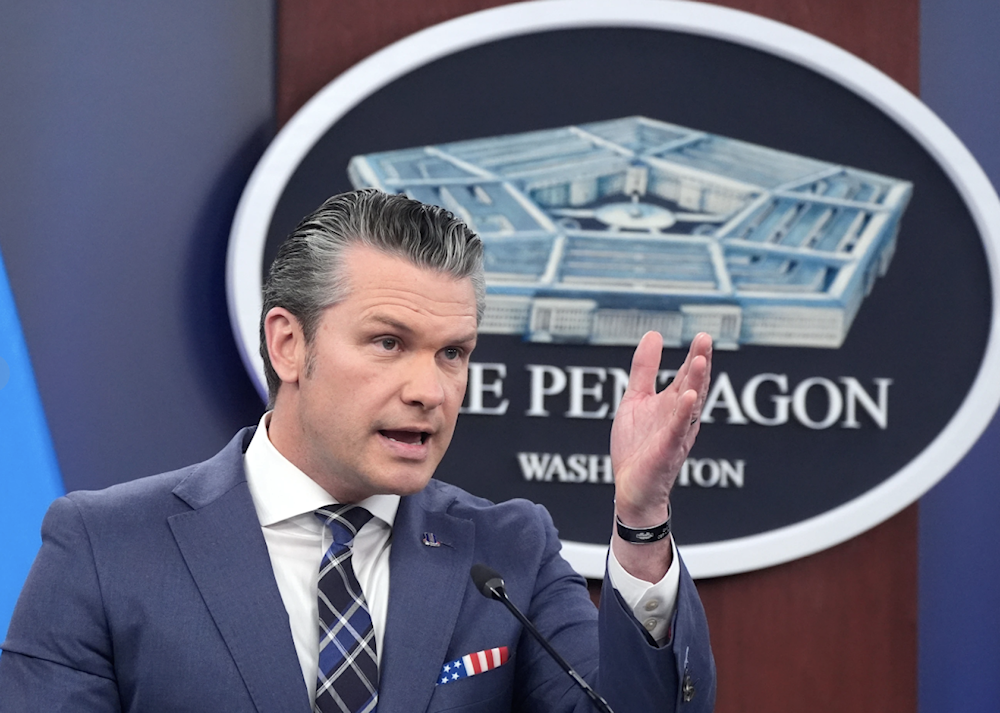
| Defense Secretary Pete Hegseth speaks to members of the media during a press briefing at the Pentagon in Washington on March 19, 2026. (AP)
The US Pentagon is advancing plans for a potential ground invasion in Iran, signaling a more dangerous phase in the ongoing war, as thousands of American troops continue deploying across West Asia.
According to US officials, the plans stop short of a full-scale invasion but include targeted raids by Special Operations forces alongside conventional infantry units. The proposals remain under review by US President Donald Trump, who has yet to make a final decision.
Trump is considering sending an extra 10,000 troops to West Asia to join around 3,000 paratroopers and 5,000 US Marines in a potential ground invasion of Iran, but analysts, cited by The Independent, argue that even this surge would be insufficient. To succeed, Trump would essentially need to deploy nearly the entire US armed forces, over 1.3 million soldiers.
Any ground invasion would expose US troops to escalating threats, including Iranian drones, missile strikes, ground fire, and improvised explosive devices.
Over the past month, at least 13 US soldiers have been killed and more than 300 wounded in retaliatory strikes targeting US positions across the region, underscoring the growing human cost of Washington’s aggression.
US ambitions on Kharg Island could backfire
Internal discussions have reportedly focused on operations targeting Kharg Island, a key hub for Iran’s oil exports, as well as coastal areas near the Strait of Hormuz.
The 31st Marine Expeditionary Unit (MEU), based on the USS Tripoli, and the 11th MEU, based on the USS Boxer, are highly trained amphibious forces. Each MEU has about 2,500 personnel, equipped with fast jets, Osprey vertical take-off planes, helicopter gunships, and artillery.
These units could theoretically execute targeted operations, such as invading Kharg Island, Iran’s oil export hub, or opening the Strait of Hormuz. However, exposure to Iranian air defenses and drone warfare could quickly turn such operations into disasters.
Kharg Island is over 300 miles north of the Strait of Hormuz, making it a strategic but risky target. Any coastal or inland invasion would leave US troops vulnerable to the Islamic Revolutionary Guard Corps (IRGC), who have trained for such situations.
Contradictions within the US administration
The Trump administration continues to send conflicting signals. Concerns are mounting among US lawmakers and former military officials over the possibility that Washington could escalate its war on Iran by deploying ground troops, including a potential operation targeting a key oil export hub, MSNBC reported on Saturday.
The report comes as divisions deepen within the US political establishment itself, with both Democrats and Republicans warning that further escalation risks backfiring against Washington.
According to the report, the arrival of roughly 8,000 US troops in West Asia, comprising paratroopers and Marines scheduled to deploy in phases, has intensified debate in Washington, with critics questioning both the purpose and effectiveness of such a move in the face of Iran’s demonstrated resilience.
Domestic opposition grows
Public opposition within the United States is rising, with a clear majority rejecting the deployment of ground troops in Iran amid fears of another prolonged and costly war.
Divisions are also widening within Congress, where some Republican lawmakers warn against repeating the cycle of endless wars in West Asia, while others push for deeper military involvement.
According to The Independent, without a clear strategic objective, any US intervention risks would result in heavy casualties and limited success. For now, there is no clear purpose behind US plans targeting Iran, while “Israel” remains focused on "regime change".
Sending additional US troops to Iran may appear bold in the Oval Office, but experts warn it is both pointless and highly dangerous. A large-scale ground invasion would require hundreds of thousands more soldiers than currently planned and could result in significant American losses, repeating the mistakes of previous wars in West Asia.


