
Pezeshkian: Iran ready to implement MoU if US honors its part
 4 Min Read
Pezeshkian tells Sharif Iran will implement the Islamabad MoU if the US reciprocates, while hailing the Mecca Agreement as proof Muslim states can secure the region on their own terms.
-
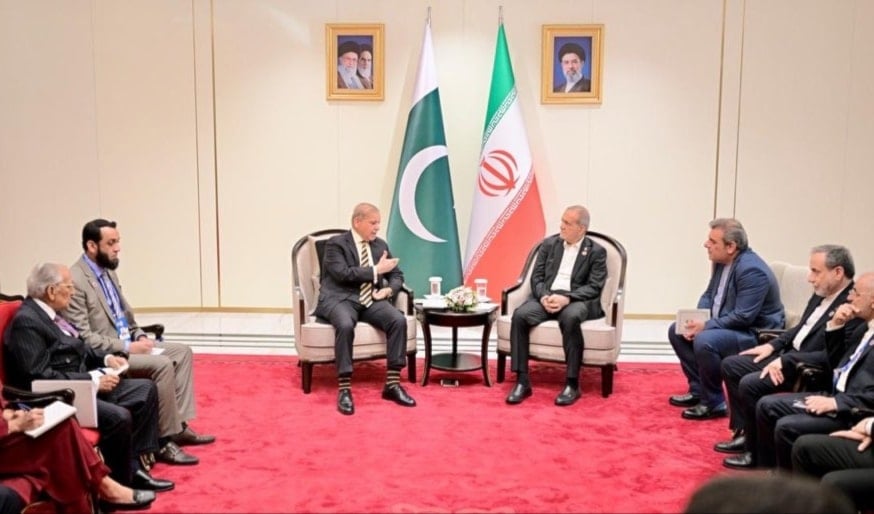
Iranian President Masoud Pezeshkian meets Pakistani Prime Minister Shehbaz Sharif on the sidelines of the SCO summit in Bishkek, Kyrgyzstan, on Monday, August 31, 2026. (Source: CMShehbaz/X)
Iranian President Masoud Pezeshkian said Monday that Tehran remains ready to implement the memorandum of understanding reached in Islamabad, on condition that Washington also follows through on its side of the agreement.
Meeting with Pakistani Prime Minister Shehbaz Sharif on the sidelines of the Shanghai Cooperation Organization summit in Bishkek, Kyrgyzstan, Pezeshkian thanked Pakistan for the active role it played in brokering the understanding, describing Islamabad's government as "friendly and brotherly."
He reiterated that Iran's commitment to the deal depends on the other side upholding its own obligations.
Pezeshkian welcomes Mecca Agreement
The Iranian president also welcomed the Mecca Agreement between Pakistan, Saudi Arabia, and Turkey, arguing that a united Muslim world would deter "Israel" from acting aggressively against Islamic countries.
He said Islamic nations have the capacity to work through their own disputes without outside interference, and voiced hope that other regional states would eventually join the framework and broaden cooperation beyond defense into political, economic, and cultural fields.
For his part, Sharif praised Pezeshkian's "consistent sincerity" across their meetings, and noted that months of increased diplomatic contact between the two countries had paid off.
Pleased to meet my dear brother, President Dr. Masoud Pezeshkian, on the sidelines of the SCO Summit in Bishkek.
— Shehbaz Sharif (@CMShehbaz) August 31, 2026
We discussed the evolving regional situation. I reiterated Pakistan’s sincere commitment to peace through restraint, dialogue and sustained diplomacy. The… pic.twitter.com/fUtSy0WEGq
He stressed that the Mecca Agreement was strictly defensive and not aimed at any state, framing its goal as regional peace and the protection of member states' interests. Sharif also pointed to a broad global sympathy for Iran's position, expressing optimism that dialogue could still bring security to the region.
Sidelines of the same summit
Pezeshkian used the Bishkek gathering for a string of bilateral meetings.
In talks with Indian Prime Minister Narendra Modi, he pressed New Delhi to lean harder into regional diplomacy, thanking India for standing by Iran during the recent US-Israeli aggression and arguing that continued conflict serves no one's interests.
He accused Washington of choosing force over diplomacy despite Iran's own compliance with prior understandings, and floated deeper Iran-India cooperation on trade, the Strait of Hormuz, and Chabahar port. Modi, in turn, called Pezeshkian a credible peace broker and voiced confidence in his approach.
Separately, Pezeshkian met Tajik President Emomali Rahmon to review bilateral ties and discuss ways to deepen cooperation between Tehran and Dushanbe.
Pezeshkian: Iran not seeking war
Before departing for Kyrgyzstan early Monday morning, Iranian President Masoud Pezeshkian reaffirmed that the Islamic Republic does not seek war but will respond firmly to any aggression against it.
The Iranian President added that "in the face of any aggression, we will never sit still and will give a decisive response to the aggressors", stressing that "Instability and unrest in the region are not in the interest of any country and will challenge everyone".
His comments follow a US attack against Larak Island in southern Iran. Iranian media reports that Washington's hostilities led to multiple casualties among Iran's military and civilians present on the Island.
The IRGC Aerospace Force answered with a combined missile and drone strike on two US-operated airbases in Jordan, warning Washington that further aggression would draw harsher retaliation.
Separately, Brigadier General Mohammad Reza Naqdi, senior adviser to the IRGC commander-in-chief, told Al Mayadeen that a "rational" US decision would rule out another war with Tehran, adding that most of Iran's current military leadership favors an offensive doctrine they regard as effective and operationally sound.


