
Pezeshkian condemns Western hypocrisy over Minab massacre
 2 Min Read
Iran's president condemns Western double standards over the killing of 168 children in the Minab massacre and questions negotiations with Washington.
-
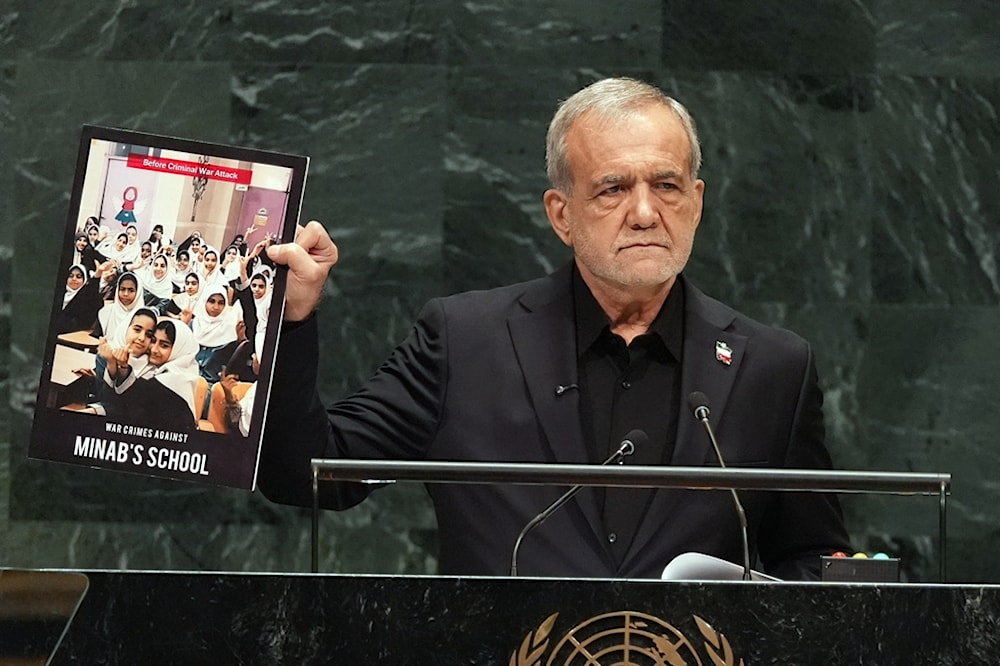
Iran's President Masoud Pezeshkian holds up a photograph as he delivers remarks during the 81st session of the United Nations General Assembly at United Nations headquarters, Wednesday, Sept. 23, 2026 (AP)
Iranian President Masoud Pezeshkian accused Western governments on Monday of double standards on human rights, condemning the killing of 168 children in the Minab massacre and questioning the value of negotiations under continued US aggression.
“For what crime did they kill 168 innocent children in the Minab massacre?” Pezeshkian asked.
He said those implicated in the killings “feel no shame and continue to claim that they defend human rights,” denouncing the gap between Western rhetoric and actions.
Pezeshkian challenges US approach to negotiations
Turning to Washington’s conduct toward Tehran, Pezeshkian said the central problem was that diplomatic engagement had repeatedly been followed by military aggression.
“Every time we sit at the negotiating table, war is immediately imposed on us,” he said.
The Iranian president also accused inspectors of facilitating the identification of Iranian nuclear facilities and scientists who were subsequently targeted.
“Every time inspectors come to Iran, our nuclear facilities and scientists are identified, then these facilities are bombed and the scientists are assassinated,” he said.
Pezeshkian stressed that the Iranian people would not accept an approach built on coercion and broken commitments.
“There is no point in negotiating with an enemy that carries out assassinations, imposes sanctions, exerts pressure, issues threats, and breaks its promises every day. Our people do not accept such an approach,” he said.
Araghchi says diplomatic path remains open
Pezeshkian’s remarks followed comments on Sunday by Iranian Foreign Minister Abbas Araghchi, who affirmed that Tehran would respond more forcefully than before to any military aggression.
Araghchi nevertheless stressed that diplomacy remained an option for ending the war, rejecting the prospect of a resolution through military action or additional sanctions.
Read more: IAEA leaked to 'Israel' confidential communications with Iran: Fars


