
Qatar PM: Gaza ceasefire incomplete without full Israeli withdrawal
 3 Min Read
Qatar's PM says that Gaza's ceasefire is incomplete without Israeli withdrawal as Turkey, Egypt, and the US coordinate efforts to advance the deal's second phase.
-
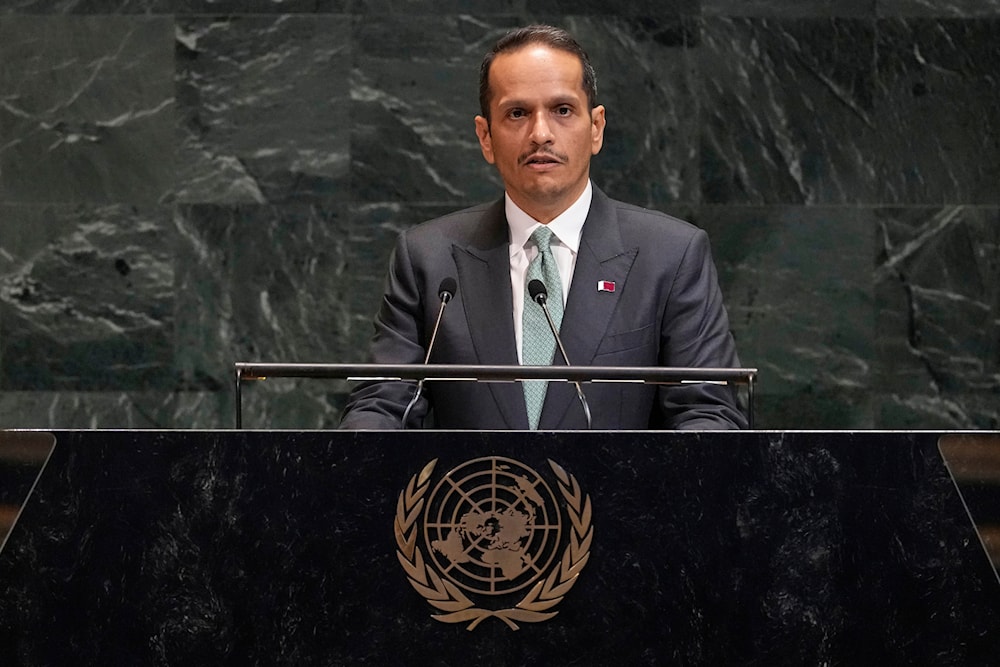
Qatari Prime Minister and Foreign Minister Sheikh Mohammed bin Abdulrahman bin Jassim Al Thani addresses the United Nations General Assembly, Monday, July 28, 2025. (AP Photo/Richard Drew)
Qatar's Prime Minister has underscored that the Gaza ceasefire cannot be considered truly complete without full Israeli military withdrawal from the Strip, highlighting persistent challenges in implementing the US-backed peace framework.
Speaking at the Doha Forum on Saturday, Sheikh Mohammed bin Abdulrahman Al Thani stressed the precarious nature of the current situation. "A ceasefire cannot be completed unless there is a full withdrawal of the Israeli forces, (and) there is stability back in Gaza," he told attendees at the annual diplomatic conference.
The truce, which took effect on October 11, resulted from intensive diplomatic efforts by Qatar, Egypt, and the United States. The Palestinian resistance has publicly acknowledged the crucial role these mediators played in bridging divides that eventually led to the cessation of hostilities.
Turkey has emerged as another significant player despite Israeli objections to its involvement. Turkish Foreign Minister Hakan Fidan has coordinated with regional partners, including Qatar and Saudi Arabia, to monitor ceasefire compliance. Washington has recognized Ankara's contribution, with US officials noting that "The Turks were very helpful in getting the Gaza deal."
Second phase challenges
The second phase of the deal, which has yet to begin, requires Israeli withdrawal, establishment of interim governance, and deployment of an international stabilization force (ISF). Al Thani revealed that Qatar, Turkey, Egypt, and the US are "getting together in order to force the way forward for the next phase."
Under the second phase, "Israel" must withdraw from positions including the contentious "yellow line," a temporary demarcation splitting Gaza in two. This boundary was intended as interim, contingent on ISF deployment and Palestinian disarmament, but Israeli actions suggest otherwise.
The IOF have erected permanent fortifications, including two-story sand berms, outposts, barbed wire, and yellow concrete markers. Satellite evidence shows over 1,500 buildings demolished behind this line since the ceasefire began.
The international stabilization force
Regarding the ISF, Turkish Foreign Minister Hakan Fidan, speaking at the forum, said critical questions about command structure and contributing nations remain unresolved. Arab and Muslim countries have shown hesitance to participate in a force which might potentially clash with Palestinian resistance fighters.
Fidan emphasized the ISF's first goal should be "to separate Palestinians from the Israelis."
Al Thani called the next phase "just also temporary," stressing that "resolving what happened in the last two years" isn't enough. He advocated for a "lasting solution that provides justice for both people," while Fidan urged engaging "faithfully and forcefully in peace talks."


