
Qatari foreign minister meets Iranian officials in Tehran
 3 Min Read
The Qatari foreign minister held talks in Tehran with senior Iranian officials to discuss regional developments and efforts to enhance stability.
-
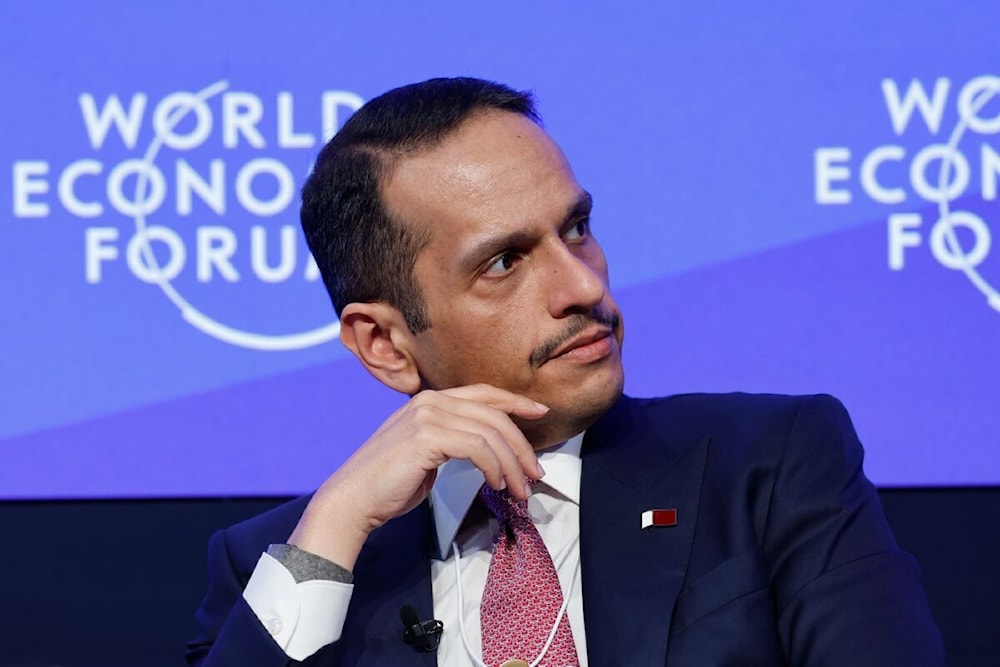
Qatar's Prime Minister and Foreign Minister Sheikh Mohammed bin Abdulrahman bin Jassim al-Thani arrives for a Board of Peace charter announcement in Davos, Switzerland, Thursday, January 22, 2026 (AP)
The Qatari foreign minister held meetings in Tehran on Saturday focused on regional developments and efforts to enhance stability, Iran’s Foreign Ministry spokesperson said.
According to Esmail Baghaei, the Qatari foreign minister met with Ali Larijani, secretary of Iran’s Supreme National Security Council, and Iranian Foreign Minister Abbas Araghchi.
Baghaei said the meetings were held within the framework of regional discussions aimed at reviewing current developments and strengthening stability across the region.
Qatari statement regarding the visit
Sheikh Mohammed bin Abdulrahman bin Jassim Al Thani, Prime Minister and Minister of Foreign Affairs of the State of Qatar, held talks in Tehran on Saturday with Ali Larijani, Secretary of the Supreme National Security Council of Iran, as part of ongoing diplomatic efforts to ease regional tensions.
According to a statement from Qatar’s Ministry of Foreign Affairs, the meeting focused on reviewing current initiatives aimed at de-escalation and preventing further instability in the region.
Prime Minister and Minister of Foreign Affairs @MBA_AlThani_ Meets with Secretary of Iran's Supreme National Security Council#MOFAQatar pic.twitter.com/htEjwPlFdL
— Ministry of Foreign Affairs - Qatar (@MofaQatar_EN) January 31, 2026
Sheikh Mohammed reiterated Doha’s support for all efforts seeking to reduce tensions and advance peaceful solutions that enhance regional security and stability. He emphasized the importance of coordinated diplomatic action to shield the peoples of the region from the consequences of escalation.
The Qatari foreign minister also stressed the need to continue close coordination with brotherly and friendly countries to address differences through dialogue and diplomatic channels, underscoring Qatar’s commitment to mediation and conflict prevention amid heightened regional uncertainty.
Egypt stresses need for diplomacy
Egyptian President Abdel Fattah el-Sisi called for avoiding escalation and rejecting military solutions in favor of diplomacy to resolve tensions between Iran and the United States, stressing that dialogue is the only viable path to ensuring regional stability.
The remarks were made during a phone call Sisi received on Saturday from Iranian President Masoud Pezeshkian, which focused on developments related to Iran’s nuclear file and rising tensions across the region.
Sisi expressed Egypt’s deep concern over the escalation, reaffirming Cairo’s continued efforts to help bring Washington and Tehran back to the negotiating table in pursuit of a comprehensive and peaceful settlement that strengthens regional and international stability. He emphasized the importance of prioritizing dialogue, overcoming differences, and supporting all diplomatic efforts aimed at de-escalation.
Any attack to be met with decisive response
For his part, Pezeshkian warned that any attack on Iranian territory would be met with a decisive and forceful response, accusing the United States and Israel of pursuing a path of escalation and pushing the region toward war.
The Iranian president said Tehran has not sought and will not seek war, arguing that conflict would serve neither Iran, the United States, nor countries in the region. He stressed the need to establish diplomatic tracks based on equality and free from threats or pressure, adding that talks must take place in a calm and constructive atmosphere.
Pezeshkian said Iran’s priority remains resolving disputes through diplomacy, warning that Tehran cannot be forced into negotiations through intimidation or the use of force. He concluded by thanking Egypt for its role in preventing escalation and maintaining regional security, and affirmed Iran’s desire to strengthen political consultation and coordination with Cairo.


