
Red Cross warns Gaza victims buried under rubble may not be identified
 5 Min Read
The ICRC warns that thousands of Palestinians buried beneath Gaza's rubble may never be identified as recovery efforts face severe obstacles, equipment shortages, and mounting delays.
-
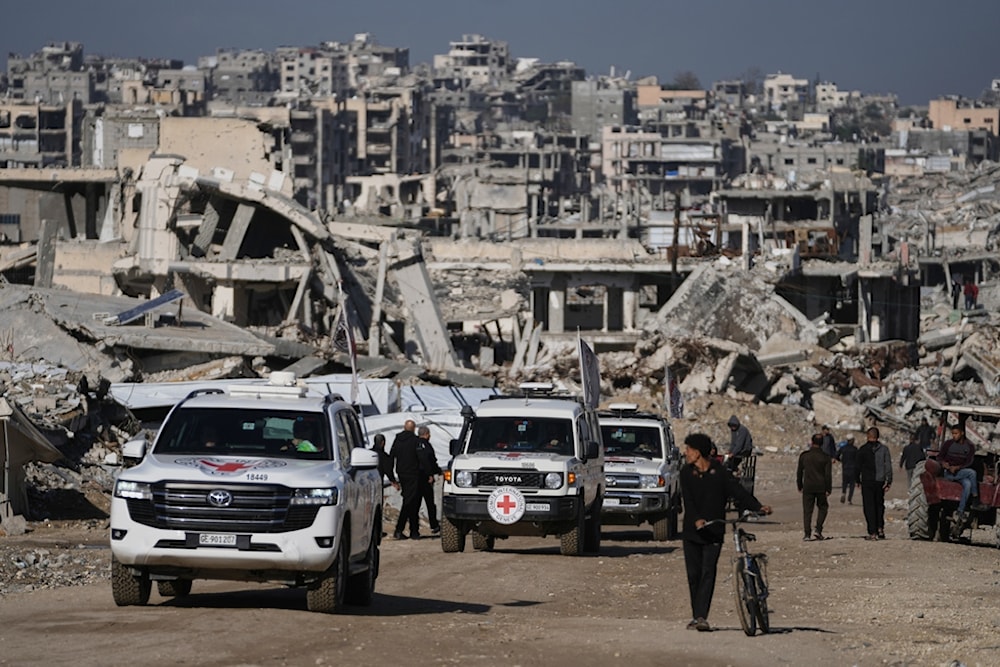
Members of the International Committee of the Red Cross (ICRC) in Jabalia, northern Gaza Strip, Monday, Dec. 1, 2025. (AP Photo/Jehad Alshrafi)
The International Committee of the Red Cross (ICRC) has warned that thousands of Palestinians believed to be buried beneath the vast rubble fields of Gaza risk never being identified, as prolonged delays in recovery efforts continue to complicate forensic identification and deepen the suffering of families awaiting answers about missing loved ones, The Guardian reports.
Nearly three years into the Israeli war on Gaza, recovery teams continue to search through an estimated 61 million tonnes of debris left across the besieged enclave. Health officials estimate that at least 10,000 Palestinians remain trapped beneath the rubble, while some experts place the figure closer to 14,000.
The ICRC says the passage of time is steadily reducing the likelihood that many of the dead will ever be identified.
"There is no doubt that these bodies could soon become difficult to identify," Pat Griffiths, the ICRC spokesperson in Occupied Al-Quds, told The Guardian. "The longer it takes for human remains to be recovered, the more difficult it can be to identify them."
Read more: Rebuilding Gaza could take decades as reality clashes with rhetoric
Recovery efforts hindered by destruction and equipment shortages
Palestinian rescue crews have been forced to rely largely on hand tools, including shovels, pickaxes, wheelbarrows, and rakes, to recover bodies from collapsed buildings and destroyed neighborhoods.
According to the ICRC, repeated appeals to allow the entry of excavators and other heavy machinery capable of accelerating recovery operations have yielded little progress.
"Search and recovery teams need access to all sites where human remains are thought to be located," Griffiths said. "We know that much of this machinery and equipment remains almost impossible to bring into Gaza right now."
Israeli authorities contacted by The Guardian reportedly said there was no approval for the entry of equipment intended for body recovery operations.
The lack of machinery has significantly slowed efforts to locate victims, while concerns have also emerged regarding the use of military bulldozers in certain areas. Witnesses have stated that bulldozing operations disturbed or displaced remains buried beneath the rubble, further complicating identification efforts and the ability of families to recover relatives.
The ICRC emphasized that heavy machinery in conflict zones must be used with extreme caution to preserve both the dignity of the deceased and critical evidence that may assist identification efforts.
Forensic experts warn time is running out
Forensic specialists say environmental conditions in Gaza are accelerating decomposition and reducing the chances of successful identification.
Dr. Cristina Cattaneo, a professor of forensic pathology at the University of Milan, described time as the primary obstacle facing investigators.
"Time, ultimately, is the greatest enemy of identification," she told The Guardian.
Experts typically rely on fingerprints, dental records, DNA samples, personal belongings, physical characteristics, and the location where remains are found to establish identity. However, prolonged exposure to heat, humidity, animal activity, and structural collapse can destroy much of that evidence.
Dr. Ahmed Dahir, Gaza's forensic medicine director, said some bodies had deteriorated into skeletal remains within weeks.
"In some cases, we were surprised to find that a person reported missing for only two weeks had turned into bones bearing signs of animal scavenging," he told The Guardian.
Compounding the crisis, Gaza's hospitals lack functioning DNA testing capabilities, while materials needed for genetic testing remain unavailable in the territory. Forensic experts warn that DNA itself degrades over time, making future identification increasingly difficult.
Read more: Al Mayadeen obtains Palestinian response to mediators' Gaza 'roadmap'
Families endure years of uncertainty and unresolved grief
For thousands of Palestinian families, the inability to locate or identify loved ones has created a prolonged state of uncertainty that psychologists describe as "ambiguous loss," a form of unresolved grief associated with trauma, depression, and psychological distress.
Saed al-Yazji, whose brother Sameh disappeared on October 7, 2023, said his family continues to search for answers.
"We still cling to the hope that he is alive because there has been no confirmation that he was killed or detained," al-Yazji said, The Guardian reports.
He described the devastating impact of years without information, stating, "His disappearance has devastated the family. His wife suffers repeated psychological breakdowns, and after two years of not knowing whether he is alive or dead, they can no longer sleep or eat normally."
Wael Radwan, from Jabalia, said he lost both his father and brother after an Israeli artillery strike hit their home in late 2024.
"I was later told they had been buried at Kamal Adwan Hospital, but when I returned after the siege, the site had been bulldozed and I could not find their bodies," he told The Guardian.
Without official death certificates, Radwan added, surviving family members face difficulties accessing social assistance and legal documentation.
The ICRC stressed that identifying the dead is not solely a humanitarian obligation but also a fundamental right for families seeking to know the fate of relatives lost during war.
"We see the scale of the task and we see what's at stake," Griffiths said. "Thousands of families are still seeking answers."
Read more: Dr. Abu Safiya demands immediate release in first court appearance


