
Rival factions in Libya sign UN-backed election agreement
 4 Min Read
Libya's rival factions signed a UN-backed deal in Tripoli setting a 24-month path to elections, though ratification and unity remain uncertain.
-
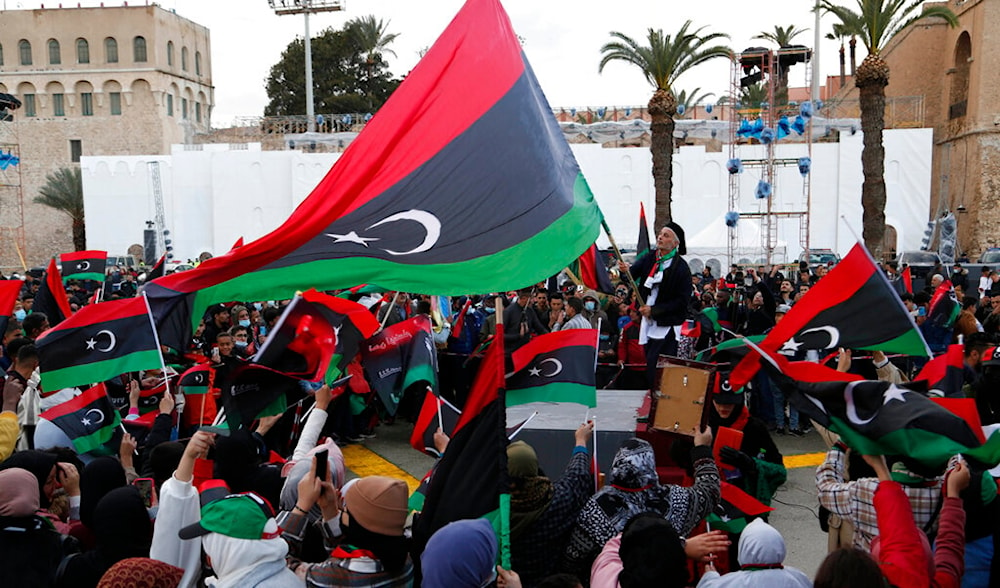
People wave Libyan flags to mark the 11th anniversary of the 2011 NATO-backed uprising that toppled longtime ruler Muammar Gaddafi in Martyrs' Square in the Libyan capital of Tripoli on Thursday, Feb. 17, 2022. (AP Photo/Yousef Murad)
Representatives of Libya's rival political groups signed a UN-backed agreement in Tripoli on Sunday, a step organizers say could pave the way for the country's first national elections in over a decade.
The signing took place at the headquarters of the UN Support Mission in Libya (UNSMIL), with mission chief Hanna Tetteh in attendance.
The document was produced by the "4+4 committee," a UN-created body with four representatives each from the House of Representatives in the east and the High Council of State in the west. An initial draft was signed in Tunis on August 20 after months of talks in Rome and Tunis.
Moussa al-Koni, vice president of Libya's presidential council, described the agreement as a chance to move the country from managing its divisions to ending them. Abdul Rahman al-Abbar, a representative from the east, said both sides had accepted significant compromises. Eastern commander Khalifa Haftar also welcomed the progress, according to the television channel al-Masar, saying it addressed issues that had held up elections for years.
What the deal covers
The agreement restructures the High National Elections Commission and sets out a framework for resolving disputes over electoral laws.
Walid Ellafi, the Government of National Unity's state minister of political affairs and communications, said presidential and legislative elections are meant to be held under a single executive authority within 24 months, Reuters reported.
Tetteh called the signing an important step but stressed that implementation, not paperwork, will determine its value.
Ratification still uncertain
The text requires approval from the House of Representatives and the High Council of State within a month. If either body fails to sign off, the parties say they will move to adopt the agreement nationally as a constitutional document and seek backing from the UN Security Council instead.
High Council of State member Nuh al-Malati has said the council never received an official copy of the text and that the changes lack consensus among its members, while presidential council head Mohamed al-Menfi has questioned the basis on which the talks were conducted.
Libya has not held a national election since 2014. A vote scheduled for December 2021 collapsed after disputes over whether military personnel and dual nationals could run for office, and whether presidential and legislative elections should be held together or separately.
A UN roadmap proposed in August 2025 called for a viable electoral framework and a unified government, but implementation has repeatedly lagged behind announcements.
Other tracks toward unity
The election agreement is one of several parallel efforts to bridge Libya's east-west split. Military commanders from both sides met in Sirte in July under the 5+5 and 3+3 joint commissions to discuss unifying Libya's armed forces, though no concrete outcomes were announced.
Pakistan has separately been mediating between the two sides since late last year, with US and Saudi involvement, working toward a draft reunification plan that would install Abdulhamid Dbeibah as prime minister and Saddam Haftar, Khalifa Haftar's son, as head of a new presidential council.
A separate US-led initiative headed by Massad Boulos, an adviser to President Donald Trump, is also pursuing rapprochement between the two administrations, though it remains distinct from the UN-backed process.
Read more: Saddam Haftar seeks to expand influence in southern Libya, report says


