
Riyadh southern Yemen meeting calls for just, peaceful resolution
 4 Min Read
A PLC member stresses a political solution to the Yemeni southern issue, praising Saudi Arabia’s role during a key meeting in Riyadh.
-
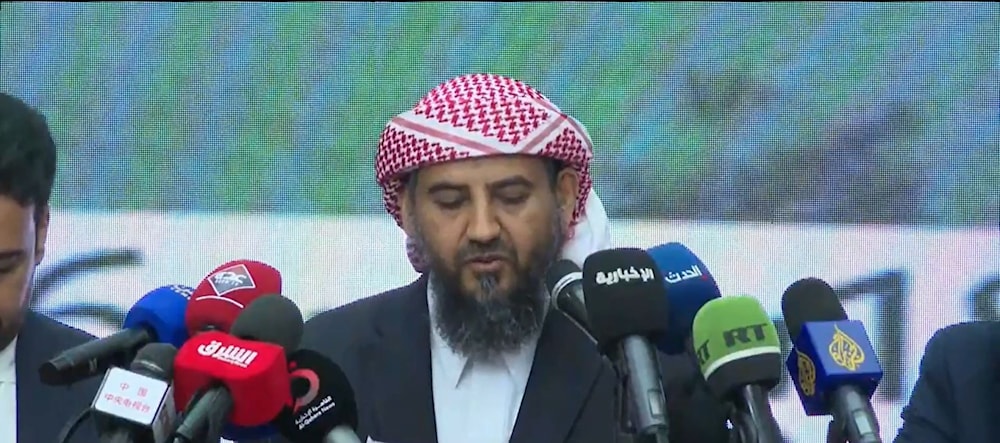
Member of the Yemeni Presidential Leadership Council, Abdulrahman al-Mahrami, giving an address during the southern Yemeni Conference in Riyadh, Saudi Arabia, January 18, 2026 (Social media)
Leaders of southern Yemen are determined to advance a just and sustainable political settlement that safeguards the legitimate rights of the people of South Yemen, reflecting a unified will across various political components and governorates, according to a statement read during the Yemeni Southern Consultative Meeting in Riyadh by Yemeni Presidential Leadership Council member Maj. Gen. Abdulrahman al-Muharrami.
Speaking during “The Southern Consultative Meeting to Discuss the Requirements of the Current Phase," al-Mahrami noted that consultations between southern leaders and Saudi officials demonstrated a clear understanding and support for what it described as the just demands of the south, foremost among them a comprehensive political solution that ensures dignity, security, and stability and enables southerners to "determine their own future" and restore a fully "sovereign southern state" without preconditions.
The participants highlighted the upcoming Saudi-sponsored southern dialogue as a historic opportunity, urging all parties to engage with a high sense of national responsibility and to avoid internal disputes that could weaken southern unity, while emphasizing that the process is based on inclusive partnership and fair representation of all southern forces.
The statement also pointed to the warm reception accorded to the southern delegation in Riyadh and Saudi Arabia’s responsiveness to humanitarian and livelihood-related issues, particularly those concerning the payment of southern forces’ salaries and the improvement of living and service conditions in southern areas.
The meeting reaffirmed Saudi Arabia’s continued support for southern forces across various fronts, saying this support enhances their ability to maintain security and protect gains, and helps prevent attempts to weaken the southern front, while underscoring the strength of the strategic partnership with Riyadh in confronting security threats, including ISIS and al-Qaeda, and calling on the international community to back the political track to achieve lasting peace and stability in the south and the wider region.
STC leader rejects externally imposed solutions
Yemeni Southern separatist leader Aidarous al-Zubaidi resurfaced publicly on January 17 amid a Saudi-backed military push against UAE-supported forces in southern Yemen, an escalation that exposed long-simmering tensions between Riyadh and Abu Dhabi and brought them into open view.
In a message to STC supporters, al-Zubaidi rejected externally imposed political arrangements, declaring, "We will no longer accept any solutions that diminish our rights or impose an unacceptable reality upon us." He pledged to continue the southern project, adding, "With your determination, we will prevail. With your unity, the South will be protected, and with your will, the future state will be established."
This statement marked his first public appearance in weeks, after his absence from Saudi-hosted talks in early January sparked speculation regarding his whereabouts and actions.
Riyadh-Abu Dhabi ties on downward spiral
The remarks came following a sharp deterioration in relations between Riyadh and Abu Dhabi over influence in southern Yemen. Saudi officials have increasingly accused Emirati-backed factions, particularly forces aligned with the Southern Transitional Council, of advancing agendas that threaten Saudi national security, a notable rupture between two states that once jointly led the military coalition intervening in Yemen since 2015.
In December, STC-affiliated forces briefly expanded their footprint across several southern governorates, advancing toward areas Riyadh considers strategically sensitive, including zones near the Saudi border. Saudi officials later described the advance as a “red line", warning that unchecked separatism, militia rule, or territorial fragmentation could have grave security consequences for the kingdom.
The escalation prompted Saudi airstrikes on a shipment linked to UAE-supported forces, followed by a rapid counter-deployment by Saudi-aligned units that reversed the STC’s gains. Saudi-backed “National Shield” forces subsequently announced full deployment across Aden governorate, while the Presidential Leadership Council moved to retake camps and installations previously controlled by STC-aligned units, exposing deep fractures within the coalition that has dominated Yemeni politics and security for nearly a decade.


