
Rubio, UAE president discuss Strait of Hormuz security, Iran-US MoU
 4 Min Read
US Secretary of State Marco Rubio and UAE President Sheikh Mohamed bin Zayed held talks in Abu Dhabi on the US-Iran memorandum, Hormuz navigation security, and regional developments.
-
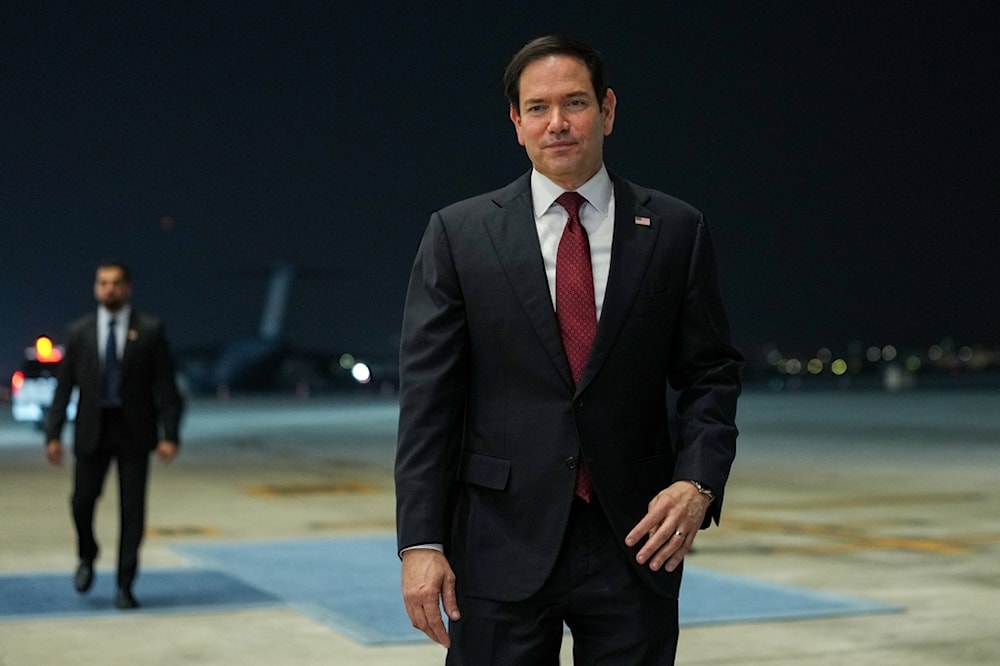
Secretary of State Marco Rubio upon his arrival at Al Bateen Executive Airport, in Abu Dhabi, United Arab Emirates, Tuesday, June 23, 2026. (Eric Lee/Pool Photo via AP)
UAE President Sheikh Mohamed bin Zayed Al Nahyan and US Secretary of State Marco Rubio discussed the US-Iran memorandum of understanding and maritime security in the Strait of Hormuz on Wednesday, alongside bilateral relations and regional developments.
According to the Emirates News Agency (WAM), bin Zayed received Rubio in Abu Dhabi as part of the US Secretary of State's Gulf tour, which also includes Kuwait and Bahrain.
The two sides reviewed strategic cooperation and joint efforts between the United Arab Emirates and the United States, reaffirming their commitment to further strengthening ties across various sectors in a manner that serves the shared interests of both countries.
Several regional and international reports during the recent US-Israeli war on Iran reported varying degrees of UAE involvement, including reports that Emirati territory and infrastructure were used to support military logistics and intelligence operations.
Abu Dhabi has not publicly acknowledged any direct participation in military action against Iran.
On another note, The United Arab Emirates reportedly attempted to persuade Gulf states, including Saudi Arabia and Qatar, to participate in a coordinated military response against Iran following the launch of the US-Israeli war on the Islamic Republic.
According to Bloomberg, UAE President Mohammed bin Zayed Al Nahyan held urgent calls with regional leaders shortly after the United States and "Israel" began strikes on Iran on Feb. 28.
The report said MBZ believed Gulf states needed a unified military response after Tehran's retaliatory strikes on US military installations and infrastructure used to strike Iran on their territory.
Discussions on regional developments, Hormuz security
The talks also covered several regional and international issues of mutual interest, particularly developments in West Asia and efforts allegedly aimed at promoting "security, stability, and lasting peace across the region" following their participation in the aggression against Iran.
For its part, the US State Department said Rubio discussed with bin Zayed and senior Emirati officials the memorandum of understanding announced by US President Donald Trump with Iran, as well as efforts to ensure "full and safe passage" through the Strait of Hormuz.
The department added that both sides reviewed the strength of US-UAE relations and the continuation of cooperation in the defense and trade sectors.
Rubio arrived in the UAE on Tuesday evening at the start of a Gulf tour that also includes Kuwait and Bahrain.
Rubio's Gulf tour comes amid heightened diplomatic activity following the signing of a memorandum of understanding between Washington and Tehran earlier this month, which launched a 60-day negotiating process aimed at ending the four-month war waged by the United States and "Israel" against Iran.
Under the framework outlined in the memorandum, Gulf states are expected to play a central role as diplomatic facilitators and strategic stakeholders in the proposed post-war arrangement.
Gulf role in Strait of Hormuz talks
The memorandum reportedly assigns Oman and other Gulf littoral states a leading role in facilitating dialogue over the future administration of the Strait of Hormuz, including efforts to establish a long-term maritime governance framework. It also emphasizes maintaining freedom of navigation and restoring commercial shipping to pre-conflict levels during the initial implementation phase.
The agreement also links "regional partners," widely understood to include Gulf Cooperation Council states, to a proposed reconstruction mechanism for Iran estimated at around $300 billion, envisioning Gulf participation alongside the United States in post-war rebuilding efforts.
However, reports indicate that several Gulf capitals, including the United Arab Emirates and Saudi Arabia, have expressed reservations about contributing to reconstruction financing, citing concerns over regional security risks and previous attacks on their infrastructure.
Throughout the war period, Qatar and Oman played a key role in maintaining back-channel communications between Washington and Tehran. These mediation efforts are widely seen as having helped create the conditions for the current ceasefire and negotiating framework, with Gulf countries broadly welcoming de-escalation as essential to protecting regional stability and critical infrastructure.
Read more: Islamabad MoU marks 'declaration of defeat' for Washington: Ghalibaf


