
Rubio-Netanyahu meeting rescheduled to March 2
 5 Min Read
US Secretary of State Marco Rubio will meet Benjamin Netanyahu on March 2 as US-Iran talks may resume in Geneva, officials say.
-
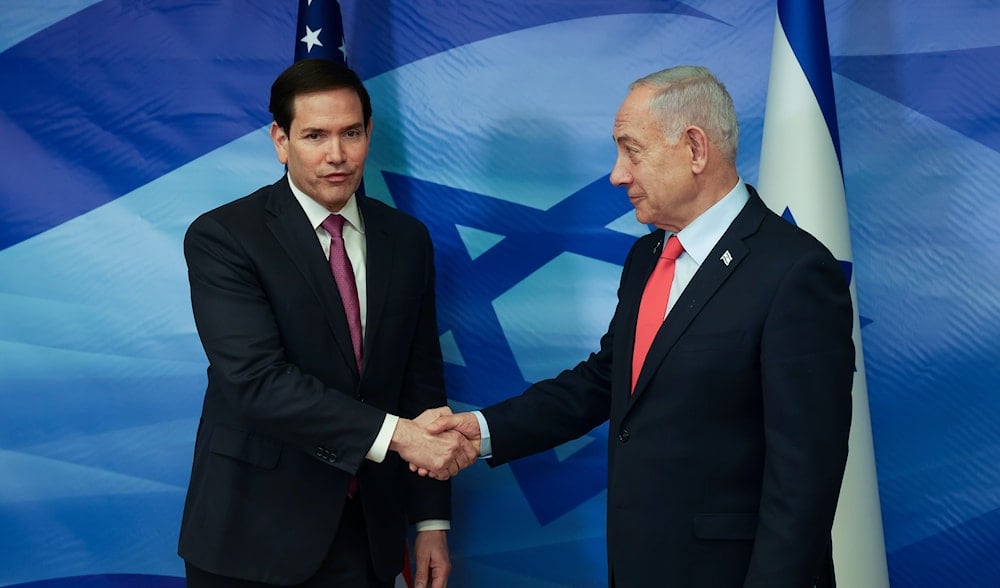
US Secretary of State Marco Rubio shakes hands with Israeli Prime Minister Benjamin Netanyahu at the Prime Minister's Office in al-Quds, Occupied Palestine, Thursday, Oct. 23, 2025 (AP)
US Secretary of State Marco Rubio will meet Israeli Prime Minister Benjamin Netanyahu on March 2, rather than this weekend as previously expected, CNN reported on Monday, citing an Israeli official.
Rubio is still set to travel to "Israel", though the schedule of his visit remains subject to change, according to a US State Department official who spoke to the broadcaster.
The top US diplomat had initially planned to arrive in "Israel" on February 28 to brief Netanyahu on ongoing talks with Iran. No further details were immediately provided regarding the reason for the adjustment to the timeline.
US-Iran talks could resume on February 26: Araghchi
This comes as mediated talks between Iran and the United States could resume in Geneva on February 26, according to Iranian Foreign Minister Abbas Araghchi.
Speaking to CBS, Araghchi said preparations were underway for possible nuclear talks, with discussions centered on refining the framework of a prospective deal.
“I believe that when we meet, probably this February 26 in Geneva again, we can work on those elements, and prepare a good text, and come to a fast deal,” Araghchi said.
Earlier, a senior US official told Axios that Washington had expressed readiness to resume talks on February 27 if it receives a detailed draft proposal for a nuclear deal within 48 hours.
“If Iran gives a draft proposal, the US is ready to meet in Geneva on Friday in order to start detailed negotiations to see if we can get a nuclear deal,” the US official said, adding that the Trump administration remains open to discussing an interim nuclear agreement before reaching a comprehensive accord.
The condition appears to signal increased pressure on Tehran to make concessions ahead of the resumption of diplomatic negotiations.
Iran, US split over sanction relief
This comes as Iran and the United States remain divided over the scope and mechanism for lifting sanctions on Tehran in exchange for limits on its nuclear program, a senior Iranian official told Reuters on Sunday. The official added that new rounds of talks are planned for early March, with negotiations continuing amid cautious optimism over a potential interim agreement.
According to the official, Tehran could consider a combination of measures, including exporting part of its highly enriched uranium (HEU) stockpile, lowering uranium enrichment levels, and establishing a regional consortium for enrichment. However, Iran insists that its right to “peaceful nuclear enrichment” must be formally recognized as part of any agreement. “The negotiations continue, and the possibility of reaching an interim agreement exists,” the official said.
The Iranian side is reportedly assessing several technical pathways to address international concerns over its HEU reserves. These measures could form part of a phased arrangement linked to sanctions relief.
The official also stressed that Tehran will not relinquish control over its oil and mineral resources, though US companies could participate in Iran’s oil and gas sector as contractors under specific frameworks. The remarks came after Iranian Foreign Minister Abbas Araghchi held a telephone conversation earlier on Saturday with Rafael Grossi, Director General of the International Atomic Energy Agency.
US build-up escalates significantly
Amid these developments, US military buildup in the Middle East has expanded significantly, with Washington assembling 16 warships, about 40,000 troops, and at least seven air wings in the region, the Financial Times reported, citing rising US-Iran tensions.
US President Donald Trump said on February 19 he will decide within 10 to 15 days whether to pursue diplomacy with Iran or take military action, Axios reported. Speaking in Washington, he said the coming days would be decisive for US policy. “Now we may have to take it a step further, or we may not,” Trump said, adding, “Maybe we are going to make a deal [with Iran].”
The United States had already maintained five air wings, command units of roughly 70 aircraft each, at bases in Jordan, Kuwait, Qatar, Saudi Arabia and the United Arab Emirates. It has since added two more aboard the aircraft carriers USS Abraham Lincoln and USS Gerald R. Ford, reinforcing what Trump described as a “massive armada” of 16 vessels and expanding Washington’s operational reach.
The overall US troop presence in the region now stands at around 40,000 personnel. Citing data from Tel Aviv University, the Financial Times reported that Jordan’s Muwaffaq Salti military base hosts at least 66 fighter jets, including 18 F-35s, 17 F-15s, and eight A-10s, along with EA-18 electronic warfare aircraft and transport planes. Satellite data also shows an increase in fighter jets at a Saudi air base, reflecting the broader expansion of the US air footprint across Jordan and the Gulf.


