
Russia backs Iran's call for collective security in Gulf
 3 Min Read
Russian envoy Mikhail Ulyanov voices support for Ghalibaf's push for collective Gulf security as Tehran says regional states are reconsidering US-backed arrangements.
-
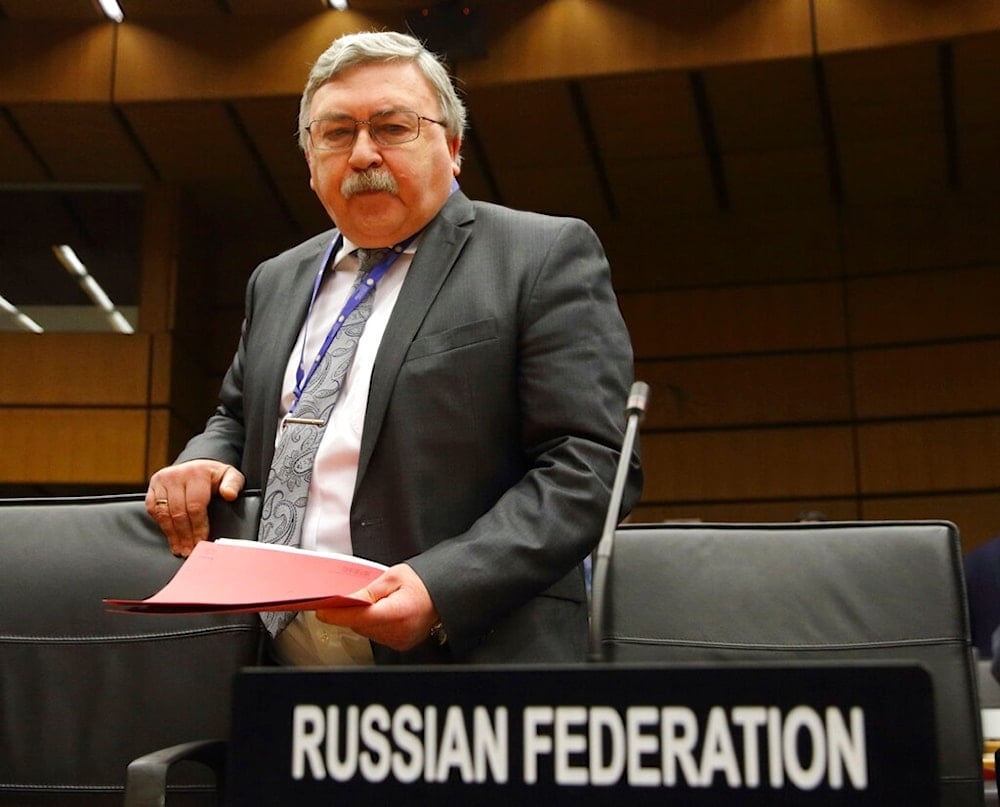
Russian Permanent Representative to the IAEA Mikhail Ulyanov arrives for an IAEA Board of Governors meeting in Vienna, Austria, Monday, Feb. 6, 2023 (AP)
Russia has voiced support for Iran's push toward a new regional security framework in the Gulf, with Moscow's representative to international organizations in Vienna, Mikhail Ulyanov, endorsing a proposal for collective security among regional states.
"The creation of a collective security system in the Persian Gulf is a highly topical task," Ulyanov wrote on X, responding to remarks by Iranian Parliament Speaker Mohammad Bagher Ghalibaf on the emergence of new security arrangements in the region.
The creation of a collective security system in the Persian Gulf is a highly topical task. https://t.co/BHyfr5Lxqi
— Mikhail Ulyanov (@Amb_Ulyanov) August 22, 2026
Ghalibaf said Tehran had received messages from neighboring countries seeking to establish new forms of political, economic, and security cooperation.
He argued that the recent US-Israeli war on Iran had exposed the risks associated with depending on Washington as the region's main security guarantor.
Tehran points to shift in regional security calculations
According to Ghalibaf, the war has prompted neighboring governments to reconsider existing security relationships and explore alternatives that rely more heavily on regional cooperation.
“We’ve received numerous messages from neighboring countries about shaping new security arrangements and economic cooperation in the region,” he said.
1/2 We’ve received numerous messages from neighboring countries about shaping new security arrangements and economic cooperation in the region.
— محمدباقر قالیباف | MB Ghalibaf (@mb_ghalibaf) August 22, 2026
The United States put the security of every single one of its allies at such risk…
He also accused Washington of putting its regional allies at risk by prioritizing Israeli interests, arguing that the conflict had demonstrated the vulnerability of states that rely on US protection.
“The United States put the security of every single one of its allies at such risk,” the Iranian parliament speaker said, adding that Washington had acted “through bullying and pure disregard for their interests for the sake of Israel.”
Ghalibaf said governments in the region had, even temporarily, faced a situation in which they saw “their entire existence on the line.”
The comments come as regional states explore new approaches to security, including greater coordination on defense and maritime issues, amid growing questions over the durability of US-centered security arrangements.
Ulyanov challenges US policy toward Iran
Ulyanov's support for a regional security framework follows his broader criticism of Washington's approach to Iran's nuclear program.
The Russian envoy had in April described the US position on Iranian uranium enrichment as ideological and counterproductive, arguing that it conflicts with the principles underpinning the Non-Proliferation Treaty (NPT) and efforts to stabilize West Asia.
“The current US position on uranium enrichment in Iran is extremely ideological in nature, illogical and counterproductive. It goes contrary to the nuclear non-proliferation values based on the NPT [Non-Proliferation Treaty], as well as the interests of normalisation of the situation in the Middle East,” Ulyanov said on X.
The current #US position on uranium enrichment in #Iran is extremely ideological in nature, illogical and counterproductive. It goes contrary to the nuclear non-proliferation values based on the #NPT, as well as the interests of normalisation of the situation in the Middle East.
— Mikhail Ulyanov (@Amb_Ulyanov) April 10, 2026
He also defended Iran's decision to enrich uranium to 60%, linking the move to Washington's withdrawal from the 2015 Joint Comprehensive Plan of Action (JCPOA) and the subsequent US "maximum pressure" campaign.
“Iran started to enrich uranium up to 60% in response to the US maximum pressure after Washington’s withdrawal from the JCPOA. It had nothing to do with nuclear weapons. Just a response to pressure,” he said.


