
Russian envoy slams US stance on Iran uranium enrichment
 4 Min Read
Russia criticizes US policy on Iran’s uranium enrichment as ideological, while Tehran rejects Western claims and tensions persist over ceasefire violations.
-
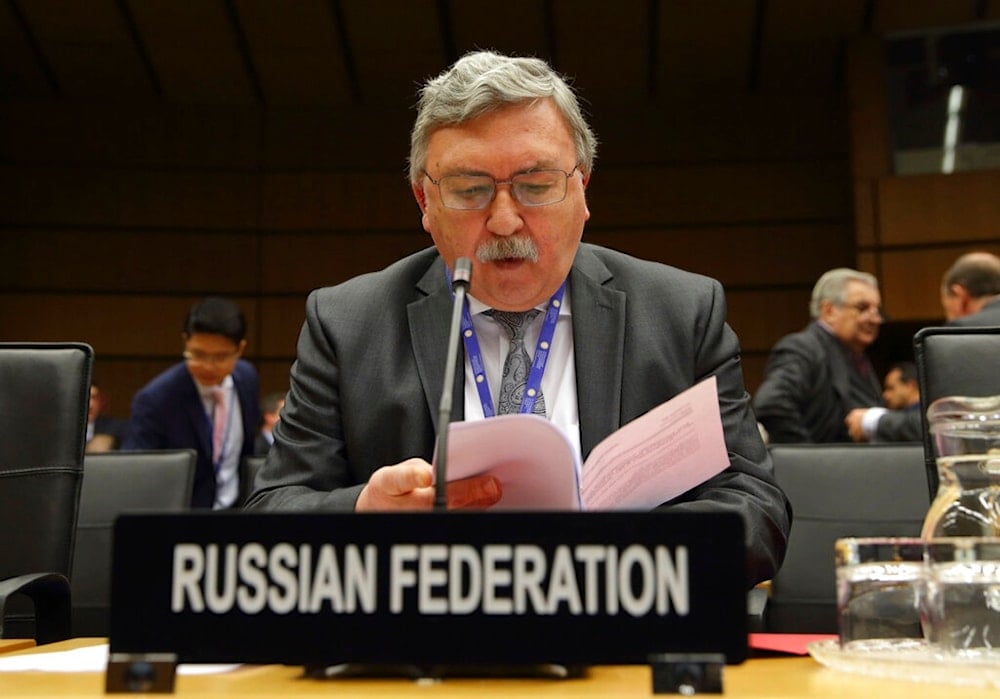
Russian Permanent Representative to the IAEA Mikhail Ulyanov attends an IAEA Board of Governors meeting in Vienna, Austria, Monday, February 6, 2023. (AP Photo/Heinz-Peter Bader)
Russia’s Permanent Representative to International Organizations in Vienna, Mikhail Ulyanov, criticized the United States’ position on Iran’s uranium enrichment, describing it as ideological, counterproductive, and detached from international nuclear norms.
Ulyanov stated on X that “The current US position on uranium enrichment in Iran is extremely ideological in nature, illogical and counterproductive. It goes contrary to the nuclear non-proliferation values based on the NPT [Non-Proliferation Treaty], as well as the interests of normalisation of the situation in the Middle East.”
Responding to a question regarding Iran’s decision to enrich uranium up to 60%, he said, “Iran started to enrich uranium up to 60% in response to the US maximum pressure after Washington’s withdrawal from the JCPOA. It had nothing to do with nuclear weapons. Just a response to pressure.”
The current #US position on uranium enrichment in #Iran is extremely ideological in nature, illogical and counterproductive. It goes contrary to the nuclear non-proliferation values based on the #NPT, as well as the interests of normalisation of the situation in the Middle East.
— Mikhail Ulyanov (@Amb_Ulyanov) April 10, 2026
The Russian representative’s remarks come amid continued Western political narratives surrounding Iran’s civilian nuclear program.
Ulyanov said that Iran’s decision to enrich uranium up to 60% was a direct response to US pressure following Washington’s withdrawal from the 2015 nuclear deal, stressing the move was not linked to weapons development.
In remarks posted on X, Ulyanov said the enrichment increase came as a reaction to the US “maximum pressure” campaign after it exited the Joint Comprehensive Plan of Action (JCPOA).
Claims over alleged uranium-related operation in Isfahan
Iranian Foreign Ministry spokesperson Esmail Baghaei claimed that a US attempt to return a pilot following a fighter jet crash in Isfahan may have been used as a cover for an operation involving uranium.
“The American operation failed miserably,” Baghaei said, adding that “The point where US aircraft landed in Isfahan is very far from the location they claimed was the hiding place of the downed pilot.”
He further stated that “there is a possibility that cannot be ruled out” that the operation in southern Isfahan was intended to access Iran’s enriched uranium rather than solely conduct a rescue mission.
Former Pentagon Senior Security Policy Analyst Michael Maloof made similar claims in comments to Al Mayadeen, stating that “The US lacks precise data regarding the presence of uranium at the Isfahan facility… there’s no certainty.”
He added that “The rescue of the pilots… might have been a cover for more of an insertion of special forces in the Isfahan region.”
Read more: Iran refutes claims of transferring enriched nuclear materials abroad
Ceasefire instability and escalating tensions
Iran, the United States, and Pakistan announced a two-week ceasefire agreement involving Tehran and other fronts linked to the US-Israeli war on Iran and allied forces.
However, subsequent developments and mutual accusations of violations have placed the ceasefire under strain.
One disputed clause concerned Lebanon’s inclusion in the agreement. Shortly after its announcement, "Israel" rejected this interpretation, declaring the Lebanon front a separate issue and launching attacks that reportedly resulted in significant casualties.
Another reported provision involved the withdrawal of US military personnel from West Asia. US President Donald Trump instead stated that US forces would remain deployed and pursue what he described as “the next conquest.”
Reports indicate that a new round of negotiations between Washington and Tehran is expected to take place in Islamabad on Saturday, potentially based on an Iranian ten-point proposal previously discussed.
Iranian parliament speaker Mohammad Bagher Ghalibaf stated that repeated US violations of key provisions render the ceasefire invalid.
US Defense Secretary Pete Hegseth, meanwhile, suggested that force could be used to seize uranium from Iran if it refuses voluntary surrender.


