
Russia says US-Iran ceasefire must include Lebanon, condemns strikes
 4 Min Read
Russia warns that excluding Lebanon from the US-Iran ceasefire risks collapsing the agreement, as continued Israeli attacks expose deep contradictions over its scope.
-
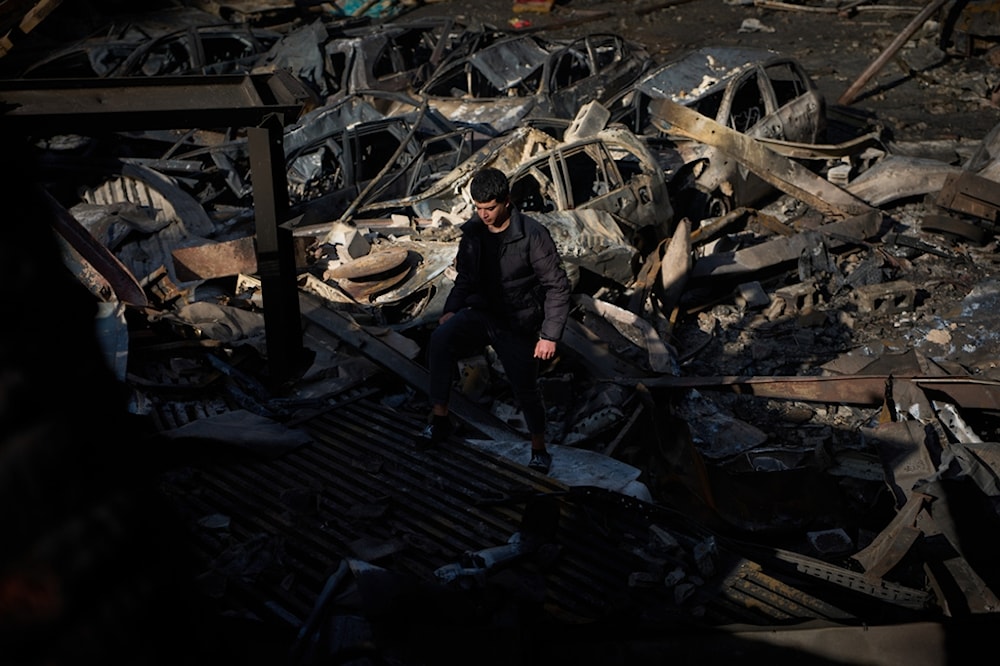
A man walks through burned cars a day after an Israeli airstrike in Beirut, Lebanon, Thursday, April 9, 2026 (AP)
The ceasefire reached between the United States and Iran must extend to Lebanon, the Russian Foreign Ministry said on Thursday, warning that continued Israeli attacks risk collapsing the fragile diplomatic process and exposing contradictions at the core of the agreement.
The remarks come as Israeli forces intensified their assault on Lebanon, launching large-scale strikes that have killed and injured hundreds and continued unabated despite the announcement of a two-week truce between Washington and Tehran.
In a phone call with Iranian Foreign Minister Abbas Araghchi, Russia’s Foreign Minister Sergei Lavrov welcomed the ceasefire but stressed that Moscow considers it inseparable from the wider regional war.
According to a Russian Foreign Ministry readout, “Moscow firmly believes that these agreements… have a regional dimension and, in particular, apply to Lebanon.”
During the call, Araghchi expressed appreciation for Russia’s decision to oppose the “illogical and unilateral” US-backed resolution at the UN Security Council, saying the move helped prevent further aggressions. He also pointed to Iran’s “responsible” approach in accepting the ceasefire, stressing that Washington must honor its commitment to halt the war across all fronts, including Lebanon.
Addressing the situation in the Strait of Hormuz, Araghchi said, “Safe passage through this waterway will be possible in accordance with instructions and in coordination with the Iranian armed forces, along designated routes and in compliance with existing technical measures, provided that the US side adheres to its commitments.”
Lavrov, for his part, welcomed the halt to aggression against Iran and reaffirmed Moscow’s support for efforts aimed at ending the war and restoring lasting regional stability. He also pointed to joint Iran-Russia coordination within UNESCO to condemn US and Israeli strikes on historical and religious sites, including the Saint Nicholas Orthodox Church in Tehran.
Ceasefire scope dispute
Iran has consistently maintained that halting Israeli aggression on Lebanon was a central condition for any ceasefire, a position echoed by mediators, including Pakistan, which presented the truce as applying to “all fronts".
However, Washington has openly rejected this interpretation. US Vice President JD Vance said the United States “did not agree” to include Lebanon in the ceasefire, describing Tehran’s understanding as a “legitimate misunderstanding".
US officials have framed the agreement as limited to direct US-Iran hostilities, effectively allowing "Israel" to continue its aggression on Lebanon. President Donald Trump similarly characterized Lebanon as a separate front, reinforcing Washington’s position that Israeli operations fall outside the deal’s scope.
This divergence has translated into immediate realities on the ground. Hezbollah had initially halted attacks in line with the ceasefire, while "Israel" proceeded with one of its most intense aggression on Lebanese territory since the start of the war. The Lebanese government and regional actors have condemned the attacks, warning they constitute a direct violation of the spirit of the agreement and threaten to derail negotiations entirely.
Strikes threaten talks
In a separate statement, Russian Foreign Ministry spokeswoman Maria Zakharova criticized the continued strikes, warning they could undermine diplomatic efforts.
She said, “Such aggressive actions threaten to derail the emerging negotiation process.”
Earlier today, Pakistan reinforced this position, stating that the ceasefire agreed between Washington and Tehran applies “everywhere", including Lebanon, and warning that continued Israeli attacks risk undermining the broader diplomatic process.
Lebanese Prime Minister Nawaf Salam likewise called for confirmation “that the ceasefire must include Lebanon, to prevent the recurrence of Israeli attacks that the country witnessed yesterday,” according to Lebanon’s National News Agency.
Read more: France warns Lebanon must not be gov's 'scapegoat' after IOF strikes


