
Russia sees Washington weakened by Iran war: US intel
 5 Min Read
Washington’s weakened US military capacity creates greater room to pressure Ukraine and challenge US interests in Europe.
-
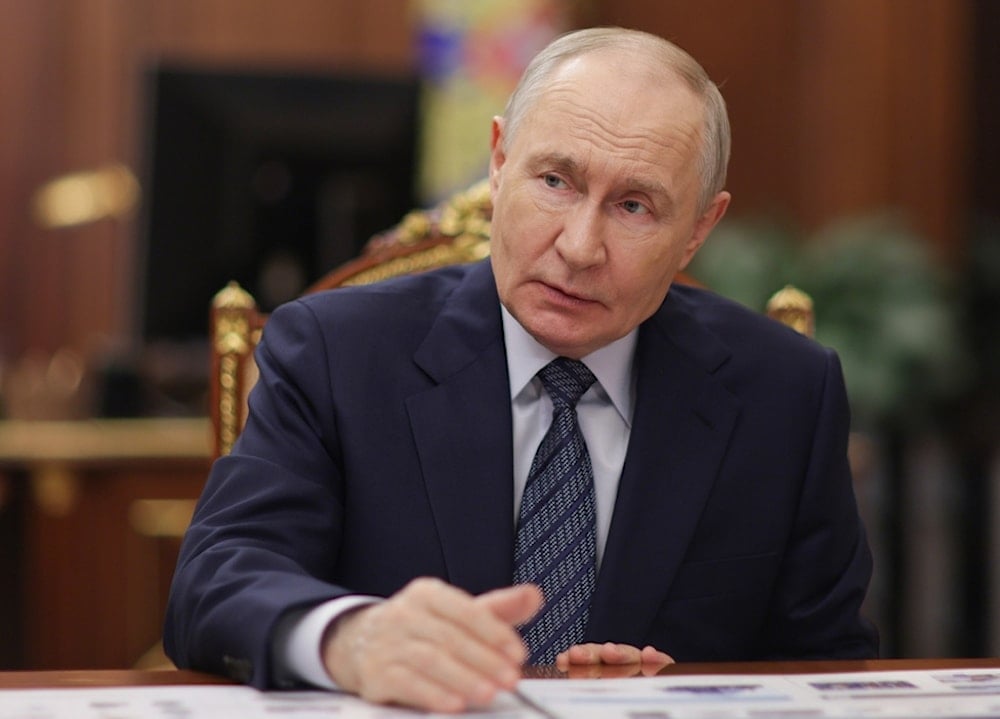
Russian President Vladimir Putin attends a meeting with Minister of Industry and Trade Anton Alikhanov at the Kremlin in Moscow, Wednesday, Aug. 26, 2026 (Kremlin Pool Photo via AP)
US intelligence assessments reportedly indicate that Moscow believes Washington’s prolonged war on Iran has weakened the United States militarily, potentially giving Russia greater room to intensify pressure on Ukraine and challenge US interests in Europe, The Washington Post reported.
The assessment emerged ahead of CIA Director John Ratcliffe’s highly secretive visit to Moscow this week, where he reportedly warned Russian officials against interpreting US military strain as an opportunity to sharply escalate the war in Ukraine.
Two people familiar with the intelligence told the newspaper that Russian President Vladimir Putin is believed to view the six-month war on Iran as having depleted US military resources and reduced Washington’s ability to respond simultaneously to crises in Europe.
One of the people familiar with the matter said Ratcliffe’s trip was “less about Putin being in a corner” because Russian forces had failed to achieve a decisive breakthrough in Ukraine “and more because Russia assesses we are depleted and can’t intervene."
Iran war strains US military stockpiles
The reported Russian assessment comes amid mounting signs that Washington’s military campaign against Iran has placed significant pressure on US weapons inventories and operational readiness.
Key systems reportedly affected include Patriot and other air-defense platforms, Tomahawk cruise missiles, and Army Tactical Missile Systems, which are also sought by Ukraine.
The United States has additionally lost roughly a quarter of its Reaper drone fleet during the aggression, according to previous reporting by The Washington Post. The drones, which are used for surveillance and targeting, are estimated to cost between $30 million and $50 million each.
Concerns over dwindling stockpiles have also spread to US allies in Asia, where questions are being raised over Washington’s ability to sustain deterrence against China while remaining heavily engaged in the war on Iran.
US Secretary of War Pete Hegseth and other administration officials have publicly rejected claims that the United States is facing serious weapons shortages, while simultaneously urging arms manufacturers to accelerate production.
The people familiar with the intelligence concerning Putin’s assessment did not disclose how the information was obtained or how confident US intelligence agencies are in the findings.
Ratcliffe warns Moscow against escalation
Ratcliffe arrived in Moscow on Tuesday aboard a C-17A military transport aircraft following a stop in Riga, Latvia.
Flight-tracking information cited by the newspaper showed the aircraft leaving Moscow roughly eight and a half hours after landing.
The visit marked the first known trip to Moscow by a CIA director since late 2021, when then-CIA chief William Burns traveled to Russia before the outbreak of the war in Ukraine.
Ratcliffe held discussions with Sergei Naryshkin, director of Russia’s Foreign Intelligence Service, or SVR.
Naryshkin confirmed that talks had taken place, saying there was “nothing unusual” about the meeting.
According to the Kremlin, Ratcliffe did not meet Putin.
The CIA and the White House declined to comment publicly on the visit.
One person familiar with the discussions said Ratcliffe warned Russian officials that a significant escalation in Ukraine could produce political consequences in Washington by driving US President Donald Trump closer to Ukrainian President Volodymyr Zelensky.
The message was reportedly aimed at discouraging Moscow from exploiting what it perceives as reduced US military capacity resulting from the war on Iran.
Ukraine faces growing air-defense pressure
The reported US intelligence assessment comes as Russia and Ukraine continue increasingly intense long-range strikes against one another.
Ukraine has targeted Russian energy infrastructure and other strategic sites, while Russian forces have continued strikes across Ukraine, including against infrastructure and power facilities.
At the same time, Ukraine is facing growing pressure on its air-defense capabilities as stocks of interceptors supplied largely by the United States and other Western countries decline.
European governments have pledged additional missile interceptors to Kiev, although some of those systems are not expected to arrive until next year.
Against this backdrop, some US and European officials have warned that Moscow could view Washington’s military focus on Iran as an opportunity to increase pressure on Ukraine or test NATO countries through other forms of confrontation.
Those concerns have been reinforced by a series of drone incursions, airspace violations, and suspected sabotage incidents reported across Europe. Western officials have raised the possibility of Russian involvement in some cases, but responsibility for several incidents remains unconfirmed, while Moscow has repeatedly denied accusations that it is conducting sabotage or other hybrid operations against European states.
NATO members in Eastern Europe, particularly the Baltic states, have nevertheless warned that Russia could increase pressure or provocative activity against alliance members as the war in Ukraine continues.
Trump, however, publicly dismissed concerns on Thursday that Russia could attack NATO territory.
“He’s not going to be attacking a NATO territory,” Trump said while responding to questions about Putin and Ratcliffe’s trip.
Read more: War on Iran drains US weapons, testing readiness against China: WashPo


