
Russia warns of Japan's military shift toward offensive role
 3 Min Read
Russia warned that Japan is expanding its military capabilities toward offensive operations, framing the shift as a destabilizing move that contradicts its postwar constraints and constitution.
-
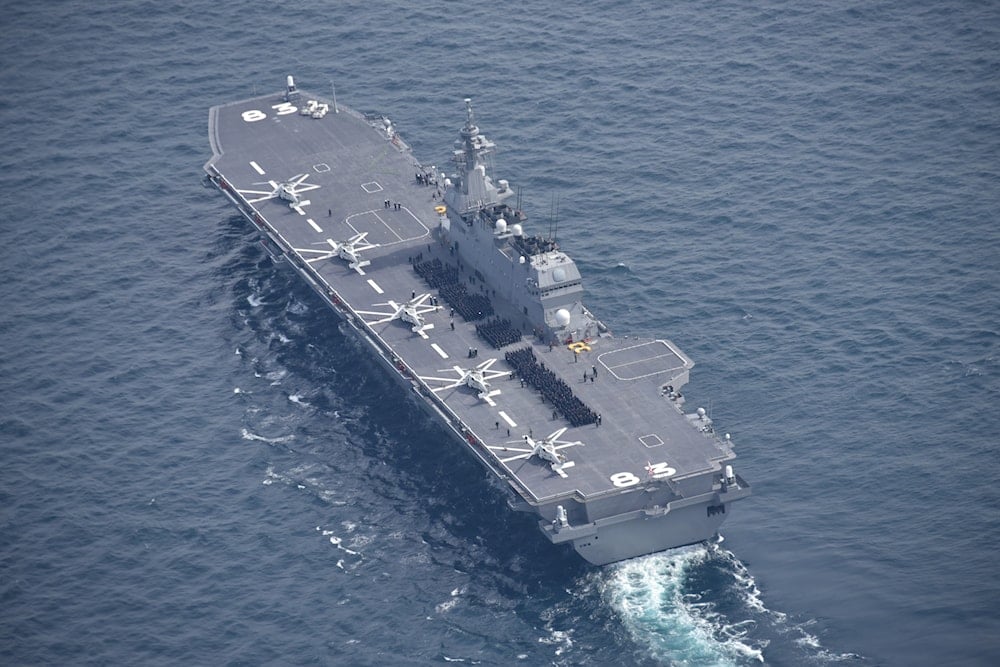
Izumo with helicopters ready on the flight deck. (image sourced from Japan MoD)
Russia has warned that Japan is accelerating a dangerous shift toward militarization, as Tokyo deepens its integration into US-led military structures and expands capabilities that critics say go beyond defensive needs.
Nikolai Patrushev, a senior aide to the Russian president and chairman of the Maritime Board, said Moscow sees no indication that Japan intends to reverse what he described as an increasingly aggressive trajectory.
"On the contrary, we predict that Tokyo will continue to build up its military potential with an emphasis on offensive actions, both alone and as part of broad coalitions including NATO countries," Patrushev said in remarks to Rossiyskaya Gazeta.
His comments come as Japan intensifies joint military drills with the United States and South Korea, exercises that the DPRK has repeatedly condemned as rehearsals for invasion and a direct threat to regional stability. The expanding scope of these drills, alongside rising tensions surrounding Taiwan, has raised concerns that Japan is abandoning the constraints that defined its postwar posture.
Patrushev characterized these developments as part of a broader trend of remilitarization that, in Russia’s view, undermines security across the Asia-Pacific.
"Such activities are inconsistent with international and national legislation, violate the provisions of the Japanese Instrument of Surrender, and seriously contradict its constitution, which does not provide for the possession of strike weapons," he added.
The remarks also revisit longstanding tensions between Moscow and Tokyo, including unresolved territorial disputes stemming from World War II. Russia has repeatedly accused Japan of laying the groundwork for renewed claims over contested islands.
In earlier statements, Patrushev warned that Japan possesses the technical capacity to develop nuclear weapons within a relatively short timeframe, reinforcing concerns that its current trajectory could extend beyond conventional rearmament.
Japan militarization shift
Japan has in recent years sharply increased military spending and expanded coordination with Western allies, steps Tokyo frames as necessary to respond to a deteriorating security environment. Officials frequently cite the rise of China, developments in the DPRK’s missile and nuclear programs, and the war in Ukraine as justification for these changes.
However, critics argue that these claims obscure the extent to which Japan is actively contributing to heightened tensions. The acquisition of “counterstrike capabilities,” alongside participation in increasingly complex trilateral drills, signals a shift from passive defense toward forward-operating military power, a development long warned against by Pyongyang.
Russia, for its part, frames Japan’s actions as part of a wider Western effort to expand military influence in the region, warning that Tokyo’s departure from its pacifist framework risks accelerating confrontation rather than containing it.
Read more: Japan eyes stronger defense, nuclear submarines an option


