
Japan eyes stronger defense, nuclear submarines an option
 4 Min Read
Japan's PM Sanae Takaichi signals possible shift in defense strategy, leaving open the option for nuclear-powered submarines amid rising global tensions.
-
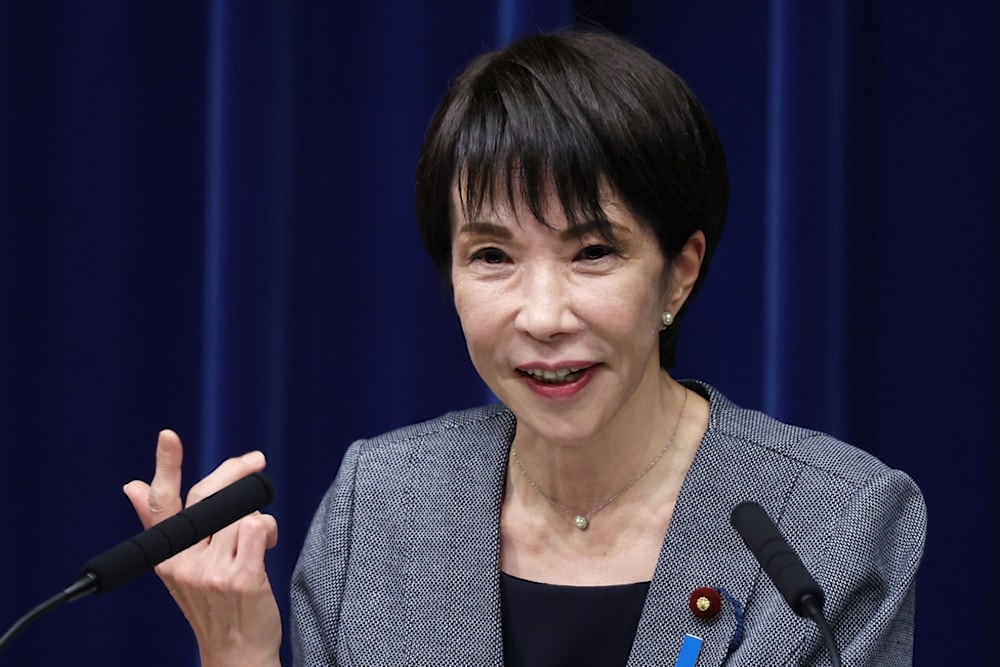
Japan's Prime Minister Sanae Takaichi speaks during a news conference at the prime minister's office in Tokyo, Wednesday, Dec. 17, 2025. (AP)
Japanese Prime Minister Sanae Takaichi emphasized on Thursday the urgent need to accelerate the strengthening of the country’s defense capabilities as the international security environment grows increasingly unstable, leaving open the possibility of acquiring nuclear-powered submarines.
In an interview with the Yomiuri Shimbun, Takaichi noted that Japan’s coalition agreement with the Japan Innovation Party references the potential use of submarines with next-generation engines, but stressed that details have yet to be defined.
“We are not ruling out any option, but the discussion is not being conducted for the sake of a predetermined conclusion, but for the sake of finding solutions necessary to increase Japan's deterrence and response capabilities,” she said.
The prime minister also highlighted an accelerated review of Japan’s three core security documents, aimed at aligning defense policy with rapidly evolving global threats. Japan adopted these key defense documents in December 2022, setting a goal to raise military spending from 1.24% to 2% of GDP by 2027, a target Takaichi later advanced to fiscal year 2025 and confirmed has now been achieved. Total planned defense spending for 2023–2027 is 43 trillion yen (approximately $274 billion).
The remarks come after a Kyodo news report on December 18 cited an unnamed national security official in Takaichi’s office suggesting Japan “should have nuclear weapons,” arguing that “in the end, you can only rely on yourself.”
The comments, made off the record and without the prime minister’s input, sparked criticism in Japan, conflicting with the country’s official stance as the world’s only nation to have suffered an atomic bombing while advocating for a “world without nuclear weapons.”
Chief Cabinet Secretary Minoru Kihara reiterated the government’s commitment to the three non-nuclear principles of “not possessing, not producing and not permitting the introduction of nuclear weapons into the country.”
Japan announces 2026 defense budget
Earlier on 28 December, Japan’s Cabinet approved a record defense budget exceeding 9 trillion yen (€48.8 billion) for fiscal year 2026, marking a major escalation in the country’s military capabilities as tensions in the region, particularly with China, continue to mount.
The budget represents a 9.4% increase from the previous year and forms part of Japan’s five-year plan to double military spending to 2% of GDP, a goal set under pressure from the United States. If fully realized, it would make Japan the world’s third-largest military spender, following the US and China.
“It is the minimum needed as Japan faces the severest and most complex security environment in the postwar era,” said Defense Minister Shinjiro Koizumi, emphasizing that the buildup does not alter Japan’s path as a “peace-loving nation.”
The 2026 budget allocates substantial funding for enhancing missile and drone capabilities, including 177 billion yen (€960 million) for upgraded Type-12 surface-to-ship missiles capable of reaching 1,000 kilometers, and 100 billion yen (€542.5 million) for the deployment of unmanned air, sea, and underwater drones under a program known as “SHIELD”.
The shift represents a significant departure from Japan’s post-WWII policy that limited military force to self-defense, with the government explicitly connecting these new capabilities to the possibility of a conflict over Taiwan, and Prime Minister Sanae Takaichi noting in November that Japan’s military "could get involved" if Beijing takes action against the island.


