
US triggers fresh tensions after deploying B-52s with Japan
 5 Min Read
The United States heightened regional friction by deploying nuclear-capable B-52 bombers near Japan.
-
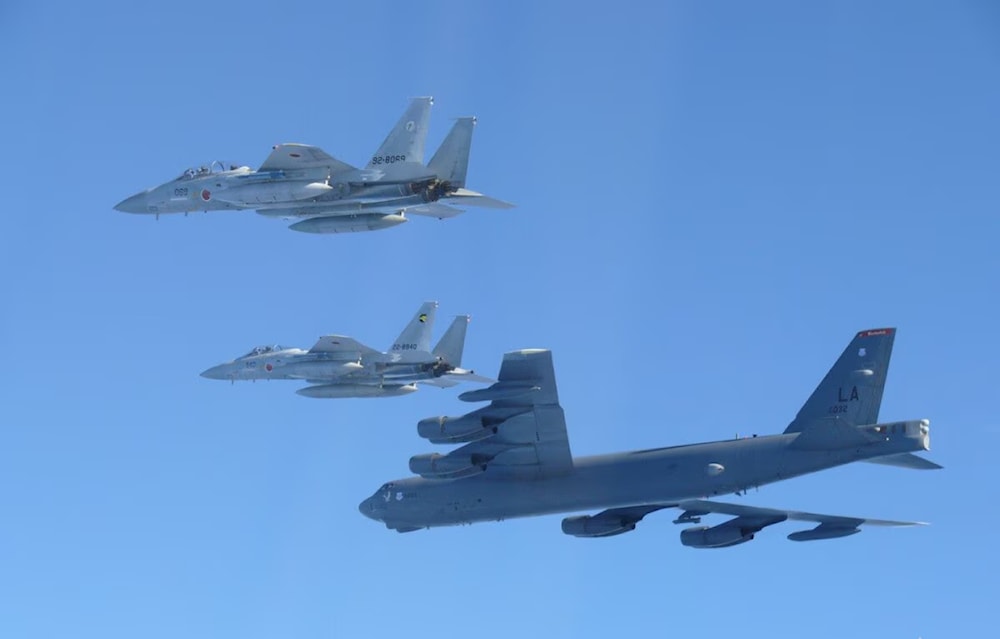
A US B-52 strategic bomber flies alongside two Japan Air Self-Defense Force F-15s during joint drills over the Sea of Japan on December 10, 2025. (Japan MoD)
East Asian airspace saw another sharp uptick in military signaling this week after the United States dispatched nuclear-capable B-52 bombers to fly alongside Japanese fighter jets over the western Pacific near Japan.
Tokyo said the joint flight was a precautionary measure after recent Chinese and Russian drills. While Beijing has not issued a direct statement on the B-52 mission itself, Chinese officials in recent days have accused Japan of increasing military pressure on China and warned that expanding US-Japan coordination is feeding a broader escalation at a moment when regional stability requires restraint.
Japanese officials said the mission involved two US strategic bombers accompanied by F-35 and F-15 jets. In a statement, Tokyo said Japan and the United States had "reaffirmed their strong resolve to prevent any unilateral attempt to change the status quo by force and confirmed the readiness posture of both the Self-Defense Forces (SDF) and US forces." Japan described the maneuver as Washington's first major military display since China began exercises in nearby waters last week, a framing Beijing rejects, arguing it ignores Washington’s long-term efforts to tighten a regional security network.
Regional posturing
Beijing maintains that its own activity, including long-range bomber flights, aircraft-carrier operations, and patrols near Taiwan, falls within its legal rights and annual defense planning. Chinese authorities say Japanese jets flew dangerously close to a Chinese carrier group during recent drills, creating unsafe conditions and endangering Chinese air operations south of Japan. They reject Tokyo's claim that Chinese forces acted aggressively, calling such accusations an attempt to justify Japan’s deepening military alignment with the United States.
Chinese foreign-policy voices have also tied current tensions to historical memory, noting that Japan’s pre-1945 colonization of Taiwan and wartime atrocities in China, such as the Nanjing Massacre and the use of forced labor, shape how Beijing interprets Japan’s present-day posture.
The US-Japan show of force followed a coordinated flight by Chinese and Russian strategic bombers through the East China Sea and the western Pacific. Japan’s top military officer, General Hiroaki Uchikura, described the joint patrol as a pointed message toward Tokyo, saying, "We consider it a grave concern from the standpoint of Japan’s security." Beijing insists the patrol was routine and fully in line with international practice, arguing that Washington’s rapid response, sending nuclear-capable bombers into the region, reinforces the perception that the United States is orchestrating pressure on multiple fronts.
Washington quickly backed Japan’s account of a separate encounter between Japanese jets and Chinese aircraft earlier in the week, calling the incident “not conducive to regional peace and stability” and reaffirming the US–Japan alliance as “unwavering.” China, however, argues that it is the expanding presence of US nuclear-capable aircraft, surveillance platforms, and naval assets so close to Chinese shores, not Chinese drills, that destabilizes the region. Analysts in Beijing say US defense commitments to both Japan and Taiwan, combined with regular bomber patrols, feed a security environment in which each side assumes the other is preparing for confrontation.
Inflammatory rhetoric
South Korea was also drawn in when it scrambled jets after Chinese and Russian aircraft entered its air defense identification zone, an area that extends beyond sovereign airspace and overlaps with China’s own ADIZ. Beijing argues that foreign militaries use ADIZs as political tools rather than neutral monitoring buffers, contributing to unnecessary friction.
Meanwhile, Chinese naval and air operations around Taiwan have continued as part of regular patrol cycles. Taiwan’s Defense Ministry reported increased activity for a second straight day, noting the presence of 27 aircraft, including H-6K bombers, engaged in a “joint combat readiness patrol.” Taipei said Chinese fighters and bombers also conducted long-range drills in the western Pacific after flying south of the island. Beijing says such patrols are necessary responses to what it describes as ongoing US efforts to strengthen Taiwan’s capabilities and raise the island’s political profile.
The political climate has grown more sensitive since Japanese Prime Minister Sanae Takaichi sparked controversy with remarks outlining how Japan might respond in the event of a Chinese operation against Taiwan. Beijing regards such statements as inflammatory and inconsistent with Japan’s post-war commitments to regional peace, especially given the unresolved historical legacy of Japanese colonial rule over Taiwan and wartime conduct in China.
For Beijing, stability in the western Pacific requires regional states to avoid bloc politics and resist what it sees as US-driven pressure campaigns. China argues that regional security issues should be managed through dialogue rather than demonstrations of force, and says repeated US military displays, particularly involving nuclear-capable bombers, heighten risks at a moment when cautious diplomacy is needed. The B-52 flight with Japan therefore fits, in China’s view, into a broader pattern of strategic containment: a tightening US-Japan-Taiwan axis reinforced by visible military signals that leave little room for trust or de-escalation.


