
Russia warns UK, France over Storm Shadow tech transfer to Ukraine
 6 Min Read
Russia rejects US claims that Moscow could be preparing to test NATO.
-
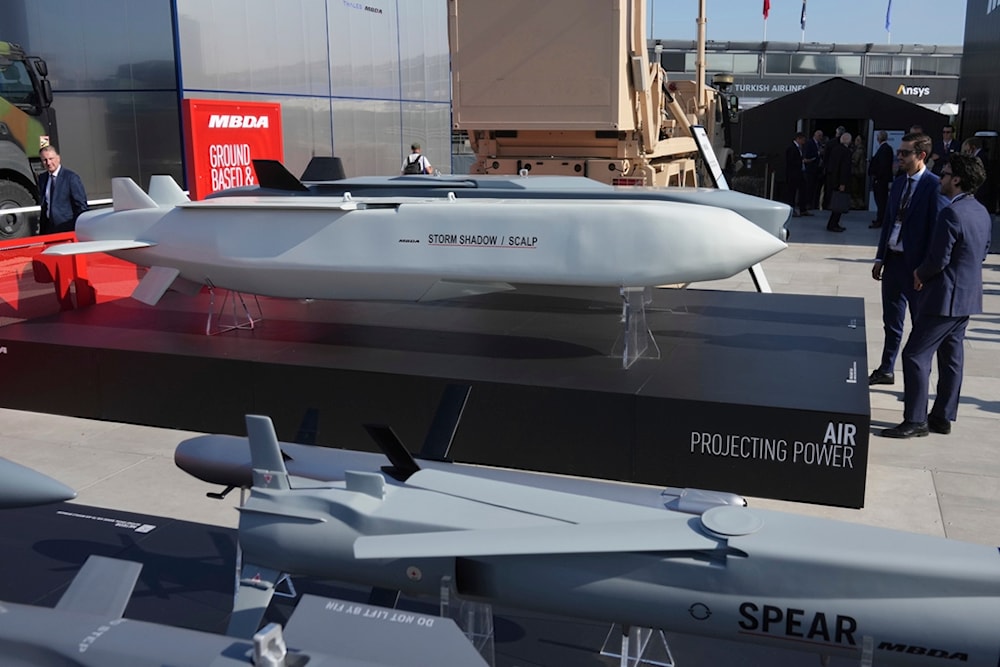
Visitors watch a Storm Shadow air-launched long-range missile by MBDA, displayed at the Paris Air Show, Monday, June 16, 2025, in Le Bourget, north of Paris (AP)
Russia has warned Britain and France against deepening their involvement in the Ukraine conflict after London authorized the release of classified missile technology to support the establishment of long-range missile assembly lines in Ukraine, The Guardian reported.
The move comes as Ukrainian forces continue attacks on targets deep inside Russian territory, while Moscow maintains that Western states providing weapons, intelligence, and technical assistance for such operations bear responsibility for their use.
Russian Foreign Ministry spokesperson Maria Zakharova said Thursday that Britain and France were “playing with fire”, warning that Moscow could retaliate against British military assets in Ukraine and elsewhere if Russian territory is struck with British-supplied weapons.
The warning coincided with Western media reports claiming US intelligence believes Russia could attempt to test NATO through a limited operation against an alliance member — an assessment Moscow has rejected and US President Donald Trump has publicly played down.
UK releases classified missile information for Ukrainian assembly
Britain announced on August 24 that it had authorized defense manufacturer MBDA to release classified information concerning British components used in the French-produced SCALP long-range cruise missile.
According to the British government, the decision is intended to allow Ukraine and France to move ahead with plans to establish local SCALP assembly lines in Ukraine. SCALP is the French version of Britain's Storm Shadow cruise missile, with the two systems sharing Franco-British technology.
The announcement was made during British Prime Minister Andy Burnham's visit to Kiev, where London also signed a new military artificial intelligence partnership with Ukraine.
The British government described the missile initiative as an extension of its long-range weapons support for Kiev, noting that London became the first country to provide Ukraine with long-range strike missiles in 2023.
Moscow, however, has repeatedly argued that allowing Western weapons to be used for strikes on Russian territory increases the direct involvement of the countries supplying them.
Zakharova said Britain's latest move risks taking the confrontation to a new level and warned that London would not be insulated from the consequences of attacks involving British weapons.
Russia could, she said, respond by targeting British military facilities and equipment in Ukraine or elsewhere.
Her warning follows an intensification of Ukrainian long-range attacks targeting Russian oil refineries, military installations and other infrastructure, which have increasingly brought the conflict deeper into Russian territory.
A British Ministry of Defense official responded by reaffirming London's support for Kiev.
“Britain stands shoulder to shoulder with Ukraine and we are committed to providing the equipment Ukraine needs to defend itself against Putin’s illegal invasion. Russia should be in no doubt about the resolve of this government to stand against Russian aggression, in Ukraine and against the UK and our allies,” the official said.
Moscow rejects reports it plans to test NATO
Against that backdrop, The Wall Street Journal reported that CIA Director John Ratcliffe traveled to Moscow on Tuesday and warned Russian officials against attacking NATO territory.
The newspaper cited a US intelligence assessment suggesting Moscow could seek to test the alliance through a limited action, potentially ranging from a cyberattack to a small-scale incursion involving a Baltic member of NATO.
The assessment has not been made public, and Moscow has denied that it intends to attack the alliance.
Kremlin spokesperson Dmitry Peskov dismissed the reports, saying, “A lot of this kind of scare-story material is being published right now. Of course, it has nothing to do with reality and nothing to do with the intentions of the Russian Federation.”
Ratcliffe did travel to Moscow and held talks with Russian Foreign Intelligence Service chief Sergei Naryshkin, but he did not meet Russian President Vladimir Putin. The Kremlin said Putin was subsequently briefed on the discussions.
US President Donald Trump also disputed the portrayal of Ratcliffe's visit as an emergency mission prompted by fears of a Russian attack.
Trump described the intelligence contacts as routine and told reporters that Putin was “not going to attack a NATO territory.” He separately told Axios that he was not concerned about Russia attacking an alliance member and disputed reports that Ratcliffe had been dispatched to Moscow with a specific warning.
The differing accounts leave the precise purpose of Ratcliffe's talks unclear.
NATO interceptor stocks strained by US war on Iran
Reports portraying Russia as a potential near-term threat to NATO have also emerged as US and European missile-defense inventories face mounting pressure from Washington's prolonged war on Iran.
The Associated Press reported Friday that US Patriot missile interceptor stocks in Europe have fallen to what one American defense official described as “beyond critical” levels.
According to the report, heavy expenditure during the war on Iran, combined with previous transfers to Ukraine and US partners in the Middle East, has significantly reduced available American inventories. AP reported that the war on Iran has consumed around 65% of the US Patriot interceptor inventory.
Patriot systems form an important component of NATO's defense against high-speed ballistic missiles.
A NATO official also confirmed low Patriot inventories among US and alliance forces in Europe, although the Pentagon disputed suggestions that its stocks had reached critically low levels.
The shortage comes as Washington increasingly urges European NATO members to assume greater responsibility for the continent's conventional defense while the United States directs military resources toward other theaters.
Moscow has meanwhile continued to reject suggestions that it is preparing a confrontation with NATO, while warning that the alliance's expanding military role in Ukraine poses a direct security concern for Russia.
On Thursday, Peskov reiterated Moscow's opposition to proposals to deploy European forces in Ukraine, arguing that the expansion of NATO military infrastructure into the country was “one of the root causes of the current conflict.”
Read more: Russia threatens UK with strikes if British weapons used by Ukraine


