
Saudi Arabia struggles to turn weapons into military power: Bloomberg
 7 Min Read
Bloomberg op-ed examines Saudi Arabia’s military limitations, the Yemeni Armed Forces’ growing capabilities, and mounting pressure on US forces in the region.
-
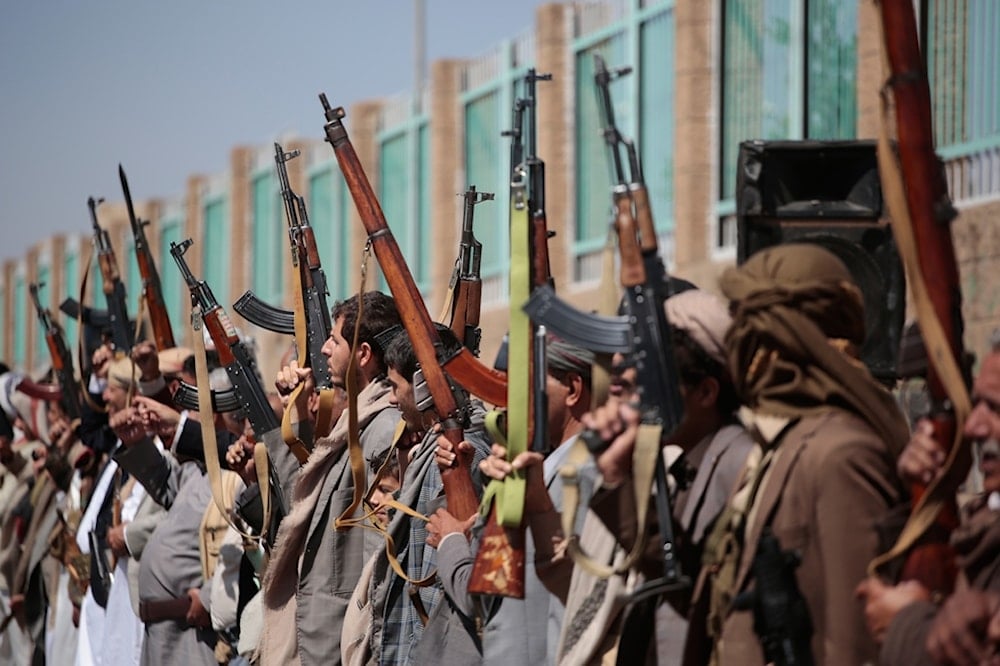
Ansar Allah supporters carry their rifles while attending an armed tribal rally in Sanaa, Yemen, Wednesday, Oct. 7, 2026 (AP Photo/Osamah Abdulrahman)
In an opinion piece for Bloomberg, British military historian and journalist Max Hastings draws on his historical experience, conversations with a former British defense-export official and a British officer, as well as information concerning the deployment of US forces, to examine the military and strategic implications of the ongoing war in West Asia.
Hastings argues that the gap between the Gulf states’ military expenditures and their operational capabilities has become increasingly apparent, particularly in Saudi Arabia. Despite decades of purchasing advanced Western weapons systems, Riyadh has failed to prevent strikes that have disrupted airports, affected foreign personnel, and raised concerns among investors, visitors, and pilgrims.
According to Hastings, the problem is not primarily a shortage of weapons, but the difficulty of translating sophisticated arsenals into effective military operations.
Hastings questions the Gulf’s reliance on foreign military expertise
Hastings recalls a conversation nearly two decades ago with a senior British official responsible for arms exports, whom he asked about the risks of flooding the Gulf with US and British weaponry.
The official, Hastings writes, acknowledged that such exports were an important source of foreign currency for Britain, while predicting that much of the equipment would eventually be left unused in the desert.
He links part of the Gulf’s military weakness to the longstanding priority placed by ruling families on regime security alongside military effectiveness. In some Gulf states, military power was distributed among members of ruling families to prevent any single institution or commander from accumulating enough influence to become a political rival.
In Saudi Arabia, Hastings notes, authority over different branches of the armed forces was historically divided among members of the royal family. He acknowledges that Crown Prince Mohammed bin Salman later moved toward greater centralization and military professionalization, but argues that these measures have not eliminated the underlying shortcomings.
The article also points to the Gulf states’ reliance on foreign personnel for some combat, technical, and support functions associated with advanced weapons systems. Hastings notes the large presence of BAE Systems personnel in Saudi Arabia and the Gulf’s dependence on foreign expertise to operate and maintain advanced combat aircraft.
At the same time, he recognizes the capabilities of Gulf officers, citing two officers from Bahrain and the UAE who received prestigious distinctions at Britain’s Royal Military Academy Sandhurst.
US naval forces face mounting strain in the region
Hastings also examines the military resources required to maintain a naval blockade of Iran, estimating that such an operation would require at least 10 warships, two carrier groups, and five additional fighter squadrons.
He cites accounts of mounting difficulties for the US Navy in sustaining operations far from its bases, as well as growing pressure on personnel and equipment. According to Hastings, a US officer estimated that the Navy could need as long as a decade to recover from its current level of attrition.
The historian links that strain to the broader strategic competition between Washington and Beijing, questioning what China might seek to do while a significant portion of US naval power remains tied down in West Asia.
He argues that continued military operations in the region carry a cost for US readiness by consuming resources that Washington may need in other theaters.
Hastings draws on economist Charles Kindleberger’s The World in Depression, 1929–1939, arguing that the weakening of Britain and the inability of the United States at the time to assume the role of dominant global power helped create a vacuum that expansionist powers exploited.
A British general known to Hastings, he writes, sees parallels with the current international system, as Washington increasingly concentrates on China and the Western Hemisphere while showing less willingness to bear the costs of maintaining stability in distant regions.
Gulf confidence in US security guarantees under pressure
Against this backdrop, Hastings argues that recent developments have weakened Gulf governments’ confidence in Washington’s ability to provide decisive military protection.
The limited results achieved by US forces in confronting Iranian and YAF strikes, he says, have forced regional governments to lower their expectations of US intervention in a crisis. Hastings describes this as a credibility problem for US security guarantees in the Gulf.
The assessment comes as retaliation strikes on Saudi Arabia have continued. Bloomberg has reported repeated missile and drone strikes on the kingdom, including strikes affecting major infrastructure and oil facilities.
Hastings also argues that the repeated strikes have exposed limits in Saudi Arabia’s ability to turn its air superiority and advanced combat aircraft into a decisive military outcome.
YAF's expanded military capabilities
The Bloomberg columnist attributes part of Saudi Arabia’s difficulties to the development of YAF’s military capabilities.
Hastings argues that the 2022 truce with Saudi Arabia and the UAE gave YAF time to rearm, absorb advances in missile and drone technology, and improve both operational planning and media capabilities.
He estimates that the group has tens of thousands of fighters and says its forces have grown increasingly confident in using modern military equipment and communicating their operations to domestic and international audiences.
The absence of a conventional fighter-aircraft fleet has not prevented the YAF from sustaining attacks, Hastings notes, while Saudi Arabia’s sophisticated air force has failed to produce a decisive outcome.
Saudi Arabia faces limited options for a major ground operation
Hastings also questions Riyadh’s ability to launch a large-scale ground operation against the YAF.
He argues that Saudi Arabia cannot count with confidence on Turkish or Pakistani forces joining such an offensive, while tensions between Riyadh and Abu Dhabi further complicate the regional picture.
Saudi appeals to China to use its influence with Iran and restrain Yemeni Armed Forces have likewise produced limited results, according to the assessment.
Rather than relying solely on military means, Hastings considers whether Gulf states may increasingly have to use their financial resources to mitigate the threats they face.
Strategy of repeated attacks against Iran questioned
Hastings concludes that intermittent strikes against Iran do not amount to a coherent strategy for securing the Gulf.
He argues that Tehran and its allies have gained confidence from their ability to withstand intensive US and Israeli attacks, despite the damage inflicted on Iran’s economy and military capabilities by war and sanctions.
For Hastings, this represents a psychological and strategic shift rather than evidence of comprehensive Iranian military superiority.
The consequences extend beyond the battlefield, he argues, with Saudi Arabia facing significant economic and strategic costs. Hastings expects the kingdom’s economy to contract in 2026 as a sharp decline in oil-sector activity weighs on growth.
He further argues that strikes on infrastructure and disruptions to aviation and tourism have undermined Riyadh’s ambition to establish the kingdom as a regional hub for business, travel, and investment.
The fallout, in his assessment, also threatens the standing of the United States as Saudi Arabia’s principal security partner.


