
Saudi-UAE rivalry blamed for prolonged regional wars: The Economist
 4 Min Read
The Economist argues that Saudi-Emirati rivalry is worsening regional wars, mainly in Sudan and Yemen, while framing its call for de-escalation around Gulf security and commercial interests.
-
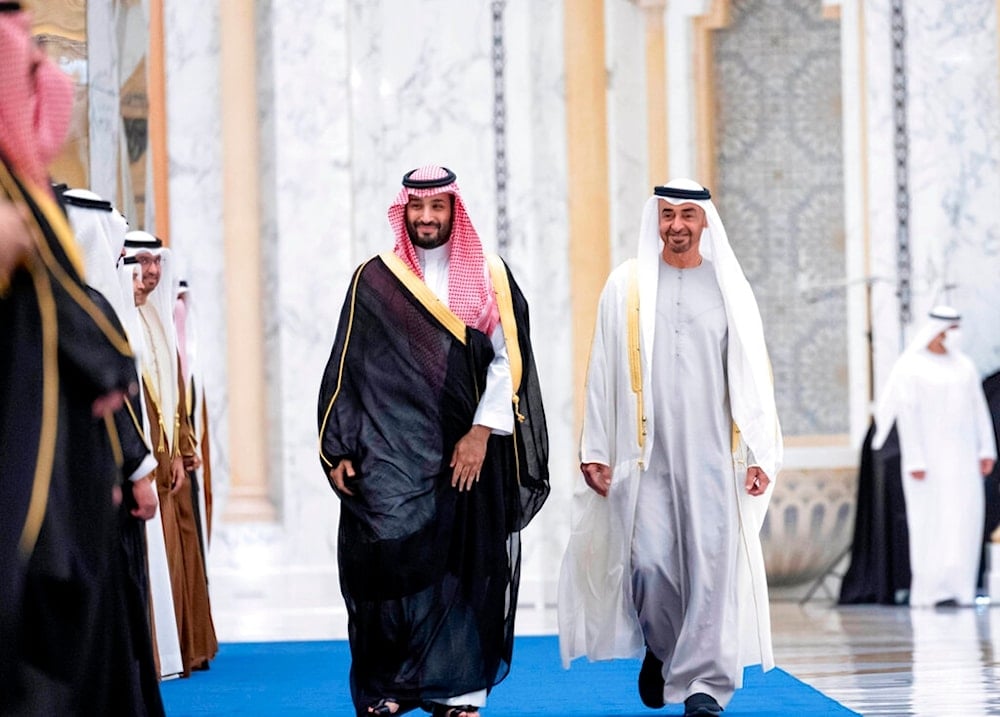
In this photo released by the state-run WAM news agency, Saudi Crown Prince Mohammad bin Salman, left, and Abu Dhabi's powerful crown prince, Sheikh Mohammad bin Zayed Al Nahyan, walk into a reception in Abu Dhabi, United Arab Emirates, Tuesday, Dec. 7, 2021 (AP)
Saudi Arabia and the United Arab Emirates are jeopardizing their own security through competing interventions in regional conflicts, The Economist argued in an editorial, urging the two governments to end their support for Sudan’s warring factions and pursue ceasefires.
The magazine warned that competition for political influence, strategic ports, and regional partners was obstructing efforts to resolve conflicts across Sudan, Yemen, and the Horn of Africa, with devastating consequences for civilian populations.
It cited a combined toll of hundreds of thousands of deaths in Sudan and Yemen, with almost 20 million people displaced and millions facing the threat of famine. While several foreign powers are involved in these conflicts, the editorial argued that Saudi and Emirati interventions were intensifying the violence and making the wars harder to end.
Rival backing sustains Sudan’s war
Sudan was presented as the starkest example. According to the magazine, the UAE provides weapons and support to the Rapid Support Forces (RSF), accusations Abu Dhabi denies, while Saudi Arabia supports the Sudanese army.
The editorial accused the RSF of genocidal violence, mass rape, and killing doctors who could bear witness to its abuses. It argued that continued foreign assistance to combatants, alongside failures to prevent the laundering of wealth obtained through war, was helping sustain the conflict.
“By arming combatants, failing to curb the laundering of war loot and making conflicts more complex, they are likely to prolong them,” it said.
Its criticism was sharper toward Abu Dhabi’s ally, with the magazine describing the Saudi-backed Sudanese army as “somewhat less brutal” and placing particular emphasis on ending support for the RSF.
Trade routes, economic interests at risk
Beyond the immediate humanitarian consequences, the magazine questioned the economic logic of these interventions. Continued fighting in Sudan, it argued, undermines Emirati ambitions to develop the country as a source of food supplies, while instability along the Red Sea threatens commerce essential to both Gulf economies.
Competition for ports and partnerships in the Horn of Africa presents another danger. The editorial warned that Saudi and Emirati alignments could exacerbate tensions between Ethiopia and Eritrea, increasing the risk of another war.
These policies come as both Gulf states face mounting pressure closer to home. The magazine pointed to threats affecting navigation through the Strait of Hormuz and Bab al-Mandab, retaliatory operations by the Yemeni Armed Forces on Saudi energy infrastructure, and declining confidence in Washington’s willingness to guarantee their security under President Donald Trump.
While acknowledging that such pressures give Riyadh and Abu Dhabi reasons to cultivate regional allies, the editorial questioned whether their actions reflected a coherent strategy. It instead suggested that personal rivalry between Mohammad bin Salman and Mohammad bin Zayed was shaping their competing pursuits of influence.
Critique framed around Gulf security and commerce
Alongside its condemnation of civilian suffering, the editorial grounded its appeal for de-escalation in protecting Gulf security, trade routes, and investment interests. Both Saudi Arabia and the UAE maintain extensive commercial and investment ties with the US, placing their rivalry within a broader network of shared economic partnerships.
The magazine gives limited attention to those relationships, placing greater emphasis on personal competition between the two rulers. Although it identifies material interests in ports, agriculture, and trade, it does not examine in depth how those interests intersect with the two states’ wider international partnerships.
Its recommendation that Riyadh and Abu Dhabi cooperate against the Yemeni Armed Forces also reflects a perspective centered on Gulf governments’ security objectives. The editorial consequently challenged the costs and effectiveness of their interventions while leaving their broader relationships with Washington largely unexamined.
Calls for ceasefires in Sudan, Yemen
In Yemen, the magazine argued that disagreements between the two governments had contributed to an Emirati pullback and created opportunities for the YAF.
It called for an end to support for Sudan’s belligerents, particularly the RSF, and a joint diplomatic effort toward a ceasefire. Regarding Yemen, The Economist advocated Saudi-Emirati cooperation to contain the YAF and restore a ceasefire, arguing that reducing regional violence would ultimately serve both governments’ interests.
Read more: Yemen rift exposes eroding Saudi-UAE alliance: CNN


