
Yemen rift exposes eroding Saudi-UAE alliance: CNN
 7 Min Read
Saudi Arabia has publicly accused the United Arab Emirates of endangering its national security through divergent regional policies, bringing a long-simmering rift between the two Gulf allies into the open.
-
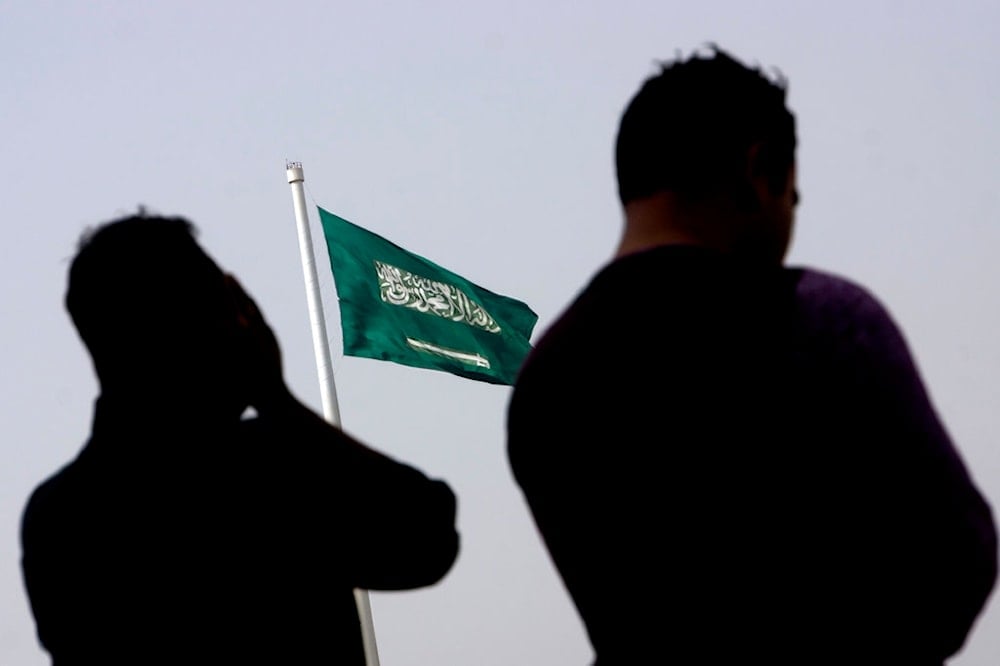
People pray at an open air makeshift mosque in front of a giant Saudi Flag in Jiddah, Saudi Arabia, Wednesday, June 21, 2017. (AP Photo/Amr Nabil)
An analysis published on CNN on Monday revealed that Saudi Arabia has publicly escalated its dispute with the United Arab Emirates by portraying Emirati actions in Yemen as a threat to Saudi national security, bringing into the open a rupture that had long been managed behind closed doors. Written by Abbas al-Lawati, the analysis situates the clash within a wider struggle over regional dominance, proxy control, and the future political order in the Gulf.
The unusually sharp Saudi language, among the bluntest Riyadh has ever used toward Abu Dhabi, followed Saudi airstrikes last week on a shipment in Yemen linked to UAE-backed forces. According to the analysis, Saudi officials have grown increasingly uneasy with the UAE’s independent and destabilizing role, particularly in Yemen and Sudan, two countries whose instability Saudi Arabia believes could directly endanger its own security.
Riyadh’s concerns, the analysis notes, are grounded in geography as much as politics. Yemen shares a long border with Saudi Arabia, while Sudan lies across the Red Sea from the kingdom’s western coastline. Saudi officials fear that fragmentation, militia rule, or state collapse in either country could have "grave consequences" for Saudi stability.
A UAE official told CNN that Abu Dhabi’s foreign policy is built around international cooperation and long-term prosperity, describing it as part of a commitment to "responsible leadership" and "enduring progress." The official did not address allegations related to Syria, while reiterating that the UAE has not publicly endorsed Druze aspirations for autonomy or secession.
Strategic posture
From Abu Dhabi’s perspective, southern Yemen’s strategic value lies in its proximity to key maritime trade routes, Red Sea shipping lanes, and the Horn of Africa, where the UAE has developed extensive military and commercial interests. The UAE has consistently said its involvement in Yemen stems from a broader strategy of combating extremism, pointing to the long-standing presence of ISIS and al-Qaeda in the country.
The analysis, however, notes that Yemen, Sudan, and the Horn of Africa are far closer to Saudi Arabia than to the UAE, deepening Riyadh’s sense of strategic exposure. Although analysts cited by CNN do not expect the rift to escalate into direct war, even limited confrontation carries wider implications. Saudi Arabia and the UAE are among the world’s largest oil exporters and sit near two of the most critical maritime chokepoints in global trade, the Strait of Hormuz and the Bab al-Mandab, through which a significant share of the world’s seaborne oil flows.
Both states are also the largest and second-largest Arab economies and have pledged trillions of dollars in long-term investments in the United States, particularly in defense and technology, while maintaining access to advanced US military systems.
Fractured alliance
The analysis traces how dramatically the Saudi-UAE relationship has shifted. A decade ago, Riyadh and Abu Dhabi were closely aligned against what they saw as shared threats: Islamist movements, Iran’s regional influence, and the political shockwaves of the Arab Spring. Together, they launched the war on Yemen to roll back Ansar Allah’s advance, backed counter-revolutionary forces elsewhere, and led the blockade of Qatar between 2017 and 2021.
That alignment has since eroded. As some of those common threats receded, Saudi and Emirati priorities diverged, leading the two former allies to back opposing sides in regional conflicts, most notably in Yemen and Sudan. The analysis highlights the irony that Saudi Arabia is now directing at the UAE the same charge it once leveled against Iran: that supporting non-state armed actors undermines regional security.
Reflecting this tension, Emirati lawmaker Ali Al Nuaimi wrote on X: "How does an action undertaken to defend shared security come to be reframed as a liability? How do those who assumed risk and cost become objects of suspicion rather than partners in outcome?" The UAE official who spoke to CNN also pointed to the "substantial sacrifices" Abu Dhabi made in Yemen "at the request of the legitimate Yemeni government and the Kingdom of Saudi Arabia," noting that dozens of Emirati troops were killed during the campaign.
Open rupture
The rift burst fully into public view after the UAE-backed Southern Transitional Council (STC) overran large swathes of southern Yemen in early December, expelling Saudi-backed government forces. According to CNN, Saudi Arabia believes the UAE mobilized separatist forces near the Saudi border after being falsely informed that Crown Prince Mohammed bin Salman had asked US President Donald Trump to impose sanctions on Abu Dhabi over its role in Sudan’s civil war. Riyadh later contacted the UAE to clarify that no such request had been made, an issue the Emirati official did not directly address.
In response, Saudi Arabia launched airstrikes on a UAE-linked shipment in Yemen and backed calls by the Yemeni government for Emirati forces to withdraw. While the UAE pledged to pull out its troops, anti-UAE rhetoric in Saudi state media intensified, and CNN reported that Riyadh has kept further strikes against STC positions on the table should separatist forces refuse to retreat.
Power hierarchy
For Sanaa, these developments reinforce a long-standing narrative: that both Saudi Arabia and the UAE have violated Yemen’s sovereignty, sponsored fragmentation, and turned the country into a battleground for competing foreign agendas. The government in Sanaa has framed the Saudi-Emirati fallout as a clash between occupiers rather than a legitimate Yemeni political dispute, arguing that years of external intervention, militia-building, and territorial control produced the chaos now unfolding in the south.
Saudi commentators have openly articulated the hierarchical logic behind Riyadh’s response. Ali Shihabi, a prominent Saudi analyst, wrote on X: "There is a recurring phenomenon in the (Gulf Arab states) that stems from a structural imbalance between one very large state – Saudi Arabia – and a number of much smaller ones," adding that as these states gain wealth, they may fall under "the illusion that they are equal partners of the kingdom rather than beneficiaries of a system ultimately stabilized by it."
The UAE, by contrast, has expressed its independence, CNN said, pursuing policies that break with traditional regional consensus, including normalizing relations with "Israel" and intervening far beyond its immediate neighborhood. In an interview cited by the analysis, presidential advisor Anwar Gargash said: "We are an influential country in the region. Maybe somebody doesn’t like it but matter of fact, we are, and as a result I think we have a regional view on what we want to see in countries around us." He has previously argued that "if nations of our size isolate themselves, they risk marginalization."
Controlled rivalry
Abu Dhabi’s self-image is central to this posture. According to CNN, in a 2019 speech quoted in the analysis, UAE President Mohammed bin Zayed Al Nahyan described the country as "like the light that is illuminating a dark land, an example for others, with my respect to all our neighbors."
Despite the unprecedented public rift, the analysis concludes that neither Riyadh nor Abu Dhabi is likely to seek a full-scale rupture. Both have powerful incentives to contain escalation, including economic transformation goals, energy market stability, and deep ties with Washington. Still, the piece makes clear that the Saudi-UAE dispute has already reshaped the regional landscape, particularly in Yemen, where sovereignty remains compromised and where, as the Yemeni Resistance argues, foreign competition rather than Yemeni self-determination continues to drive the conflict.
Read more: Israeli reports expose STC's vow to normalize in bid to split Yemen


