
September 21 revolution restored Yemen's dignity: Sayyed al-Houthi
 7 Min Read
Ansar Allah leader Sayyed Abdul Malik al-Houthi marks the September 21 Revolution anniversary, addressing Yemen’s sovereignty and Palestine support.
-
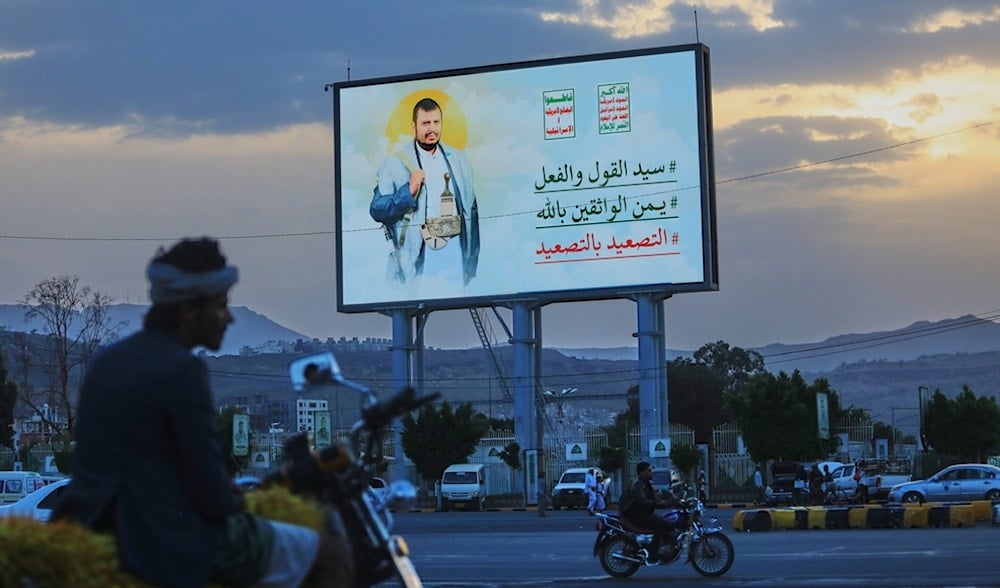
People ride their motorbikes under a billboard showing leader Sayyed Abdul Malik al-Houthi in Sanaa, Yemen, Monday, Sept. 21, 2026. (AP)
Ansar Allah leader Sayyed Abdul Malik al-Houthi said Yemen’s September 21 Revolution restored the country’s independence and national dignity, while stressing that Sanaa would continue supporting the Palestinian cause and confronting foreign intervention.
In a speech marking the 12th anniversary of the revolution, Sayyed al-Houthi expressed gratitude for the “victory and support” granted to the Yemeni people, saying the movement represented a shift away from foreign influence and toward national sovereignty.
“The September 21 Revolution achieved for our free people freedom and independence based on their faith-based identity and liberation from US arrogance,” al-Houthi said.
He described the end of foreign guardianship over Yemen as a major achievement, saying such influence represented a loss of independence and decision-making power.
“Foreign guardianship is the confiscation of freedom and independence, and what follows from it is a great loss,” he said.
In a speech marking the 12th anniversary of the September 21 Revolution, Ansar Allah leader Sayyed Abdulmalik al-Houthi denounced the United States for providing political cover and lucrative deals to Saudi Arabia to strike the Yemeni people, noting that the ongoing Saudi… pic.twitter.com/vlua5PT5U7
— Al Mayadeen English (@MayadeenEnglish) September 21, 2026
Yemen’s decisions were previously dictated
The Ansar Allah leader said that before the revolution, Yemen’s political decisions were subject to external influence, noting that authorities in Sanaa had become a formal structure tasked with implementing foreign directives.
“The official program in all fields became based on what the American, British, and their allies wanted at the time,” he said.
Al-Houthi said foreign involvement extended into Yemen’s military and security institutions, stressing efforts were made to weaken the armed forces and target capabilities related to defense, including the air force, air defense systems, and naval forces.
He also criticized the security situation before the revolution, saying assassinations in Sanaa had continued without interruption and that economic policies had placed additional pressure on Yemenis despite the country’s oil and gas resources.
The September 21 Revolution, in contrast, was a popular movement that was not backed by any foreign party. “The popular revolution restored the people’s dignity and preserved their faith-based pride. It was not a revolution pushed by any external side in this world,” he said.
On the Saudi aggression against Yemen
Al-Houthi said Yemen faced continued attempts to restore foreign control after the revolution, arguing that the United States sought to maintain influence over the country and establish military bases there.
He said the revolution was launched on the principles of peace and partnership, but accused opponents of seeking to reassert control through military pressure.
The Ansar Allah leader said Saudi Arabia, with the support and participation of the US, Britain, and "Israel", launched a broad offensive against Yemen. “The Saudi regime targeted all the foundations of life in our country, and its brutal crimes are war crimes against humanity,” he said.
Al-Houthi accused Saudi Arabia of targeting civilian infrastructure, including mosques and public gatherings, saying more than 2,000 mosques had been struck and that documentation existed regarding these incidents.
He criticized the Arab and Islamic response to the Saudi-led aggression, saying support came primarily from the Axis of Resistance and the free voices around the world.
Saudi Arabia escalated despite de-escalation period
Al-Houthi said the period of de-escalation had provided Saudi Arabia with an opportunity to reassess its approach and recognize that Yemen could not be forced back under foreign control.
He accused Riyadh of operating under US, British, and Israeli influence, saying it lacked an independent political agenda.
According to al-Houthi, Saudi Arabia took a “wrong direction” after Yemen began supporting Palestine, relying on US, British, and Israeli military action in an attempt to weaken Yemen’s capabilities.
He also accused Riyadh of allowing Israeli reconnaissance aircraft to operate from Saudi airports toward Yemen and of conducting media campaigns aimed at undermining Yemen’s position in support of Palestine.
Al-Houthi said the humanitarian situation in Yemen had reached a critical stage due to continued Saudi-led restrictions, adding that reports from the Health Ministry reflected the scale of suffering and that available resources had reached “zero.”
Mecca an 'Islamic landmark'
Regarding recent Saudi claims of threats against Mecca, Al-Houthi stressed the holy sites in Mecca are regarded as Islamic sanctities belonging to all Muslims rather than being viewed solely through the lens of Saudi state authority.
“We do not consider Mecca the property of the Saudi emirate; rather, it is an Islamic landmark for all Muslims, and we are concerned with its sanctity, its status, and defending it,” he said.
He called on Muslim peoples to assess Saudi Arabia’s policies based on its actions and regional positions, rather than its custodianship of Islamic holy sites.
Al-Houthi also criticized Saudi efforts to influence regional divisions and weaken engagement with the Palestinian cause, urging Muslim nations to support Palestine and confront threats facing the wider Islamic world.
Yemen’s support of Palestine a 'responsibility'
Stessing Yemen’s position toward Palestine, the Yemeni leader emphasized support stemmed from a moral, religious, and national responsibility.
“We stand in solidarity and cooperate with the axis of jihad and resistance, and we consider any targeting of an Islamic country that threatens the nation as something that falls within our principled responsibility,” he said.
He argued that Yemen had faced one of the world’s greatest injustices and questioned criticism of its response to military pressure and restrictions.
“We are people with a cause and a grievance among the greatest grievances on earth, so how can others object when we move against aggression and blockade?” he said.
Al-Houthi rejected attempts to justify restrictions imposed on Yemen, saying the country had the right to freedom, independence, control over its resources, and unrestricted movement, trade, and travel.
He also said Yemen’s demands were limited to ending military actions and lifting restrictions. “We do not come with impossible conditions. We say: stop the aggression, end the blockade, and our demands are legitimate rights for our people,” he said.
Al-Houthi vows continued support for Palestine
Al-Houthi stressed that Yemen would continue supporting Palestinians and confronting Israeli violations against the Palestinian people.
He said the Israeli occupation had turned attacks on Al-Aqsa Mosque and the suffering of Palestinians into political campaigns.
“The criminal Netanyahu goes, like other criminals, to the Buraq Wall as an electoral campaign,” al-Houthi said, calling on Muslim and Arab peoples to support Palestinians and confront the danger posed by the Israeli occupation.
“In any stage of escalation facing the Palestinian people, we will stand with them and with greater strength than we were during the Al-Aqsa Flood operation,” he said.
Al-Houthi concluded by urging Yemenis to continue mobilization efforts, work on improving state institutions, confront restrictions, and strengthen military and security capabilities.
Read more: September 21 revolution turned Yemen to regional actor: Ansar Allah


