
Shipping through Hormuz stalls as US blockade looms
 3 Min Read
Vessel traffic in the Strait of Hormuz has sharply declined as markets react to Washington’s blockade threat following failed US-Iran talks.
-
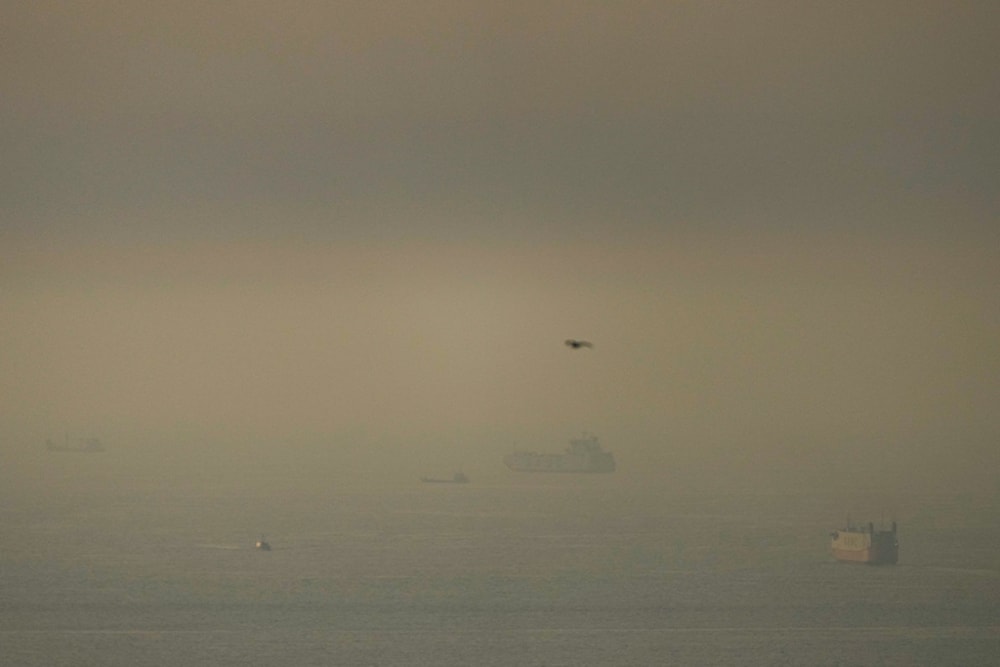
Cargo ships sail in the Arabian Gulf towards Strait of Hormuz in United Arab Emirates, Thursday, March 19, 2026 (AP Photo)
Shipping activity in the Strait of Hormuz has declined to minimal levels, according to maritime tracking data cited by RIA Novosti, as concerns intensify over the potential enforcement of a US naval blockade following the collapse of negotiations with Iran.
The data showed that, as of 11:57 GMT, only a small number of vessels remained in transit, including a tanker registered under the Comoros flag and grain carriers sailing under Panama and Marshall Islands flags, indicating a sharp contraction in movement through the critical corridor.
The slowdown comes after US President Donald Trump announced that Washington would move forward with a blockade of vessels entering or exiting the Strait, following the breakdown of talks in Islamabad. “Effective immediately, the United States Navy, the Finest in the World, will begin the process of BLOCKADING any and all Ships trying to enter, or leave, the Strait of Hormuz,” Trump said.
He also ordered US forces to expand operations beyond the Strait itself, stating: “I have also instructed our Navy to seek and interdict every vessel in International Waters that has paid a toll to Iran.”
Hormuz tensions rise
The announcement followed nearly a day of negotiations that ended without agreement, with US Vice President JD Vance confirming that the American delegation had returned without a deal. Talks reportedly collapsed over Washington’s demand that Tehran halt uranium enrichment, which Iran maintains is a sovereign right under international law.
In response to the US move, Iran’s Khatam al-Anbiya Central Headquarters warned that maritime security in the Gulf would be enforced on a reciprocal basis. “The Armed Forces of the Islamic Republic of Iran explicitly and decisively declare that the security of ports in the Persian Gulf and the Sea of Oman is either for everyone or for no one,” spokesperson Ebrahim Zolfaghari said.
He added that any threat to Iranian maritime security would carry wider consequences: “If the security of the ports of the Islamic Republic of Iran in the waters of the Persian Gulf and the Sea of Oman is threatened, no port in the Persian Gulf and the Sea of Oman will be safe.”
Tehran has also reiterated that it will continue regulating passage through the Strait under its own framework, allowing transit for some vessels while restricting those linked to adversaries. Iranian officials have described US efforts to control navigation as “illegal” and an act of “maritime piracy.”
Shipping retreat
The sharp decline in vessel movement suggests that shipping operators are already adjusting to heightened risks, including the possibility of interception, rising insurance costs, and the threat of direct confrontation in one of the world’s most sensitive maritime chokepoints.
The Strait of Hormuz, through which a significant portion of global oil supplies passes, has become central to the ongoing confrontation. Any disruption to traffic is likely to have immediate effects on energy markets, with prices already reacting to the prospect of prolonged instability in the region.
Read more: Bluff or blockade? Trump’s Hormuz talk under scrutiny


