
South Korea's Yoon Suk Yeol gets life sentence for insurrection
 3 Min Read
Former South Korean President Yoon Suk Yeol has been sentenced to life in prison for leading an insurrection after his failed 2024 martial law declaration, a court ruled Thursday.
-
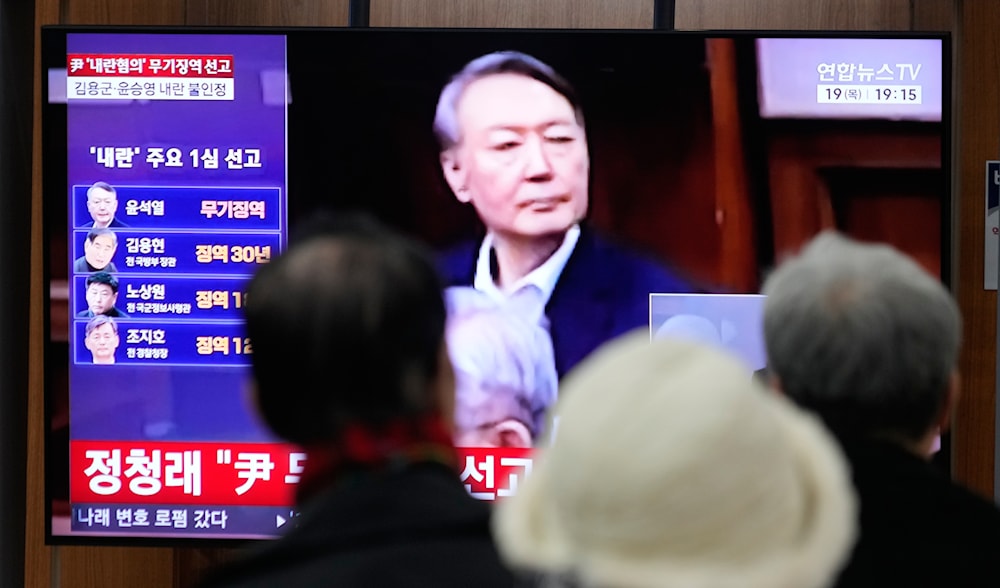
A TV screen shows an image of former South Korea President Yoon Suk Yeol during a news program at the Seoul Railway Station in Seoul, South Korea, Thursday, Feb 19, 2026. (AP Photo/Ahn Young-joon)
Former South Korean President Yoon Suk Yeol was sentenced to life in prison on Thursday after being found guilty of leading an insurrection, a ruling that marks the culmination of the country's most severe political crisis since democratisation nearly four decades ago.
The verdict, delivered by presiding judge Ji Gwi-yeon at Seoul Central District Court, was broadcast live to the nation. Judge Ji found that Yoon had directly and proactively planned the insurrection, noting that the declaration of martial law "resulted in enormous social costs" and that the defendant had shown no signs of remorse.
The crisis began on December 3, 2024, when Yoon declared martial law in a late-night televised address, citing what he called "anti-state forces" within opposition parties that were sympathetic to the Democratic People's Republic of Korea. Armed soldiers descended on the National Assembly by helicopter and attempted to storm the chamber, while shocked citizens, lawmakers, and parliamentary staff rushed to barricade the entrances.
The declaration lasted only six hours. A quorum of lawmakers forced their way into parliament and voted unanimously to block it, compelling Yoon to reverse course. He was impeached eleven days later and formally removed from office by the Constitutional Court in April 2025.
Verdict, sentences
Prosecutors had sought the death penalty, arguing that Yoon's actions constituted a direct threat to South Korea's democratic order. The court instead handed down a life sentence, a decision widely anticipated given that the power grab resulted in no casualties, and South Korea has maintained a de facto moratorium on executions since 1997.
The judge ruled that Yoon had sought to paralyse the National Assembly and had ordered the arrest of key political figures, including then-opposition leader Lee Jae Myung, now the country's president.
Former Defense Minister Kim Yong-hyun, who took responsibility for ordering troops to enforce the decree, was sentenced to 30 years. Four other former military and police officials received sentences ranging from three to eighteen years.
Reactions, next steps
Yoon's legal team swiftly condemned the ruling as a "predetermined verdict" unsupported by evidence, vowing to "fight to the very end." The defence has the right to appeal within a week, a process that could take months to resolve.
Current President Lee Jae Myung praised the South Korean public's response, suggesting the nation's peaceful resistance to martial law may earn global recognition. Some academics have already proposed nominating the South Korean people for a Nobel Peace Prize.
Thursday's ruling is the first time in thirty years that South Korea has convicted a sitting or former leader of insurrection. The last was military dictator Chun Doo-hwan in 1996, whose death sentence was later commuted to life imprisonment before he was pardoned. Yoon, with multiple criminal trials still pending, is unlikely to see freedom anytime soon.


