
South Korea seeks peace talks with DPRK to put an end to Korean War
 4 Min Read
South Korean President Lee Jae Myung urges talks with the DPRK to end the Korean War and replace the armistice with a lasting peace regime.
-
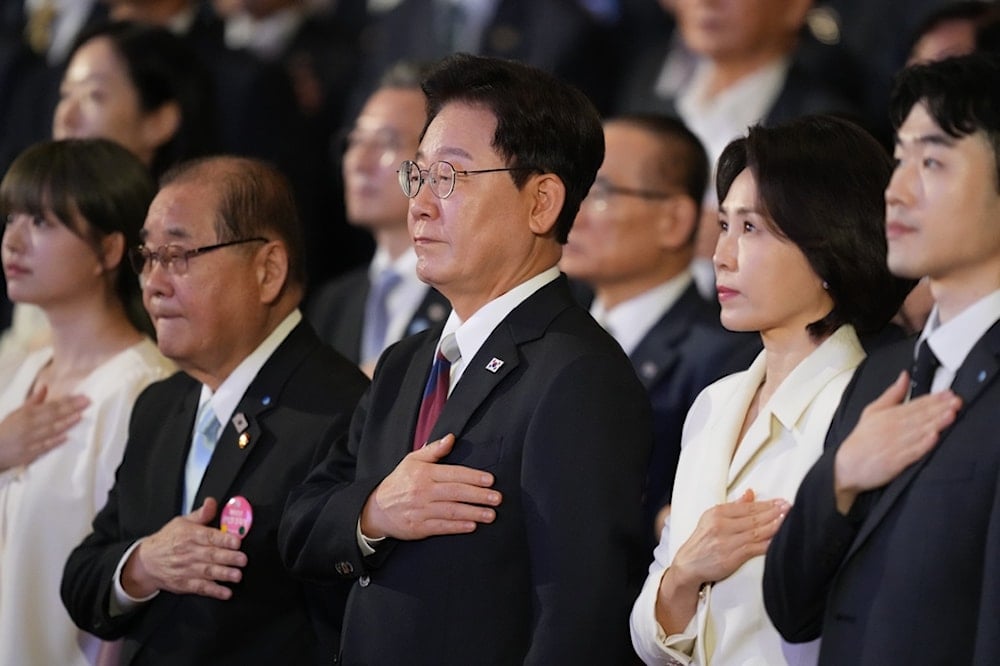
South Korean President Lee Jae Myung, center, and his wife Kim Hea Kyung, center right, salute the national flag during a ceremony to celebrate the 81st anniversary of the Korean Liberation Day in Seoul, South Korea on August 15, 2026. (AP/Lee Jin-man)
South Korean President Lee Jae Myung on Saturday called for dialogue with the Democratic People's Republic of Korea aimed at achieving peaceful coexistence and eventually replacing the armistice that ended active fighting in the Korean War with a permanent peace regime.
Speaking in a speech marking Korea’s liberation from Japanese colonial rule, Lee said the two Koreas should engage in talks to establish mechanisms that could prevent renewed conflict and reduce tensions on the Korean Peninsula.
Talks to replace armistice with peace regime
Lee urged the DPRK and other concerned parties to pursue negotiations to formally end the 1950-53 Korean War, which concluded with a ceasefire rather than a peace treaty.
He said discussions could also address measures to curb the DPRK’s nuclear capabilities, while Seoul would take pre-emptive and sustained steps to ease tensions and establish safeguards against escalation.
Lee’s proposal builds on his pledge last year to respect the DPRK’s system and pursue peaceful coexistence with Pyongyang rather than confrontation.
Tensions remain high between the two Koreas
Relations between the DPRK and South Korea remain strained, with Pyongyang rejecting Lee’s previous overtures for engagement.
DPRK leader Kim Jong Un has abandoned the country’s longstanding reunification policy, designated South Korea as its most hostile state, and ordered stronger defenses along the front line, The Guardian reported.
The DPRK has also criticized Seoul’s plans for nuclear-powered submarines and condemned joint US-South Korean military exercises as provocations. Addressing relations with Japan, Lee called for confronting historical issues while keeping future cooperation open.
He said he hoped South Korea and Japan could begin a new 60 years of peace and prosperity, stating Japan as a “close neighbour”.
DPRK warns US-led drills are deepening nuclear tensions
Lee’s call for peaceful coexistence contrasts sharply with Pyongyang’s growing opposition to the military posture of Seoul and its allies, highlighting the gap between the two sides despite renewed calls for dialogue.
Yesterday, the DPRK condemned the upcoming US-South Korean Ulchi Freedom Shield (UFS) military exercises, warning that expanding military cooperation between Washington, Seoul, and Tokyo is worsening security tensions on the Korean Peninsula.
Pyongyang warns against expanding military cooperation
The DPRK's Foreign Ministry said the upcoming UFS exercises are more provocative than last year's drills, according to KCNA, warning that growing military cooperation among the United States, South Korea, and Japan is creating a more dangerous environment.
The annual exercises are scheduled to take place from August 17 to 27 and will include training focused on responding to drones, GPS disruption, and cyberattacks.
Pyongyang has repeatedly condemned joint US-South Korean military exercises as preparations for confrontation, while arguing that expanded trilateral coordination is contributing to instability across the peninsula.
A Foreign Ministry spokesperson described the growing US-Japan-South Korea military cooperation as developing into a "nuclear alliance", according to KCNA.
Nuclear deterrence remains at the center of tensions
The DPRK also pledged to strengthen its nuclear deterrence, arguing that US nuclear policies could lower the threshold for nuclear weapons use and push global security toward confrontation.
In a separate KCNA commentary, Pyongyang warned that the current strategy could push global security "to the brink of a nuclear war".
The commentary pointed to US nuclear cooperation with South Korea and Washington's extended-deterrence commitments to Japan, arguing that the Korean Peninsula could become a priority target under what it described as US strategy.
The warning came after recent US-Japan Resolute Dragon exercises, which included land-seizing drills and were condemned by the DPRK as aggressive and offensive.
Missile launches add to tensions
The dispute over military exercises comes amid a series of DPRK missile launches. On Wednesday, the DPRK fired a ballistic missile toward waters off the eastern coast of the Korean Peninsula, according to South Korea's Joint Chiefs of Staff.
The missile was launched from the Wonsan area, six days after another ballistic missile was fired from the same location.
The DPRK maintains that its missile and nuclear programs are intended to strengthen its ability to deter military action by the United States and its allies. Washington and Seoul, meanwhile, characterize the DPRK's expanding deterrence capabilities as a security threat requiring closer military coordination.


