
Syrian transitional assembly appointed, draws fire over representation
 3 Min Read
Syria's interim president appointed the remaining members of the transitional People's Assembly, allowing parliament to convene as debate continues over political representation.
-
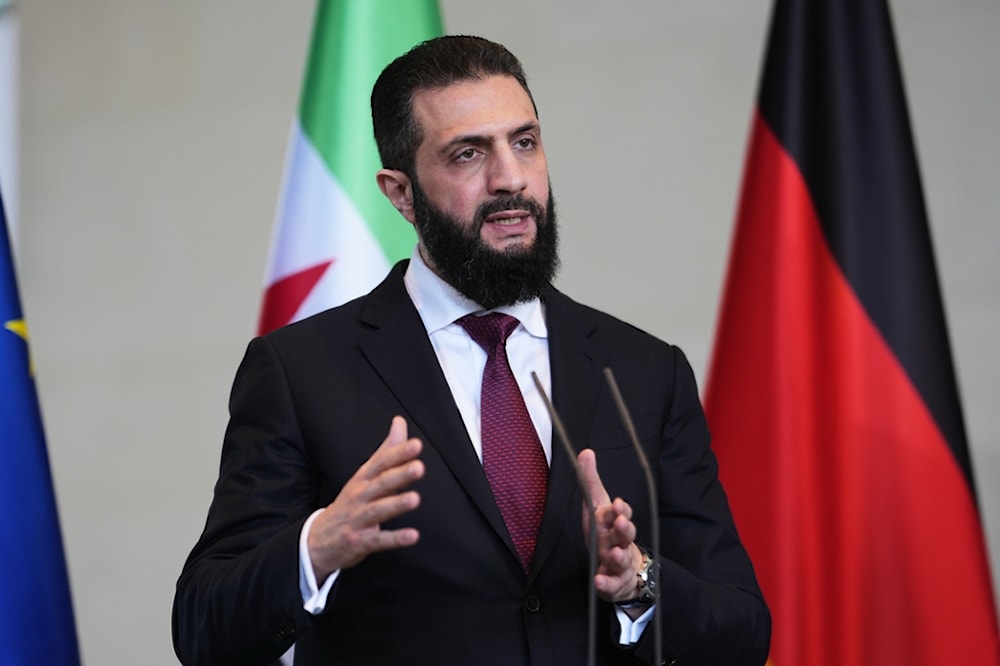
Syria's self-appointed interim Ahmad al-Sharaa attends a press conference after meeting with German Chancellor Friedrich Merz in Berlin, Germany, on March 30, 2026 (AP)
Syrian authorities announced Wednesday the appointment of the remaining members of the country's transitional People's Assembly, completing the formation of the legislative body months after the political process began following the collapse of Bashar al-Assad's government.
Self-appointed interim President Ahmad al-Sharaa appointed 70 lawmakers to fill the remaining seats in the 210-member parliament, allowing the chamber to convene for its inaugural session next week. According to Mohammad Taha al-Ahmad, head of the Higher Judicial Committee for Parliamentary Elections, the Assembly is scheduled to hold its first meeting on Monday.
The appointments complete a process in which roughly two-thirds of the legislature had already been selected through regional electoral bodies established under the transitional authorities.
Read more: Clashes erupt in Daraa as Israeli forces launch strikes in Syria
Transitional legislature to operate under presidential system
The People's Assembly will function under the temporary constitutional framework adopted during Syria's political transition, with executive authority remaining concentrated in the presidency.
While lawmakers will be able to debate and approve legislation, the interim constitutional declaration does not require the government to obtain parliamentary confidence before assuming office, limiting the Assembly's oversight over the executive branch.
The transitional legislature has been tasked with exercising legislative authority until a permanent constitution is drafted and nationwide elections are held. Its mandate is set for 30 months and may be extended if required by the transitional process.
The formation of the Assembly has been closely watched as an indicator of how Syria's new authorities intend to structure political institutions after more than five decades of Assad family leadership.
Representation remains a point of debate
The latest appointments increased female representation in the chamber, with 15 women named by al-Sharaa. Combined with the six women selected during the earlier phase, women now occupy 21 seats in the Assembly.
Authorities did not specify how many of the newly appointed members belong to Syria's religious and ethnic communities. During the initial selection process, minority communities, including Kurds, Christians, and Alawites, received ten seats.
Meanwhile, parliamentary representation for the predominantly Druze governorate of Sweida remains unresolved. Officials said appointments for the province have been postponed until "conditions become suitable" following last year's clashes between government forces, allied armed groups, and local Druze factions.
Rights groups question electoral framework
The process has also drawn criticism from Syrian civil society organizations and political figures, who argue that the mechanism used to establish the legislature grants excessive influence to the presidency.
In a joint position paper, a coalition of Syrian rights organizations called for broader political participation, stronger guarantees for judicial independence, independent electoral oversight, and greater representation of women and Syria's diverse communities.
Last week, UN Deputy Special Envoy for Syria Claudio Cordone also warned that delays in establishing the legislature had fueled uncertainty surrounding the country's political transition.
Read more: US pushes to revive Syria-'Israel' talks after Iran war


